
Security Guard Services in Fullerton, CA: A Local Guide
Fullerton occupies a distinctive place in North Orange County. Within roughly 22 square miles it combines a historic downtown with a busy restaurant and nightlife scene, one of the largest public universities in California, a regional rail hub, a major medical center, established residential neighborhoods and a working industrial corridor. The U.S. Census Bureau estimated the city’s population at 138,675 as of July 1, 2025. Each of those settings carries a different security profile, and the most effective protection is built around the specific street, campus or building rather than a generic template. This guide explains how security guard services work in Fullerton, which risks matter most in each part of the city, and how to put together a program that fits. For a full overview of our local coverage, visit our Fullerton security services page. Why Fullerton Requires a Local Approach Fullerton’s activity follows a rhythm that shifts by neighborhood and by hour. Downtown is busiest on evenings and weekends. The Cal State Fullerton area follows the academic calendar, swelling in fall and spring and quieting in summer. The industrial and logistics corridor is active during working hours and most exposed after dark. Residential communities in the hills and along the major arterials face steady, lower-level issues such as package theft, vehicle break-ins and trespassing in common areas. A security provider that understands this rhythm can place officers where and when they make a difference, rather than staffing every site the same way around the clock. Security Needs Across Fullerton’s Key Areas Downtown Fullerton Downtown’s concentration of restaurants, bars, music venues, shops and historic buildings draws large crowds, particularly on Thursday through Saturday nights. Venues and property owners contend with intoxicated patrons, disputes that spill onto sidewalks, vandalism, after-hours loitering and crowding around entrances at closing time. Officers stationed at doors and in adjacent parking areas help manage lines, check identification where required, discourage confrontations and keep exits clear. Retail tenants and building owners downtown often benefit from evening patrol checks of alleys, rear doors and parking structures after businesses close. The Cal State Fullerton area Cal State Fullerton expected more than 45,000 students for the fall 2025 term, according to the university. That population supports a dense ring of off-campus apartments, student housing complexes, shopping centers and restaurants along the surrounding corridors. Property managers in this area deal with unauthorized guests, parties that escalate, bicycle and vehicle theft, and common-area damage. Officers experienced in school and university security understand how to enforce community rules firmly while keeping a respectful tone with young residents. Fullerton College, a short distance from downtown, adds further student activity to the city’s core. Harbor Boulevard and the retail corridors Harbor Boulevard runs north to south through the heart of the city, connecting downtown with shopping centers, medical offices and dining. Along Harbor, Orangethorpe Avenue and other arterials, retail centers face shoplifting, aggressive panhandling, loitering near entrances, vehicle break-ins and overnight encampments behind buildings. Visible officers during business hours and patrol visits after closing are the usual foundation of shopping center and retail security in this setting, supported by clear trespass procedures agreed with property management. Industrial and logistics properties Fullerton’s industrial land, much of it concentrated along East Orangethorpe Avenue near the 57 and 91 freeways, is shifting from legacy manufacturing toward modern distribution. State environmental filings for the former Kimberly-Clark manufacturing site on East Orangethorpe, for example, describe a logistics center of roughly 1.6 million square feet across four buildings. These facilities face cargo and trailer theft, catalytic converter theft from parked fleets, copper and equipment theft, and after-hours intrusion through fence lines. Effective warehouse security here combines gate and dock control during operating hours with randomized overnight patrols and, where appropriate, remote camera monitoring of yards and loading areas. Apartments and residential communities Fullerton’s multifamily properties range from small garden-style buildings to large gated complexes. Common concerns include package theft, garage break-ins, unauthorized parking, trespassing at pools and laundry rooms, and noise complaints that require a calm, documented response. Scheduled patrol visits and, for larger communities, evening standing officers provide strong deterrence for apartment and condominium communities without the cost of round-the-clock posts. Healthcare and the Fullerton Transportation Center Providence St. Jude Medical Center and the surrounding medical offices in north Fullerton require officers who can manage emotional visitors, control access to sensitive areas and support emergency procedures, all hallmarks of strong healthcare security. Nearby clinics and pharmacies have similar needs on a smaller scale. Downtown, the Fullerton Transportation Center serves Metrolink and Amtrak passengers, and the businesses and parking facilities around it see a constant flow of commuters. That steady foot traffic calls for visible officers, well-lit parking areas and clear procedures for loitering and trespass. What a Fullerton Security Plan Should Include Whatever the property type, a sound plan for a Fullerton site answers the same practical questions before the first officer arrives: Peak risk windows. Closing time downtown, move-in weeks near campus, shift changes at distribution buildings and overnight hours at retail centers each deserve specific attention. Access points. Every gate, garage entry, loading dock and rear door should be identified, with clear rules for who may use each one and when. Escalation and police coordination. Officers need written guidance on when to call a supervisor, when to request police assistance and how to document trespass warnings so that repeat offenders can be addressed. Reporting format. Hourly entries with notes and timestamped photos give managers a reliable record for insurers, owners and, where applicable, a workplace violence prevention plan under California’s SB 553. Settling these points in writing at the outset avoids the most common failure in contract security: officers who are present but unsure what the client actually expects. Services Available to Fullerton Properties Most Fullerton clients draw on a combination of the following: Unarmed and armed security officers for lobbies, entrances, venues and retail centers, with armed coverage reserved for sites where the risk assessment calls for it. Mobile vehicle patrol with GPS-verified, randomized visits,
How Security Services in Irvine Help Businesses and Communities in Uncertain Times
How professional security services help Irvine businesses, HOAs, campuses and medical offices stay safe during uncertain times, from patrols and lobby officers to monitoring and emergency readiness.
Orange County Mobile Patrol: Do You Need a Marked or Unmarked Patrol Car?
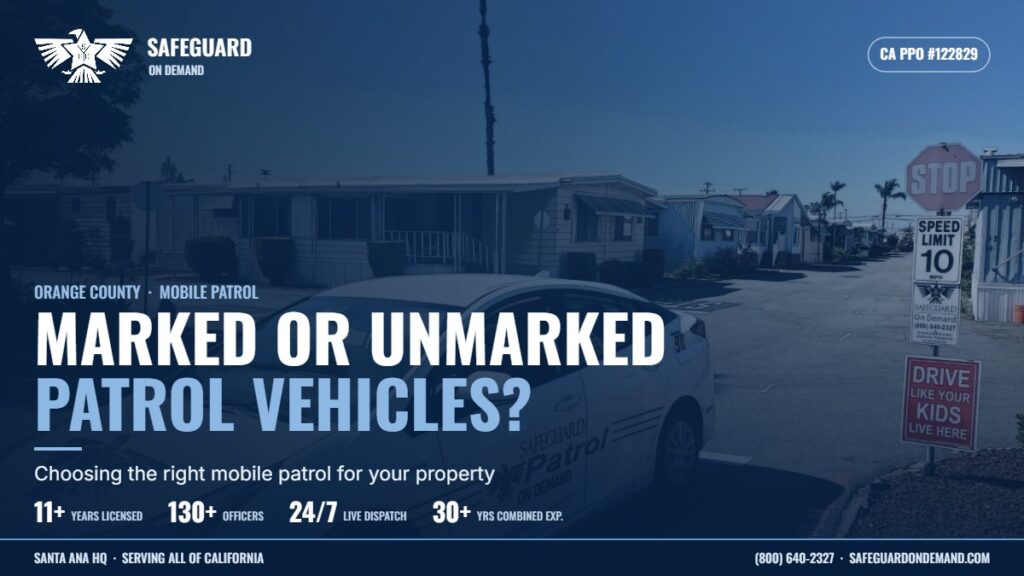
Marked or unmarked security patrol vehicles? Compare deterrence, discretion and best uses for Orange County mobile patrol at HOAs, businesses, construction sites and more.
Safeguard On Demand’s Security Services Give Your Business Unparalleled Support
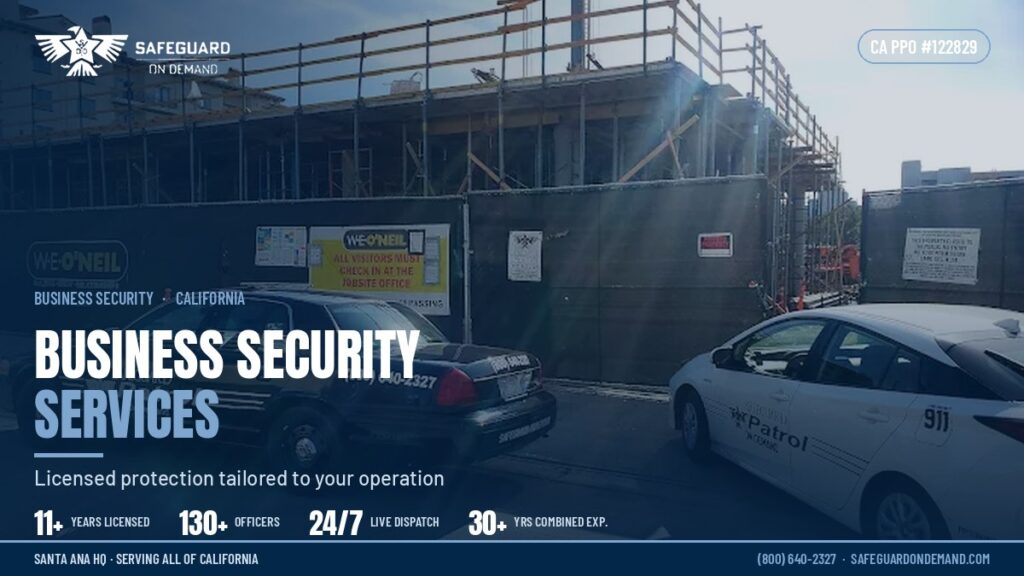
Business security services from Safeguard On Demand: on-site guards, mobile patrols, remote monitoring, and 24/7 dispatch tailored to your California company.
How to Hire Security Officers for Events and Private Parties
Most events never need security to intervene. That is the point. A well-planned security presence keeps uninvited guests out, settles small problems before they grow, protects the host from liability and lets everyone else enjoy the occasion. Whether you are planning a corporate gala, a quinceañera, a wedding reception, a backyard graduation party or a ticketed festival, the process of hiring security officers follows the same logic: understand the risks, size the team correctly, book early and agree on a written plan. This guide walks California hosts and event planners through each step, with attention to the state-specific rules that affect who can provide event security and how. Start With the Event Profile Before you request a quote, gather the details a security provider needs to design coverage. The more precise the profile, the more accurate the staffing recommendation and the price. Guest count and admission type. An invitation-only dinner for 120 differs sharply from an open-admission street fair with the same attendance. Venue layout. Number of entrances, parking areas, outdoor spaces, stages, VIP areas and points where crowds will gather or queue. Timing. Start and end times, including setup, load-in, teardown and the period after the event when guests are leaving. Alcohol. Whether alcohol will be served, by whom and until what time. Known concerns. High-profile guests, valuable items such as gifts or auction lots, past problems at the venue, or interpersonal conflicts the host is aware of. How Many Security Officers Do You Need? California does not set a single statewide ratio of security officers to guests for private events. Staffing is built from the specific duties the event requires, and a local permit or venue contract may impose its own minimum. A useful way to plan is to list the positions first: Entry control. At least one officer for each active entrance, more where tickets, wristbands, bag checks or guest lists must be verified. Roving coverage. Officers moving through the venue to watch for disputes, medical issues, intoxication and unauthorized areas. Fixed posts. Stages, VIP areas, gift tables, cash points and back-of-house doors. Parking and perimeter. Lots, valet areas and neighboring properties, especially at night. Supervision. For larger teams, a lead officer or supervisor who coordinates positions and communicates with the host. Two example deployments As an illustration, a 150-guest backyard party with a hosted bar might be well covered by two officers: one controlling the entrance and guest list, the other roving the yard and street. A 500-guest corporate event in a hotel ballroom with several entrances, a VIP reception and an open bar could require a team of six or more, plus a supervisor. Alcohol, late hours, open admission and a history of incidents all push numbers higher. Crowd Management Fundamentals Effective crowd management is mostly about design and early action, not force. Officers should understand the venue’s occupancy limit, keep exits and fire lanes clear, manage queues so they do not spill into streets or driveways, and watch crowd density near stages and bars. They should know where first aid is located, how to reach emergency services and how to direct guests during an evacuation. Courtesy matters as much as vigilance. Guests respond far better to an officer who greets them, explains the rules and offers help than to one who simply blocks a doorway. California’s training standards now emphasize de-escalation: before a Guard Card is issued, every officer completes eight hours of Power to Arrest and Appropriate Use of Force training, and registered officers complete annual continuing training that includes use-of-force review. Alcohol Service Considerations Alcohol is the single largest factor in event security incidents. If alcohol will be served, address three questions early: Who is serving? Licensed caterers and venues bring their own obligations. Under California’s Responsible Beverage Service law, on-premises alcohol servers and managers at licensed establishments must hold RBS certification from the Department of Alcoholic Beverage Control, obtained within 60 days of their first date of employment. Hosting a nonprofit or public event with alcohol sales may require a separate temporary license. How will age be verified? Decide whether officers or bar staff will check identification, and how guests who are 21 or older will be marked. When does service end? Ending alcohol service well before the event closes, with food and water available, reduces late-night conflicts. Officers should be briefed on how to handle guests who are visibly intoxicated, including arranging safe transportation. Security officers do not replace responsible service by bartenders, but they can support it by watching for over-service, intervening early in disputes and keeping intoxicated guests from driving. Venue, Permit and Insurance Requirements Requirements vary by city, county and venue, so treat the following as a checklist rather than a legal opinion: Venue contracts. Many hotels, halls and event centers require licensed security for certain events, specify minimum officer counts and require a certificate of insurance from the security company. Special event permits. Larger public events, street closures and events in parks often need a city or county permit, which may require a security plan, traffic control or coordination with local police. Fire code. Occupancy limits, exit access and crowd management requirements are enforced by the local fire authority, particularly for large assemblies. Noise and neighborhood rules. Private parties in residential areas should respect local noise ordinances and parking restrictions; officers can help manage both. Whatever the event, confirm that your security company is a California-licensed private patrol operator, that every officer holds a current BSIS Guard Card, and that the company can issue a certificate of insurance naming you or the venue before the event. Armed or Unarmed Event Security? When unarmed officers are the right fit Most private parties and corporate events are well served by trained unarmed security officers, whose approachable presence fits a celebratory setting. When armed coverage makes sense Armed security officers may be appropriate when large sums of cash are handled, when high-value items are displayed, when a credible threat exists or when a venue requires armed coverage. Armed
Questions to Ask Before Hiring a Security Guard Company
Hiring a security company is a decision with legal, financial and reputational consequences. The officers you bring on site will interact with your tenants, employees and customers, make judgment calls under pressure and produce the records you may later depend on in an insurance claim or lawsuit. Yet many organizations choose a provider based on an hourly rate and a short sales conversation. A structured set of questions changes that. The list below is organized by category so you can work through it in a single meeting or a written request for proposal. It reflects California’s specific licensing and labor rules, which differ meaningfully from other states. A qualified provider should answer every question clearly, and back the answers with documents. Licensing and Legal Standing Is your company a licensed private patrol operator in California? Any company that provides security officers to other businesses in California must be licensed as a private patrol operator (PPO) by the Bureau of Security and Investigative Services (BSIS), part of the Department of Consumer Affairs. Ask for the exact legal name on the license, then verify it yourself rather than relying on a number printed in a brochure. How do I verify the license? Use the Department of Consumer Affairs License Search at search.dca.ca.gov. Select the appropriate license type, enter the company name and confirm three things: the license is current and active, the name matches the entity that will sign your contract, and there is no record of disciplinary action you have not been told about. The same tool lets you check individual officers’ security guard registrations. Does every officer hold a current Guard Card? In California, security officers must hold a BSIS security guard registration, commonly called a Guard Card, and must carry it while on duty. Ask how the company tracks expiration dates and what happens if an officer’s registration lapses. A well-run provider monitors renewals centrally and never schedules an officer whose registration is not current. Insurance and Financial Protection What insurance do you carry, and will you name us as an additional insured? BSIS requires every private patrol operator to maintain general liability insurance of at least $1,000,000 per occurrence, written on an occurrence basis. That is the legal floor; many commercial clients require more, along with automobile liability for patrol vehicles and umbrella coverage. Ask for a certificate of insurance naming your organization as an additional insured, and receive it before the first shift. Do you carry workers’ compensation coverage? California law requires every employer to carry workers’ compensation insurance, even with a single employee. If a provider cannot produce proof of coverage, an officer injured on your property could become your problem. Request the certificate and confirm the policy dates. Employment Model Are your officers employees or independent contractors? BSIS describes security guards as individuals employed by licensed private patrol operators or private security employers. Officers who work for a reputable provider are W-2 employees, covered by payroll taxes, workers’ compensation and California wage and hour protections. A provider that relies on independent contractors or informal subcontracting exposes clients to misclassification claims and leaves real gaps in supervision and insurance. Do you subcontract any shifts? Ask directly whether any of your posts will be filled by another company. If the answer is yes, the subcontractor needs its own license and insurance, and you need to know who is accountable for its officers. How do you handle meal periods, relief and overtime? California requires a meal period for shifts of more than five hours, daily overtime after eight hours and double time after twelve. Ask how the provider staffs relief so posts are never left unattended, and how it schedules to avoid unnecessary premium pay that would otherwise surface in your invoice. Training and Qualifications What training do officers complete before and after they start? State law sets the minimum. Applicants must complete eight hours of Power to Arrest and Appropriate Use of Force training before a Guard Card is issued, followed by 16 hours of security officer skills training within 30 days of employment, another 16 hours within six months and eight hours of continuing training every year. Ask what the provider adds beyond that floor: site orientation, de-escalation practice, report writing, emergency procedures and industry-specific instruction. Our own standards are outlined on our security officer training page. How do you train officers on our specific site? Every new officer should receive a site orientation and a copy of written post orders before working a shift alone. Ask who conducts that orientation and how relief officers are briefed. Armed Coverage Do we actually need armed officers? A trustworthy provider will tell you when armed coverage is unnecessary. Armed officers make sense for cash handling, high-value assets, certain healthcare and financial settings, and sites with credible threats of violence. Many properties are well protected by trained unarmed security officers, at a lower cost and with less liability. What qualifications do your armed officers hold? Every armed security officer must hold an exposed-firearm permit from BSIS in addition to a Guard Card. Applicants must be at least 21, complete a Bureau-approved firearms course and requalify on the range twice in each twelve-month period of the two-year permit. First-time applicants who hold a security guard registration must also pass a psychological assessment. Ask how the company tracks requalification and what use-of-force policy its armed officers follow. Supervision, Reporting and Response Who supervises the officers on our site? Ask for the name and role of the field supervisor responsible for your account, how often the supervisor visits, and who answers the phone at 3 a.m. Experienced leadership matters; you can read about ours on our qualified management page. What do your reports look like? Request a sample daily activity report. Strong reports include hourly entries, conditions found, actions taken and timestamped photos. For patrol accounts, ask whether routes are GPS-verified and whether you can review checkpoint data. How quickly can you respond to an incident or a call-off? Ask how
Essential Security Tips for Condominium Residents and HOA Boards
Essential condo security tips for residents and HOA boards in California: unit safety, access control, garages, packages, amenities and when to add security officers or patrols.
Hiring Security Guards in Orange County: What You Should Know
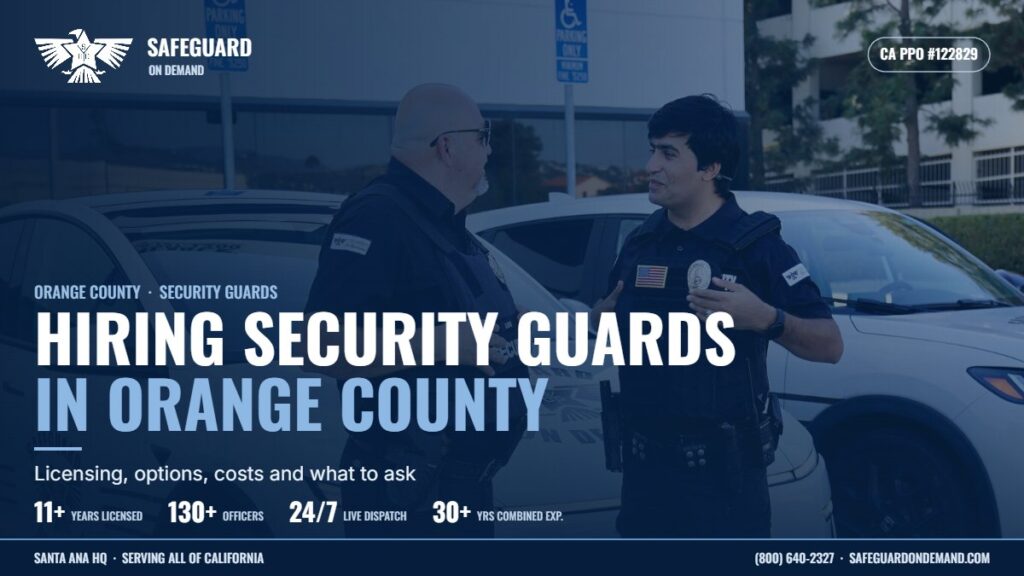
What to know before hiring security guards in Orange County, CA: licensing, armed vs. unarmed, patrol options, costs, contracts and questions to ask a provider.
Security Guards in Santa Ana, CA: Tailored Security Services from a Local Team
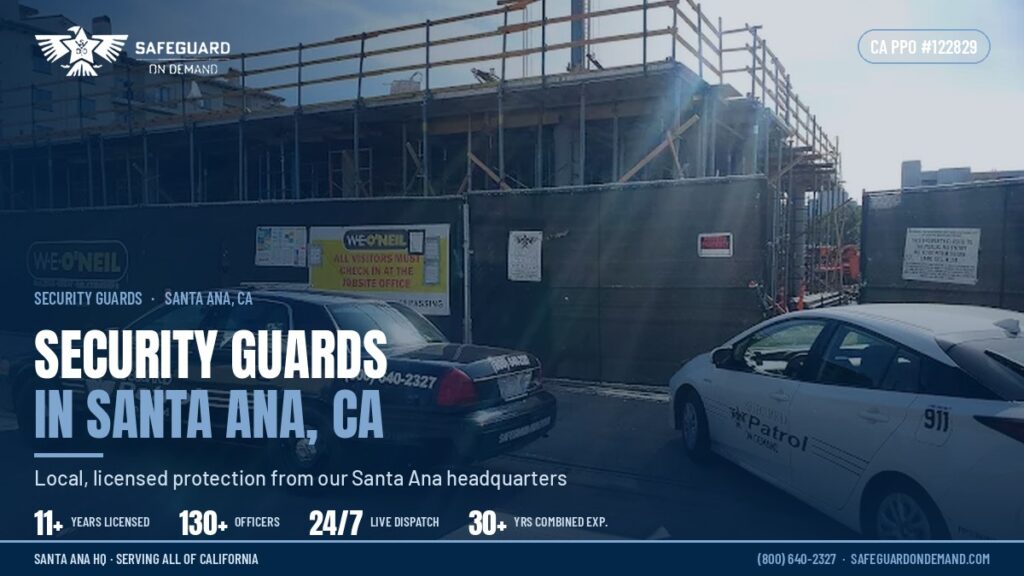
Hire licensed security guards in Santa Ana, CA. Armed and unarmed guards, mobile patrols and fire watch, tailored to your site by a Santa Ana-based company.
Security Guard Jobs in Los Angeles: A Challenging but In-Demand Career

Thinking about security guard jobs in Los Angeles? Learn what the work involves, California licensing requirements, the skills that matter, career paths, and what Safeguard On Demand offers officers.