
Updated October 2026 · 6 min read · Reviewed by Safeguard On Demand
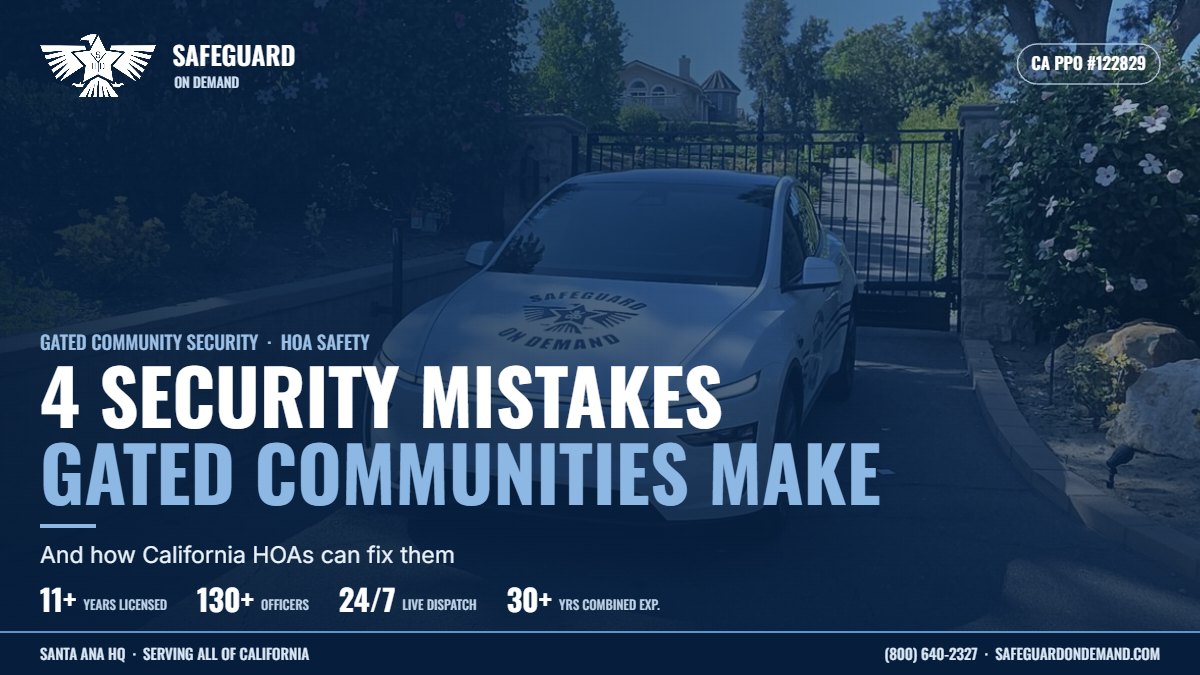
A gate at the entrance gives residents a sense of safety, and it does deter casual trespassers. But many California HOAs and property managers discover, often after a string of package thefts, car break-ins, or a burglary, that a gate by itself is not a security program. Gates get tailgated, codes get shared, and pedestrian entrances get propped open.
This guide covers the four most common gated community security mistakes we see across Southern California, the Bay Area, Sacramento, and the Central Valley, and the practical fixes that turn a gate into real protection for residents, guests, and common areas.
Key Takeaways
- ✓A gate controls vehicles, not people; tailgating and shared codes defeat it every day.
- ✓Visitor and contractor management needs rules, records, and someone enforcing them.
- ✓Common areas such as pools, clubhouses, mailrooms, and parking need their own coverage plan.
- ✓A security officer or patrol service ties the system together with presence, enforcement, and reporting.
Why Gated Communities Still Experience Crime
Most offenders who target gated neighborhoods are not climbing walls. They follow a resident through the gate, walk in through a pedestrian door, use a code someone posted for a delivery driver, or arrive as a contractor nobody checked. Once inside, they often feel less watched, because residents assume everyone past the gate belongs there.
That false sense of security is the real vulnerability. Effective gated community security treats the gate as one layer in a plan that also covers people, vehicles, visitors, common areas, and response.
Mistake 1: Relying on the Gate Alone
An unattended gate controls access only as well as its weakest moment. Tailgating, when a vehicle follows a resident through before the arm or gate closes, is the most common way unauthorized people enter. Malfunctioning gates left open for repair, slow-closing pedestrian doors, and gaps in perimeter fencing all create easy openings.
The fix: Inspect the gate, fencing, and pedestrian entries regularly, and add a human layer. A gatehouse officer at the main entrance during peak hours, combined with mobile patrol checks overnight, closes the gaps that hardware leaves open. Cameras on entry and exit lanes that capture license plates help investigate incidents when they do happen.
Mistake 2: Weak Visitor and Contractor Management
Delivery drivers, rideshare drivers, landscapers, pool services, contractors, and guests come and go all day. When gate codes are shared freely, or when nobody verifies who a visitor is there to see, the community has no record of who entered and when.
The fix: Set clear visitor procedures and enforce them. Rotate gate codes on a schedule, use temporary or one-time codes for vendors, and require guests to be registered by residents. A trained officer can verify visitors, log license plates, issue passes, and politely turn away anyone who cannot explain why they are there. Those logs become valuable evidence if something goes wrong.
Rotate gate codes
Change codes on a set schedule and after any known leak, and avoid posting them for drivers.
Register guests
Have residents pre-register visitors through an app, call box, or the gatehouse.
Verify vendors
Keep an approved vendor list and confirm contractors with the management company.
Log every entry
Record names, plates, and times so incidents can be traced quickly.
Mistake 3: Ignoring Common Areas
Many HOAs focus on the front gate and overlook the places where problems actually happen: the pool and spa after hours, the clubhouse, fitness center, mail and package rooms, guest parking, and perimeter walking paths. These areas see vandalism, unauthorized parties, package theft, and loitering, and they create liability for the association.
The fix: Map every common area, set posted hours, and assign coverage. Patrol officers can lock and unlock amenities on schedule, check that doors are secure, clear the pool at closing, and walk perimeter paths. Remote video monitoring adds live eyes on mailrooms and amenity entrances between patrol visits.
Gated Community Security Options Compared
| Option | Best for | Typical coverage |
|---|---|---|
| Gatehouse officer | Communities with heavy visitor traffic | Staffed entry during set hours or 24/7 |
| Mobile patrol | Overnight checks and amenity lock-ups | Multiple randomized visits per night |
| Foot patrol officer | Large communities with paths and amenities | Walking rounds through common areas |
| Remote video monitoring | Gates, mailrooms, pools, and parking | Live operators watching cameras |
| Combined plan | Most HOAs | Gatehouse plus patrol plus monitoring |
Mistake 4: No Clear Rules, Enforcement, or Reporting
Parking rules, amenity hours, and noise policies only work if someone enforces them consistently. When enforcement is left to volunteer board members or individual residents, it becomes inconsistent, uncomfortable, and sometimes confrontational. Just as important, many communities have no written record of incidents, so the board cannot see patterns or justify decisions.
The fix: Put your policies in writing, share them with residents, and let trained officers handle enforcement professionally. Officers document parking violations, coordinate with your authorized towing company, address noise and amenity complaints, and file daily reports with timestamped photos. Board members get the information they need to make decisions without becoming the neighborhood police.
A gate makes residents feel safe, but it does not watch anything. The communities that stay safe pair the gate with people who know the property, enforce the rules the board sets, and document what happens every night.
— David Nawabi
President & CEO, Safeguard On Demand
Building a Complete Gated Community Security Plan
Every community is different. A large master-planned community in Irvine may need a 24/7 gatehouse and roving patrols. A smaller HOA in Rancho Cucamonga or Sacramento County may need nightly patrol visits and live monitoring of the gate. A senior community may prioritize visitor verification and quick response for residents.
Start with a walkthrough at night, review your incident history and resident complaints, and identify your peak-risk hours. From there, a licensed security provider can recommend the right mix of officers, patrols, and technology. At Safeguard On Demand, we approach every HOA with security solutions built around the root of the problem, not just a block of guard hours. Learn more about our HOA security services.
Main entrance
Gatehouse officer or live-monitored gate with license plate cameras.
Perimeter and paths
Foot or vehicle patrols checking fences, walls, and pedestrian gates.
Pools and clubhouses
Scheduled lock-ups, closing sweeps, and after-hours monitoring.
Mail and package rooms
Camera coverage, access control, and patrol checks.
Parking and streets
Permit enforcement, towing coordination, and vehicle checks.
Reporting
Daily reports and incident photos sent to the board and manager.
Gated Community Security Across California
Safeguard On Demand is a licensed California private patrol operator protecting HOAs, gated communities, and apartment communities throughout the state, from Orange County and Los Angeles to San Diego, the Inland Empire, Silicon Valley, and Northern California. Our BSIS-licensed officers are trained for residential environments, where courtesy and judgment matter as much as vigilance.
We work directly with boards and management companies to set post orders, reporting standards, and escalation procedures, so everyone knows what to expect. See our approach and how we train our officers.
Frequently Asked Questions
Is a gate enough to keep a community safe?
No. A gate controls vehicle access, but tailgating, shared codes, pedestrian entrances, and unverified visitors regularly defeat it. Most communities need a human layer, such as a gatehouse officer or patrol service, plus clear visitor rules.
How often should an HOA change its gate codes?
Many communities rotate codes on a regular schedule, such as quarterly, and immediately after a code is known to be shared publicly. Temporary vendor codes and guest registration reduce the need to share permanent codes.
What does a gated community security officer do?
Officers verify and log visitors, monitor the entrance, patrol common areas, lock and unlock amenities, enforce parking and community rules, respond to resident calls, and write daily and incident reports for the board.
Is mobile patrol or a gatehouse officer better for an HOA?
It depends on traffic and risk. Communities with heavy daytime visitor traffic benefit from a gatehouse officer, while many smaller HOAs get strong results from several unpredictable patrol visits each night. Many use both.
Can security officers enforce HOA parking rules?
Officers can monitor and document violations according to the rules your board adopts and coordinate with your authorized towing company. The association sets the policies and authorizes tows under California law.
A gate is a good start, but residents deserve a security plan that covers every entrance, every common area, and every hour. To review your community’s risks and get a tailored plan, request a free quote or call Safeguard On Demand at (800) 640-2327.
Get a free security assessment
Licensed armed and unarmed officers, patrols and fire watch across California. Call (800) 640-2327 or request a quote online.