Parking Enforcement Services in California — Permit, Guest and Tow-Away Rules Enforced Fairly

Private Parking Enforcement for HOAs, Apartments, Retail Centers and Business Parks

Few issues generate as many complaints to a property manager or HOA board as parking: residents who cannot find their assigned space, guests who stay for weeks, commuters who leave cars in a shopping center lot, delivery vans idling in a fire lane. Safeguard On Demand provides parking enforcement services that apply the rules your property has already adopted, consistently and with a written record of every decision. Our officers manage permits and guest registration, issue warnings and property violation notices, keep fire lanes and accessible spaces clear, and coordinate tows with licensed towing companies only when the property meets the requirements of California law. We support homeowners associations, apartment communities, retail centers, medical offices and business parks across Los Angeles, Orange County, San Diego, the Inland Empire, the Bay Area and Sacramento.

It is just as important to be clear about what private enforcement is not. Our security officers are not police and do not write government parking tickets; a notice left on a windshield by private security carries no court fine, DMV hold or criminal penalty. The legitimate tools on private property are warnings and notices under your posted rules, documentation that lets management or the HOA board act under its governing documents, and towing through a licensed tow operator when California Vehicle Code Section 22658 is satisfied. Certain violations, such as blocking a designated fire lane or parking in an accessible space without a placard, can also be cited by local police or municipal parking enforcement, and our reports give them what they need.

A Parking Program Built on Clear Rules, Proper Signage and Evidence

Effective enforcement begins before the first patrol. We review your rules, permit system, assigned-space map, tow agreement and every sign at your entrances, then point out gaps that could expose the property to liability, such as a missing law enforcement phone number on a tow-away sign or rules that residents were never formally given. Where the rules are unclear, we help management draft post orders that spell out exactly which violations receive a warning, which receive a notice and which justify a tow request.

Once enforcement begins, officers patrol on the schedule your property needs, whether overnight checks for an apartment community, weekday time-limit monitoring for a medical office or weekend sweeps of a shopping center. Every violation is photographed with the plate, the location and the governing sign in frame, and every vehicle’s history is logged, so a second warning is never mistaken for a first. We combine enforcement with marked vehicle patrol, foot patrol or bike and golf cart patrol so the same visit also deters break-ins, loitering and vandalism.

Safeguard On Demand no-trespassing signage posted at a gated HOA community

Parking Enforcement Solutions Across California — Consistent Patrols, Documented Violations and Lawful Tow Coordination

Community managers, HOA boards, apartment operators and commercial property owners across California rely on Safeguard On Demand parking enforcement because our officers enforce the same rule the same way every night, and because every warning, notice and tow request is backed by photographs and a written log. Residents and tenants learn quickly that the rules are real, legitimate guests are not penalized, and the board or manager receives the evidence needed to resolve disputes calmly. Coverage is scheduled by the hour or by the patrol visit, with no long-term contract, whether you need nightly checks at a condominium in Irvine, weekday enforcement at a medical plaza in Pasadena or weekend sweeps at a retail center in Chula Vista. Request a free custom quote or call (800) 640-2327.

What Every Safeguard Parking Enforcement Program Includes

Included with every deployment

  1. Rules and signage audit – A review of your posted tow-away and accessible-parking signs, permit system and governing documents against California Vehicle Code requirements before enforcement begins.
  2. Permit and guest-parking management – Resident permits, guest passes and overnight registrations verified on every patrol, with a current list maintained for management.
  3. Tiered warnings and violation notices – Courtesy warnings and property violation notices issued under your rules, never represented as government citations.
  4. Fire-lane and accessible-space checks – Priority attention to blocked fire lanes, hydrants, entrances and accessible spaces, with referral to police or a tow request where the law allows.
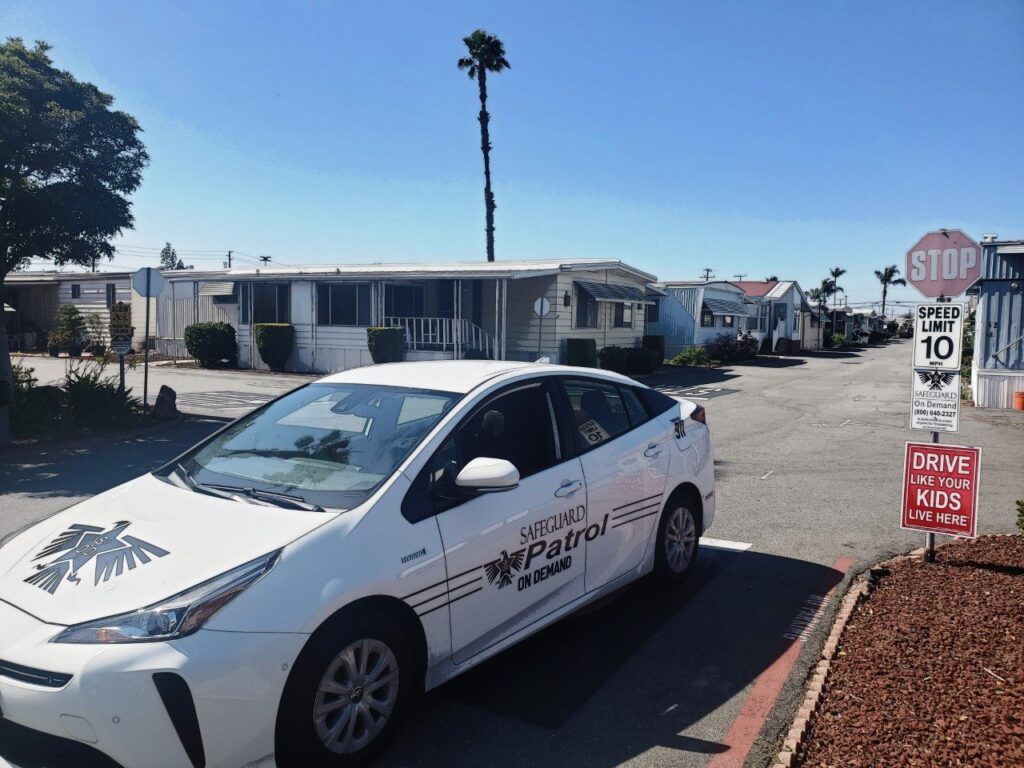
Safeguard On Demand patrol vehicle conducting parking enforcement rounds at a California retail center
Licensed. Insured. On Post.State-LicensedBSIS-Licensed24/7 DispatchNo Long-Term Contract
  1. Photo-documented violations – Timestamped photographs of each vehicle, plate, location and posted sign, attached to the daily report.
  2. Licensed tow coordination – Tow requests placed only with the towing company named on your signs and covered by your towing agreement, with the written authorization the Vehicle Code requires.
  3. Dispute-ready records – Searchable vehicle histories and incident reports that support appeals, HOA hearings and tenant conversations.
  4. GPS-verified patrols and daily reports – Every enforcement round is time-stamped and location-verified, with 24/7 dispatch and an on-call supervisor.

Ready to bring order to your parking lot? Our team will review your signage and rules, recommend a patrol schedule and start enforcement on a date that gives residents or tenants fair notice. Request a parking enforcement plan or call (800) 640-2327.

Parking Enforcement Services for Every Property Type

HOA and Master-Planned Community Parking

Homeowners associations and gated communities adopt parking rules for overnight street parking, guest stays, RVs, boats and commercial vehicles. Our officers document each violation and report it to management so the board can act through the notice and hearing process its governing documents and the Davis-Stirling Act require.

Apartment Community Parking Control

Assigned spaces, carports and limited guest stalls fill quickly at apartment and condominium communities. We verify permits, keep a current guest log, respond to residents whose assigned space is taken and identify abandoned or inoperable vehicles that monopolize scarce parking.

Retail and Shopping Center Lots

Customer parking at shopping centers disappears when commuters, neighboring businesses or overnight campers occupy it. Officers enforce time limits and customer-only rules courteously, keep loading zones and fire lanes clear and deter the break-ins and loitering that accompany unmanaged lots.

Medical Office and Clinic Parking

Patients arriving for appointments, often with limited mobility, need open spaces close to the entrance. At medical offices and clinics, we monitor patient-only and short-term stalls, keep accessible spaces and drop-off lanes clear, and handle every interaction with patience and discretion.

Business Park and Office Campus Parking

Tenants of business parks and office buildings pay for parking ratios that outside vehicles quietly consume. We enforce tenant permits and reserved stalls, monitor visitor parking, and flag vehicles stored long-term in commercial lots before they become an abandonment problem.

Parking Structures and Mixed-Use Properties

Mixed-use buildings must balance residents, retail customers, employees and visitors in one parking structure. Officers monitor zone assignments level by level, keep ramps and emergency access clear, and combine enforcement with garage patrols that deter vehicle burglary.

Industries We Serve

Security Guard Services for Every Industry in California

From hospitals and schools to construction sites and gated communities, our BSIS-licensed officers follow post orders written for your industry.

View All Industries →

What Sets Safeguard Parking Enforcement Apart in California

Even-handed, photo-documented parking enforcement by state-licensed officers, with lawful tow coordination and month-to-month terms across California.

Enforcement Grounded in California Law

Towing from private property is governed by detailed statutes, and property owners who skip a step can be liable for double the towing and storage charges. Our supervisors know the signage, notice and authorization requirements of Vehicle Code Sections 22658 and 22511.8, and we identify compliance gaps before enforcement starts rather than after a resident challenges a tow. Part of our parking enforcement program for residential and commercial properties across California.

Consistent, Even-Handed Rules

Inconsistent enforcement creates more conflict than none at all. Our officers follow written post orders that define each violation and the response it receives, so a board member's neighbor and a first-time guest are treated alike. That consistency is what persuades residents and tenants to change their habits. Available for communities in Orange County, San Diego and Riverside County.

Photo Evidence for Every Violation

Disputes are settled by evidence, not memory. Each violation is photographed with the license plate, the space, the time and the posted sign in view, and logged against the vehicle's history. Management can answer a complaint in minutes, and an HOA board can rely on the record at a hearing. Pairs with our mobile patrol services and remote video monitoring for round-the-clock visibility.

Fire Lanes and Accessible Spaces First

A car in a fire lane can delay an engine company, and a car in an accessible space can keep a patient or resident from reaching the door. Officers check these locations on every round, attempt to locate the driver, and when the vehicle remains, request a tow where the law permits or refer the violation to the local police or parking authority. Backed by BSIS-licensed officers and full liability insurance.

Guest and Permit Systems Residents Understand

Many parking problems are really registration problems. We help management simplify permits, guest passes and overnight registration, keep the authorized-vehicle list current and give residents a predictable way to host visitors. Fewer surprises means fewer tows, fewer complaints and fewer late-night calls to the manager. Related coverage: apartment and condominium security.

Licensed Tow Partners Under Your Agreement

We place tow requests only with the licensed towing company named on your signs and covered by your written towing agreement, and only for violations your post orders authorize. The officer documents the grounds, the time the vehicle was first observed and the authorization, so the property can answer any question from the vehicle owner or law enforcement. Coordinated from six California offices, including San Francisco Bay Area coverage from Mountain View.

Officers Who De-escalate

Parking confrontations can turn heated quickly. Our officers are trained to explain the rule, listen, keep their distance from an angry driver and disengage when necessary, leaving the dispute to management and, if needed, to police. A calm, professional encounter protects your residents, your staff and your reputation. Ask about adding concierge security officers to your parking enforcement plan.

Flexible Schedules Statewide

Enforcement can run as a dedicated officer, as scheduled patrol visits or as overnight sweeps, across Los Angeles, Orange County, the Inland Empire, San Diego, the Central Coast, the Central Valley, the Bay Area and Sacramento, on month-to-month terms that adjust as conditions improve. Request a free parking assessment for your property today.

Parking Enforcement in Depth: What California Law Allows and How We Apply It

California Vehicle Code Section 22658 sets the ground rules for removing vehicles from private property. In most cases, the owner or person in lawful possession of the property may have an unauthorized vehicle towed only if signs are displayed in plain view at every entrance, at least 17 by 22 inches with lettering at least one inch high, prohibiting public parking, stating that vehicles will be removed at the owner’s expense, and listing the telephone number of the local traffic law enforcement agency and the name and telephone number of each towing company that is party to a towing agreement with the property. The statute also allows removal in a few other circumstances, such as when a vehicle was issued a notice of parking violation and 96 hours have passed. Before a tow, the towing company must obtain written authorization from the property owner, lessee or association, or an employee or agent, who generally must be present at the time of removal and verify the violation; the authorization records the vehicle, the grounds for removal, the time the vehicle was first observed and the identity of the person authorizing it. A general, standing authorization is permitted only for vehicles parked within 15 feet of a fire hydrant, in a fire lane or in a way that blocks an entrance to or exit from the property, and the tow operator must photograph that violation first. If the vehicle owner returns after the vehicle is hooked up but before it leaves the property, the tow company must release it for no more than half its regular towing charge. Accessible spaces have their own rules under Section 22511.8.

Those requirements shape how we work. During onboarding we confirm that your signs, tow agreement and rules satisfy the statute, and we establish in writing who may authorize a tow: your on-site manager, a board-designated representative or, where your agreement designates us as your agent, our supervisor on scene. On patrol, officers rely first on the least disruptive tool that will change behavior: a courtesy warning, then a property violation notice, then a documented report to management. Towing is reserved for the violations your post orders specify and for situations where a vehicle is creating a hazard. This graduated approach, applied identically to every vehicle and backed by photographs, is what reduces disputes over time. Residents know what to expect, guests know how to register, and when a complaint does reach the manager or the board, the record shows exactly what was observed, when, and why each step was taken. Many properties find that after the first few weeks of consistent enforcement, violations fall enough to scale patrol hours back.

How Safeguard Parking Enforcement Works

1. Parking audit and rules review

We inspect signage, permit systems, assigned spaces, fire lanes and accessible stalls, review your rules and tow agreement, and recommend corrections before enforcement starts. Part of our parking enforcement program for residential and commercial properties across California.

2. Post orders and resident notice

We write post orders defining each violation and response, confirm who authorizes tows, and help management notify residents or tenants of the start date. Available for properties in Los Angeles, Santa Ana and Sacramento County.

3. Patrols, notices and documentation

Officers verify permits, issue warnings and violation notices, photograph each violation and track vehicle histories on GPS-verified rounds. Pairs with our marked vehicle patrol and unarmed security officers for complete coverage.

4. Lawful towing and reporting

Authorized tows go to your contracted towing company with complete documentation, and management receives daily reports and trend summaries. Backed by BSIS-licensed officers and full liability insurance.

Parking Enforcement Standards and Compliance in California

Vehicle Code Section 22658. Governs removal of vehicles from private property, including entrance signage, written tow authorization, the limited situations in which a general authorization is allowed, storage within ten miles of the property unless law enforcement approves otherwise, and the half-fee release when the owner returns before the tow leaves. A property owner or agent who fails to meet the signage or notice requirements, or who will not state the grounds for removal when asked, can be liable for double the towing and storage charges. We review these items with you before enforcement begins.

Accessible spaces and fire lanes. Vehicle Code Section 22511.8 allows removal of vehicles without a disabled placard or special plates from designated accessible spaces in private off-street facilities, after notifying the police or sheriff, where a sign of at least 17 by 22 inches with the statutory wording is posted at the space or at each entrance. Section 22500.1 prohibits parking in a fire lane designated by the fire department, including in privately owned off-street parking facilities, and peace officers or local parking enforcement may cite those violations.

HOA rules and licensing. Under Civil Code Sections 5850 and 5855, a common interest development may impose fines only according to a fine schedule distributed to members and after giving the member at least ten days’ notice and an opportunity for a hearing, so our role is to document violations accurately, not to fine. Officers performing parking enforcement must work for a California-licensed private patrol operator and hold a current BSIS Guard Card. Safeguard On Demand is a state-licensed private patrol operator, fully bonded and insured.

PARKING ENFORCEMENT NEAR YOU

Parking Enforcement Services Across Every Region of California

Safeguard On Demand provides parking enforcement services statewide from offices in Santa Ana, Northridge, San Diego, Mountain View and Sacramento, plus our Inland Empire team in Corona. Select your region to see the cities we cover, or search for your city to reach its local security page. To start a parking audit anywhere in California, call (800) 640-2327.

Parking Enforcement Services in California - Safeguard On Demand

Parking Enforcement in Los Angeles County

Managed from our Northridge branch and Santa Ana headquarters, our officers enforce permit, guest and time-limit rules at San Fernando Valley apartment communities, Westside condominiums, Long Beach and South Bay retail centers, Glendale and Pasadena medical offices and Santa Clarita HOAs, with photo-documented violations and lawful tow coordination.

Parking Enforcement Services in California - Safeguard On Demand

Parking Enforcement in Orange County

Managed from our Santa Ana headquarters, our officers enforce parking rules at Irvine and Tustin master-planned communities, Huntington Beach and Garden Grove apartment complexes, Anaheim shopping centers and Santa Ana business parks, keeping guest stalls, fire lanes and accessible spaces available for the people they serve.

Parking Enforcement Services in California - Safeguard On Demand

Parking Enforcement in the Inland Empire

Managed from our Inland Empire office in Corona, our officers enforce permit and guest rules at HOAs and apartment communities in Riverside, Corona and Rancho Cucamonga, keep commuter and truck parking out of Ontario and Fontana retail centers, and manage tenant parking at Moreno Valley and San Bernardino business parks.

Parking Enforcement Services in California - Safeguard On Demand

Parking Enforcement in San Diego County

Managed from our San Diego office, our officers enforce parking rules at coastal condominiums, Chula Vista and Escondido apartment communities, Oceanside and Carlsbad shopping centers and medical offices near the region’s hospital campuses, with particular attention to beach-season overflow and long-term vehicle storage.

Parking Enforcement Services in California - Safeguard On Demand

Parking Enforcement on the Central Coast & Ventura

Managed from our Southern California and Bay Area offices, our officers enforce permit, guest and visitor rules at Oxnard and Ventura apartment communities, Santa Barbara and San Luis Obispo mixed-use properties, Santa Maria retail centers and Salinas business parks, including seasonal visitor pressure near the coast.

Parking Enforcement Services in California - Safeguard On Demand

Parking Enforcement in the Central Valley

Managed from our Sacramento office, our officers enforce parking rules at Fresno and Clovis apartment communities, Bakersfield and Visalia retail centers, Modesto and Stockton medical offices and HOAs along the Highway 99 corridor, addressing abandoned vehicles, unauthorized truck parking and guest-stall misuse.

Parking Enforcement Services in California - Safeguard On Demand

Parking Enforcement in the Bay Area & Silicon Valley

Managed from our Mountain View office, our officers enforce permit and reserved-stall rules at San Jose, Santa Clara and Sunnyvale apartment communities, Oakland and Berkeley mixed-use buildings, Fremont and Hayward business parks and Peninsula medical offices, where every space carries a premium.

Parking Enforcement Services in California - Safeguard On Demand

Parking Enforcement in Sacramento & Northern California

Managed from our Sacramento office, our officers enforce parking rules at downtown and Midtown apartment buildings, Elk Grove and Roseville HOAs, Folsom and Rocklin business parks and Davis student-area housing, as well as retail centers and communities in Chico, Redding and Santa Rosa.

Do not see your city? View all California service areas or request parking enforcement for any property in the state.

Frequently Asked Questions About Parking Enforcement Services in California

No. Private security officers cannot issue government citations, and a notice from private security carries no court fine, DMV consequence or criminal penalty. Our officers issue warnings and property violation notices under your posted rules, document violations for management or the HOA board, and coordinate tows with a licensed towing company when the law allows. Police or municipal parking enforcement may cite certain violations, such as blocked fire lanes.

Under Vehicle Code Section 22658, a vehicle may generally be removed when compliant tow-away signs are posted at every entrance, or in other limited cases, such as when a notice of parking violation was issued and 96 hours have passed. The towing company also needs written authorization from the property owner, lessee or association, or its employee or agent, who usually must be present to verify the violation. Specific situations may involve additional rules, so we review your property with you before enforcement begins.

Section 22658 calls for signs in plain view at all entrances, at least 17 by 22 inches with lettering at least one inch high, prohibiting public parking, stating that vehicles will be removed at the owner’s expense, and listing the phone number of the local traffic law enforcement agency and the name and phone number of each towing company under agreement with the property. Accessible spaces require a separate sign with statutory wording under Section 22511.8.

The property owner, lessee or homeowners association, or an employee or agent, signs a written authorization that identifies the vehicle, the grounds for removal and the time the violation was first observed, and in most cases must be present at the time of removal. A standing, general authorization is allowed only for vehicles within 15 feet of a hydrant, in a fire lane or blocking an entrance or exit. We set up the authorization process with you in writing before the first tow.

Officers check fire lanes, hydrants and accessible spaces on every round. They attempt to locate the driver first; if the vehicle remains, they photograph the violation and either request a tow where the statute and your post orders allow or refer the violation to the local police or parking authority, which can issue a citation. These locations receive priority because they affect emergency access and residents or visitors with disabilities.

Yes, if the association follows its governing documents and the Davis-Stirling Act. Civil Code Sections 5850 and 5855 require a fine schedule distributed to members and at least ten days’ notice and an opportunity for a hearing before the board imposes a fine. Our officers do not fine anyone; they provide the dated photographs and reports the board needs to make a fair decision. See our HOA security services.

Disputes usually come from rules that are unclear or applied unevenly. We start with an audit of signs and rules, help management give residents fair notice, then enforce the same way every time with a graduated sequence of warning, notice and, only where authorized, tow. Photographs and vehicle histories let management answer complaints with facts, and the visible patrol presence changes habits within weeks.

Cost depends on whether you need a dedicated officer or scheduled patrol visits, the hours and nights covered, and the size of the property. Dedicated unarmed officers typically run $28 to $42 per hour depending on region and requirements, while patrol-based enforcement costs a fraction of a fixed post. There is no long-term contract. Call (800) 640-2327 or request a free custom quote.

Need security coverage? We operate 24/7.

Licensed guards, marked patrols and remote monitoring statewide. Free, no-obligation assessment.

Get free consultation

(800) 640-2327

Copyright © 2026 Safeguard On Demand, Inc.. All Rights Reserved.