

Updated October 2026 · 5 min read · Reviewed by Safeguard On Demand
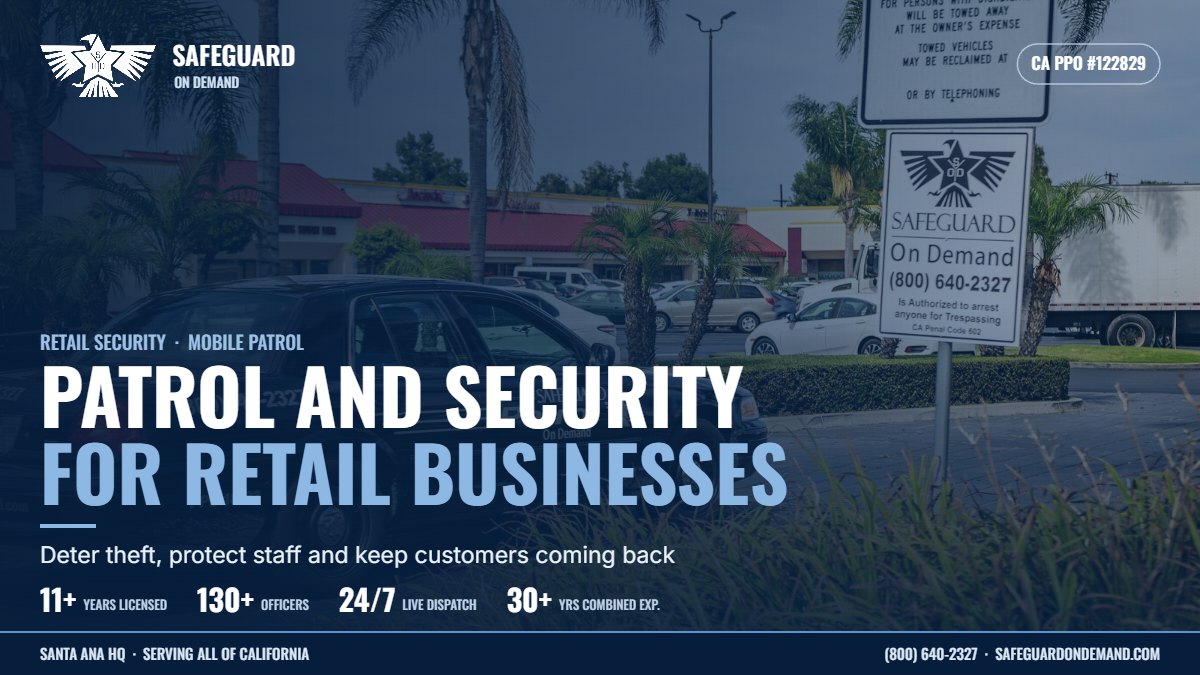
Retailers in California face a demanding mix of security challenges: everyday shoplifting, organized retail theft, aggressive customers, parking lot crime, and after-hours burglary and vandalism. Every incident affects margins, employee morale, and how safe customers feel coming back.
Professional patrol and security services give retailers practical ways to address those problems, from a uniformed officer in the store to marked patrol vehicles that check the shopping center overnight. This guide explains why retail businesses hire security, which options work best for stores and centers of different sizes, and how to get the most from your security partner.
Key Takeaways
- ✓Uniformed officers deter shoplifting, organized theft, and disruptive behavior.
- ✓Parking lot patrols protect customers and employees and reduce vehicle crime.
- ✓Closing-time and overnight coverage prevents burglary, vandalism, and loitering.
- ✓The right mix of officers, patrols, and monitoring depends on store size, hours, and incident history.
The Security Challenges Retailers Face
Shoplifting and organized theft
Losses from individuals and coordinated groups targeting high-value merchandise.
Aggressive or disruptive visitors
Confrontations that put employees and customers at risk.
Parking lot crime
Vehicle break-ins, catalytic converter theft, and robberies.
After-hours burglary
Break-ins through doors, windows, and loading areas when stores are closed.
Vandalism and graffiti
Damage to storefronts, signage, and common areas.
Loitering and trespassing
Activity near entrances and behind buildings that drives customers away.
Benefit 1: Deter Shoplifting and Organized Retail Theft
A uniformed officer at the entrance or walking the sales floor is one of the most effective theft deterrents available. Many shoplifters simply leave when they see professional security. Officers also watch for the behaviors associated with organized theft, such as groups entering together, lookouts, and repeated visits, and they communicate with store management and law enforcement according to company policy.
It is important that officers follow your loss prevention policies and California law. Professional security focuses on deterrence, observation, and reporting rather than risky confrontations.
Benefit 2: Protect Employees and Customers
Retail employees deal with difficult customers, threats, and sometimes violence. An officer trained in de-escalation can step in early, calm tense situations, and remove people who violate store policies. That support helps businesses meet their workplace violence prevention obligations and shows employees that management takes their safety seriously.
Benefit 3: Safer Parking Lots
Customers judge a store by its parking lot. Mobile patrol vehicles and foot patrol officers reduce vehicle break-ins, discourage loitering, and help customers feel comfortable after dark. Officers can also escort employees to their cars at closing. See our guide on how to make your parking lot safer.
Benefit 4: Closing-Time and Overnight Protection
Closing is one of the riskiest times for retail staff, especially when cash is being counted or deposits are being made. An officer during closing hours helps employees lock up safely. After the store is closed, patrols check doors, loading areas, and rooftops at unpredictable times, and remote video monitoring can watch storefronts and parking lots overnight with live audio warnings.
Benefit 5: Documentation for Losses and Liability
Officers record incidents, suspicious activity, and maintenance issues in daily reports with times and photos. That documentation supports police reports and insurance claims, helps loss prevention teams identify patterns, and shows that the business takes reasonable steps to protect people on its property.
Retail Security Options Compared
| Option | Best for | Main advantage |
|---|---|---|
| In-store unarmed officer | Stores with frequent theft or disruptive visitors | Visible deterrence and customer service |
| Armed officer | High-value goods, cash handling, prior robberies | Stronger response to violent threats |
| Shopping center patrol | Multi-tenant centers and strip malls | Coverage of lots, common areas, and storefronts |
| Overnight mobile patrol | Closed stores and centers | Unpredictable after-hours checks |
| Live video monitoring | Storefronts, lots, and loading areas | Real-time warnings and dispatch |
Retailers need security that protects the store without making customers feel like suspects. Our officers are friendly at the door and serious about the job, and that balance is what keeps both the shoppers and the merchandise coming back.
— David Nawabi
President & CEO, Safeguard On Demand
Choosing the Right Retail Security Partner
Look for a licensed California Private Patrol Operator with retail experience, officers trained in customer service and de-escalation, clear post orders that reflect your loss prevention policies, and reporting you can review. Ask how the provider adjusts coverage for holidays, promotions, and incident spikes. For shopping centers, confirm the provider can coordinate with multiple tenants and property management. Learn more about our shopping center and retail security.
Retail Security Across California
Safeguard On Demand is a licensed California private patrol operator providing in-store officers, shopping center patrols, and monitoring for retailers across Los Angeles, Orange County, San Diego, Ontario and the Inland Empire, Bakersfield, the Bay Area, and Sacramento. We provide unarmed and armed officers and design every plan around security solutions that address the store’s real problems.
Frequently Asked Questions
Do security guards reduce shoplifting?
Yes. A visible, uniformed officer is one of the most effective deterrents to shoplifting and helps identify organized theft activity, especially when combined with good store layout and camera coverage.
Can retail security guards stop shoplifters?
Officers follow the retailer’s policies and California law. Professional security emphasizes deterrence, observation, and reporting, and avoids unnecessary confrontations that put people at risk.
What is the difference between in-store security and patrol services?
An in-store officer provides constant presence during set hours, while patrol services make periodic, unpredictable visits to stores, parking lots, and shopping centers, often overnight.
Should retail stores have armed or unarmed security?
Most stores use unarmed officers focused on deterrence and customer service. Armed officers may be appropriate for high-value merchandise, cash handling, or locations with violent incidents.
Can a shopping center share security across tenants?
Yes. Many centers hire patrol officers for parking lots and common areas, while individual tenants add in-store officers as needed.
Retail security protects your merchandise, your people, and the customer experience that keeps your business growing. To build a plan for your store or shopping center, request a free quote or call Safeguard On Demand at (800) 640-2327.
Get a free security assessment
Licensed armed and unarmed officers, patrols and fire watch across California. Call (800) 640-2327 or request a quote online.