

Updated October 2026 · 8 min read · Reviewed by Safeguard On Demand
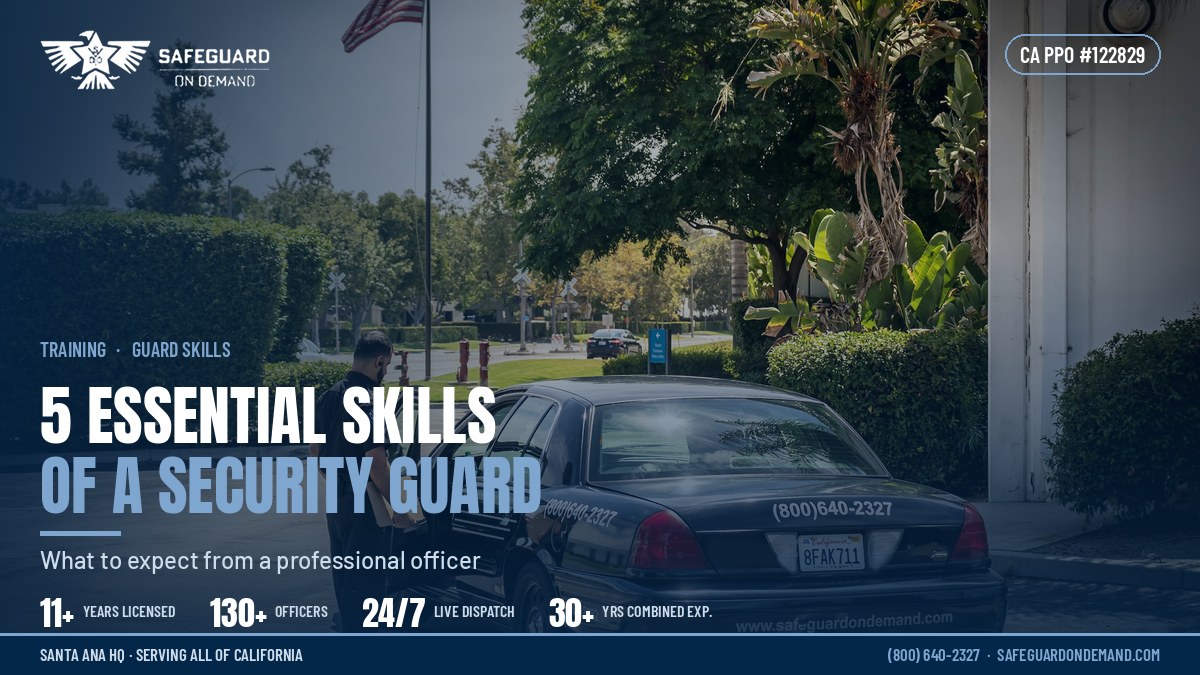
A guard card proves an officer met California’s minimum requirements. It does not prove the officer will notice the propped-open door, calm an angry visitor, or make the right call at 3 a.m. Those outcomes depend on skills, and skills vary widely from one officer to the next.
Below are the top five essential skills your security guard should possess, what each one looks like on an actual post, the supporting abilities that separate good officers from great ones, and how to make sure the officers assigned to your property have them. Whether you manage an apartment community, a retail center, or an office tower, these are the qualities that determine whether security works.
Key Takeaways
- ✓Alertness and observation are the foundation of security work, because officers cannot respond to what they do not notice.
- ✓Integrity matters because guards hold keys, codes, and access to sensitive areas.
- ✓Professional communication and de-escalation resolve most incidents before they become emergencies.
- ✓Sound judgment under pressure, including knowing the legal limits of a guard’s authority, protects both people and the client.
- ✓The most reliable way to get these skills is through a licensed company that screens, trains, and supervises its officers.
Why Security Guard Skills Matter More Than the Uniform
In California, every security guard must meet a baseline set by the Bureau of Security and Investigative Services (BSIS). According to BSIS, a guard must be at least 18, pass a DOJ and FBI background check through Live Scan, complete Power to Arrest training before registration, complete 16 hours of training within 30 days of employment and another 16 hours within six months, and complete 8 hours of continuing training every year.
That baseline is important, but it is a minimum. The officers who actually prevent losses combine training with judgment, attention, and character. When you evaluate a security provider, ask how it develops the five skills below, not just whether its guards are licensed.
1. Alertness and Observation
Security work is mostly watching, and watching well is harder than it sounds. A skilled officer stays active for an entire shift, knows what normal looks like on the property, and notices small changes that signal a problem.
Alertness also makes an officer’s reports valuable. A guard who records the time a gate was found open, the plate of a vehicle that keeps returning, or a broken light near the loading dock gives management the details it needs to fix problems before they turn into incidents.
Knows the baseline
Learns the regular tenants, vendors, vehicles, and routines so anything unusual stands out.
Checks the details
Tests doors, gates, and lighting on every round instead of walking past them.
Watches people, not just places
Notices behavior such as loitering, repeat visits, or someone testing locked entrances.
Stays engaged
Avoids phone distractions and uses patrol routes to stay alert through overnight hours.
Essential Security Guard Skills and How to Verify Them
| Skill | What it looks like on post | How to verify |
|---|---|---|
| Alertness | Thorough rounds, early detection of unusual activity | Daily activity reports and GPS patrol records |
| Integrity | Follows procedures and reports honestly | Background checks, supervisor spot checks |
| Professionalism | Courteous, clear communication and well-written reports | Sample reports and client feedback |
| Sound judgment | Calm emergency response within legal limits | Training records and incident report reviews |
| Command presence | Confident, attentive bearing that deters problems | Site visits and supervisor evaluations |
2. Integrity and Trustworthiness
Guards often hold master keys, alarm codes, and access to offices, stock rooms, and residents’ packages. A single dishonest officer can do more damage than an outside thief. That is why integrity is a non-negotiable security guard skill.
Trustworthy officers follow procedures when nobody is watching, report their own mistakes, and keep what they see on the job confidential. Background checks screen out some risks; supervision, clear post orders, and GPS-verified patrol records help confirm that officers do what they report.
3. Professionalism and Communication
The best officers understand their duties without constant reminders and represent your property well. For concierge security and lobby security posts, the officer is often the first person a visitor meets.
Communication is the core of professionalism. Officers must give clear directions, explain rules politely, and use de-escalation to calm upset people before conflict turns physical. They also need to write. Clear, accurate daily activity reports and incident reports protect the client when insurers, police, or attorneys ask what happened.
A license tells you an officer met the minimum. What protects a property is the officer who notices the small things, writes them down, and knows exactly when to step in and when to call for help.
— David Nawabi
President & CEO, Safeguard On Demand
4. Presence of Mind and Sound Judgment
Emergencies leave little time to think. A security guard with presence of mind already knows the plan for a medical emergency, a fire alarm, a fight, or a suspicious package, and acts calmly while others panic.
Sound judgment also means knowing the limits of a guard’s authority. Security officers in California have no police powers. Under Penal Code section 837, a private person may arrest another only for a public offense committed or attempted in their presence, for a felony the person has committed, or when a felony has in fact been committed and there is reasonable cause to believe the person committed it. A skilled officer knows when to observe and report instead of intervening, and when to call police immediately.
Medical emergencies
Calls 911, directs responders to the right location, and keeps the area clear.
Fire alarms
Assists evacuation and meets the fire department with building information.
Conflicts
Separates the parties, de-escalates, and calls police if violence is threatened.
Suspicious items
Keeps people back, does not touch the item, and reports it immediately.
5. Command Presence and Physical Readiness
A confident posture, a clean uniform, and an attentive stance communicate authority before an officer says a word. That presence is a deterrent in itself, because people looking for an easy target avoid sites where an officer clearly pays attention.
Physical readiness matters too. Officers may stand for long shifts, walk large properties, climb stairs during a fire watch, or patrol construction sites at night. Good command presence is never about intimidation; it is calm confidence that keeps situations under control.
Supporting Skills That Separate Great Security Officers
Beyond the top five, the strongest officers bring these supporting abilities:
Report writing
Accurate, factual, timely reports that stand up to review by managers, insurers, and police.
Customer service
A helpful, respectful manner with tenants, shoppers, and visitors, which builds cooperation.
Technology use
Comfort with patrol apps, access control systems, radios, and remote video monitoring tools.
Site knowledge
Familiarity with exits, utility shutoffs, alarm panels, and emergency contacts for the property.
Teamwork
Working smoothly with supervisors, dispatch, property managers, and responding agencies.
How to Make Sure Your Security Guard Has These Skills
You cannot test every officer yourself. The practical answer is to work with a licensed company that screens, trains, and supervises for these skills. At Safeguard On Demand, every officer is BSIS-licensed and completes our security guard training program, and our leadership team brings 30+ years of combined law enforcement and private security experience to officer development. Armed officers hold BSIS exposed-firearm permits.
Ask any provider how it evaluates judgment and communication, what supervisors check on each shift, and to see sample reports. Our 24/7 live dispatch, GPS-verified patrols, and daily activity reports give clients visible proof of officer performance. To see how we apply these standards, review why clients choose Safeguard On Demand or explore our unarmed security guard services.
Frequently Asked Questions
What is the most important skill for a security guard?
Alertness. Every other skill depends on noticing a problem early. Training, supervision, and clear post orders help officers stay alert; learn about our security guard services.
What training do security guards need in California?
BSIS requires Power to Arrest training before registration, 32 hours of skills training within six months of employment, and 8 hours of continuing training each year. See our security guard training standards.
Can security guards arrest people?
Only as private persons under Penal Code section 837, and they must turn the person over to police. They have no police powers. Our management team trains officers on these limits.
Do armed guards need different skills?
Armed officers need the same core skills plus firearms proficiency, a BSIS firearms permit, and especially strong judgment. Learn about our armed security guards.
How can I evaluate a security company's officers?
Ask about screening, training, supervision, and reporting, and request sample reports. You can also start with a free site assessment; contact our team to schedule one.
The top five essential skills your security guard should possess, alertness, integrity, professionalism, sound judgment, and command presence, are what turn a licensed guard into an effective officer. Safeguard On Demand recruits, trains, and supervises for those skills across California. Call (800) 640-2327 or request a free quote for officers you can trust.
Get a free security assessment
Licensed armed and unarmed officers, patrols and fire watch across California. Call (800) 640-2327 or request a quote online.