

Updated October 2026 · 7 min read · Reviewed by Safeguard On Demand
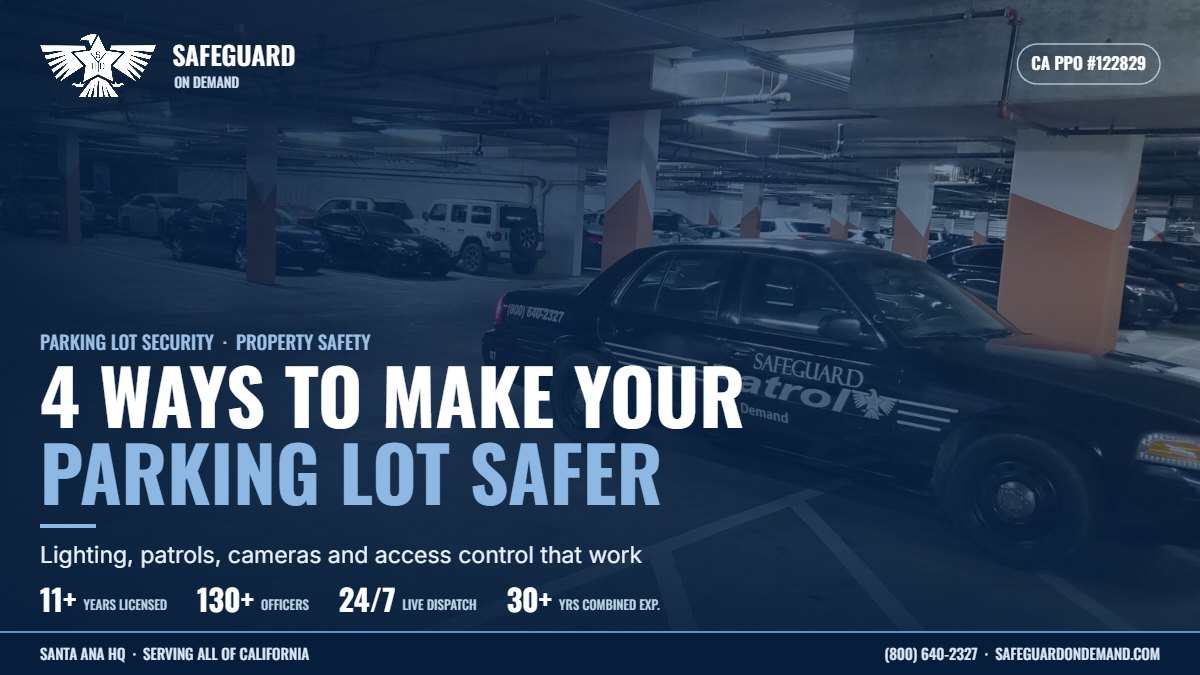
For most visitors, your parking lot is the first and last part of your property they experience. It is also where a large share of property crime happens: vehicle break-ins, catalytic converter theft, vandalism, loitering, and assaults on people walking to and from their cars. A lot that feels dark, empty, or unwatched invites trouble, and the liability that follows lands on the property owner.
The good news is that parking lot security is rarely about one expensive fix. The safest lots in California combine four layers: good lighting and visibility, controlled access, active video monitoring, and a visible security presence. This guide walks through each layer, what it costs you to skip it, and how to put a practical plan in place for a retail center, office campus, apartment community, hospital, or garage anywhere from San Diego to Sacramento.
Key Takeaways
- ✓Lighting and clear sightlines are the cheapest, fastest way to make a parking lot feel and be safer.
- ✓Access control, from gates and signage to permits and towing enforcement, decides who is in your lot after hours.
- ✓Cameras only deter crime when someone is watching; live remote video monitoring turns footage into a response.
- ✓Uniformed patrol officers remain the strongest deterrent and the best way to document incidents and support your liability defense.
Why Parking Lot Security Matters for California Properties
Parking areas are attractive to offenders for simple reasons: vehicles hold valuables, people are distracted while loading or unlocking, and large open spaces are hard for staff to watch. Garages add stairwells, elevators, and blind corners. When incidents happen, tenants, shoppers, patients, and employees remember where it happened, and so do plaintiffs’ attorneys.
Property owners in California have a general duty to take reasonable steps against foreseeable harm on their premises. Prior incidents, nearby crime, and late-night use all affect what is considered reasonable. That is why a documented, layered approach to parking lot and garage security protects both people and the business. It shows that you identified the risk and acted on it.
Vehicle break-ins and theft
Smash-and-grab burglaries, catalytic converter theft, and stolen vehicles are the most common losses in open lots and garages.
Personal safety threats
Robberies, harassment, and assaults often happen in the short walk between a building entrance and a parked car.
Loitering and encampments
Unmonitored lots after hours attract loitering, drug activity, and overnight camping, which drive away customers and tenants.
Vandalism and illegal dumping
Graffiti, damaged gates and equipment, and dumped debris add up to recurring repair and cleanup costs.
1. Improve Lighting and Visibility
Lighting is the foundation of any parking lot safety plan. Even, consistent light lets drivers and pedestrians see who is around them, gives cameras usable images, and removes the shadows offenders rely on. Walk the lot at night and look for burned-out fixtures, dark pockets between poles, and areas where landscaping blocks light.
- Replace failing fixtures with LED lighting that renders color accurately, so witnesses and cameras can describe vehicles and clothing.
- Prioritize walkways, entrances, stairwells, and pay stations, where people stop and are most exposed.
- Trim hedges and tree canopies to keep clear sightlines from the building and the street into the lot.
- Keep signage visible, including hours of operation, no-trespassing notices, and camera notices.
These steps follow the principles of Crime Prevention Through Environmental Design (CPTED): make the space easy to watch, easy to understand, and clearly cared for. A well-lit, well-kept lot tells offenders that someone is paying attention.
2. Control Who Enters and When
An open lot with no rules invites anyone at any hour. Access control does not have to mean a full gate system. It means deciding who belongs in your parking area and making that visible and enforceable.
For apartment communities and gated communities, that may mean resident permits, guest passes, and enforced towing policies. Office parks and business parks often use badge-controlled gates or after-hours closures. Retail centers typically post customer-only parking rules and close sections of the lot overnight. Hospitals and medical clinics need clear separation between public, staff, and emergency parking.
Whatever system you choose, it only works if someone enforces it. Posted rules that nobody follows teach people that the lot is unmanaged.
3. Add Cameras That Someone Actually Watches
Security cameras are valuable for evidence, but recorded footage alone rarely stops a crime in progress. Most offenders know that a camera on a pole means, at worst, a grainy clip reviewed days later. What changes behavior is a response in the moment.
Remote video monitoring connects your cameras to trained operators who watch for suspicious activity in real time. When someone enters a closed lot, tampers with a vehicle, or lingers near an entrance, the operator can issue a live audio warning through on-site speakers, dispatch a patrol officer, and contact law enforcement when needed. For large lots, construction sites, and properties that close overnight, monitoring is a cost-effective way to cover hours when a full-time guard is not practical.
Parking Lot Security Measures Compared
| Measure | What it does best | Limitations |
|---|---|---|
| Upgraded lighting | Improves visibility and camera images; low ongoing cost | Does not respond to incidents |
| Access control and signage | Defines who belongs and supports towing and trespass enforcement | Needs consistent enforcement |
| Recorded cameras only | Provides evidence after an incident | No real-time deterrence or response |
| Live remote video monitoring | Detects activity, issues live warnings, dispatches response | Depends on camera coverage and lighting |
| Mobile patrol | Unpredictable visits across one or several sites | Not on site every minute |
| Dedicated security officer | Constant visible presence, escorts, immediate response | Highest hourly cost |
4. Put Visible Security Officers on Patrol
A uniformed officer is still the strongest deterrent a parking area can have. People who are looking for an easy target generally move on when they see a marked vehicle or an officer walking the rows. Officers also do what cameras cannot: they escort employees to their cars, ask loiterers to leave, check gates and lighting, assist with disabled vehicles, and write detailed reports that support insurance claims and liability defense.
There are two common models. Mobile patrol security sends a marked patrol vehicle to your lot several times per shift at unpredictable intervals, a strong fit for properties that need overnight coverage without a full-time post. A dedicated unarmed security officer or foot patrol officer stays on site during high-risk hours, such as closing time at a shopping center or shift change at a hospital. Higher-risk properties sometimes add armed security guards after a risk assessment.
A parking lot tells people right away whether anyone is paying attention. Good lighting, clear rules, live monitoring, and a patrol car that shows up when nobody expects it change that message fast, and that is usually what stops the problem.
— David Nawabi
President & CEO, Safeguard On Demand
Building a Layered Parking Lot Security Plan
The most effective plans combine these layers based on how your lot is actually used. A Los Angeles retail center may need an officer at closing and patrol checks overnight. A Sacramento office campus may need gate enforcement and remote monitoring after 7 p.m. An Orange County apartment community may need towing enforcement, resident permits, and a nightly patrol. A San Jose garage may need foot patrols through stairwells and elevators during peak hours.
Start with a walkthrough at the times incidents occur, review your incident history and police calls for service, and then match each problem to the layer that solves it. Safeguard On Demand provides security risk assessments as part of our proposals, because we focus on security solutions that address the root cause rather than simply adding hours.
Retail and shopping centers
Closing-time officer presence, overnight patrols, and loitering enforcement.
Apartments and HOAs
Permit and towing enforcement, gate checks, and nightly patrols. See our apartment security services.
Hospitals and clinics
Staff escorts at shift change and coverage for emergency department parking.
Office and business parks
After-hours gate control, lock-ups, and remote video monitoring.
Parking garages
Foot patrols through stairwells, elevators, and upper levels.
Construction and vacant lots
Monitoring and patrols that protect equipment and materials overnight.
Statewide Parking Lot Security from Safeguard On Demand
Safeguard On Demand is a licensed California private patrol operator with offices serving Southern California, the Inland Empire, Silicon Valley, Sacramento, and San Diego. Our BSIS-licensed officers patrol parking lots and garages for retail centers, apartment communities, hospitals, and business parks across Los Angeles, Orange County, San Diego, the Inland Empire, the Bay Area, the Central Valley, and Sacramento.
Every officer completes California-required training plus our own site-specific instruction, and every shift produces timestamped reports with photos so you can see exactly what happened on your property. Learn more about our security guard training and why clients choose us.
Frequently Asked Questions
What is the most effective way to make a parking lot safer?
Combining layers works best: good lighting, clear access rules, live video monitoring, and visible security patrols. Lighting and visibility are the most affordable first step, while uniformed officers provide the strongest deterrent and immediate response.
Do security cameras prevent parking lot crime?
Recorded cameras mainly help after an incident. Live remote video monitoring is more effective at prevention because operators can issue audio warnings and dispatch officers while something is happening.
Is mobile patrol enough for a parking lot?
For many lower-risk lots, several unpredictable patrol visits per night provide strong deterrence at a lower cost than a full-time post. Properties with frequent incidents or late-night foot traffic usually benefit from a dedicated officer during peak hours.
Can security officers enforce towing in a private lot?
Security officers can monitor parking rules, document violations, and coordinate with your authorized towing company according to your posted policies and California law. The property owner or manager sets the rules and authorizes the tows.
How quickly can Safeguard On Demand start parking lot security?
In many cases we can begin patrols or place officers within 24 to 48 hours after a site walkthrough and signed agreement, depending on location and coverage hours.
A safer parking lot starts with seeing it the way an offender does: where it is dark, where no one is watching, and where no one responds. Fix those gaps one layer at a time. To get a parking lot security plan for your property, request a free quote or call Safeguard On Demand at (800) 640-2327.
Get a free security assessment
Licensed armed and unarmed officers, patrols and fire watch across California. Call (800) 640-2327 or request a quote online.