
Introduction
Knowing how to hire a licensed security guard company in California starts with more than comparing hourly rates. A company may look professional on a website, but you still need to confirm its license, insurance, guard credentials, supervision, and service standards before signing a contract.
California regulates private security businesses and personnel through the Bureau of Security and Investigative Services (BSIS). BSIS provides an official Verify a License tool that consumers can use to check companies and individual security guards.
This guide explains what to check before hiring a security provider, including the company license, security guard registration, insurance, and required documentation. You will also learn which questions to ask, how to compare quotes, what warning signs to watch for, and how to choose a security company that fits your property and coverage needs.
Why Licensing Matters When Hiring a Security Company in California
Before comparing prices, verify that the security company is properly licensed. In California, the Bureau of Security and Investigative Services (BSIS) regulates private security businesses and personnel under the Private Security Services Act and related state rules. BSIS also provides a public license verification system for consumers.
It is important to understand the difference between a company license and an individual registration. A company that contracts security services to customers generally operates as a Private Patrol Operator (PPO). The individual officers working for that company have their own security guard registration, commonly called a guard card. BSIS states that security guards working for a PPO must have valid registration.
Checking these credentials helps reduce practical risks for a buyer. An unverified company may create questions about insurance, accountability, and who is responsible when a problem occurs. BSIS also provides a process for reporting suspected unlicensed activity and complaints, giving buyers an important way to check a provider before signing a contract.
How to Verify a Security Guard Company License in California
Before comparing prices, verify that the security company is properly licensed. In California, the Bureau of Security and Investigative Services (BSIS) regulates private security businesses and personnel under the Private Security Services Act and related state rules. BSIS also provides a public license verification system for consumers.
It is important to understand the difference between a company license and an individual registration. A company that contracts security services to customers generally operates as a Private Patrol Operator (PPO). The individual officers working for that company have their own security guard registration, commonly called a guard card. BSIS states that security guards working for a PPO must have valid registration.
Checking these credentials helps reduce practical risks for a buyer. An unverified company may create questions about insurance, accountability, and who is responsible when a problem occurs. BSIS also provides a process for reporting suspected unlicensed activity and complaints, giving buyers an important way to check a provider before signing a contract.
How to Verify a Security Guard Company License in California
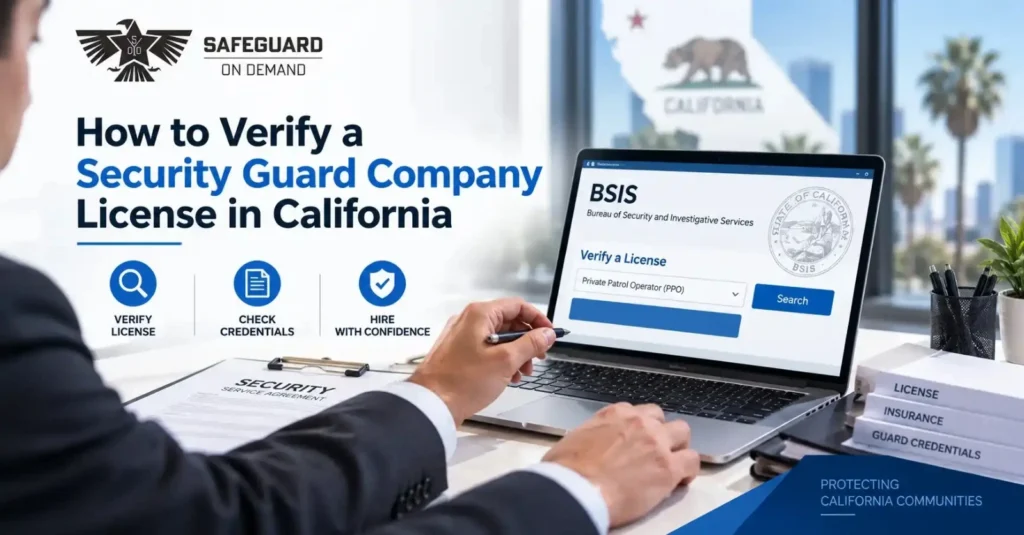
Before hiring a security provider, take a few minutes to verify its license through the official BSIS Verify a License tool. This is one of the simplest ways to confirm that you are dealing with a legitimate BSIS licensed security company.
Use the BSIS Verify a License Tool
Start by asking the company for its legal business name and license number. Then open the official BSIS Verify a License page and select Private Patrol Operator when checking a company that provides contract security. Search the business information and make sure the name and license details match the company you are speaking with. BSIS also allows searches for individual Security Guard registrations.
What Does a PPO License Confirm?
A Private Patrol Operator (PPO) license is the company level credential for a business that protects people or property or prevents theft. California states that a business cannot operate as a PPO without the proper license, unless an exemption applies.
What Does a Guard Card Confirm?
A guard card relates to the individual officer’s BSIS registration. Security guards must meet BSIS registration requirements, including a criminal history check and required training.
What If the Company Information Does Not Match?
Treat an expired record, name mismatch, refusal to provide license information, or unclear subcontracting arrangement as a reason to stop and verify the details before signing a contract.
What Licenses and Insurance Should a California Security Company Have?
Before hiring a security provider, check both the company credentials and the credentials of the officers assigned to your property. A contract security company should have the appropriate Private Patrol Operator (PPO) license, while security guards should have current BSIS registration. California requires PPO licensees to confirm that employees performing security guard duties have valid registration.
Private Patrol Operator License
The PPO license is the company level credential for businesses that provide private security services. Ask for the license information and verify it through BSIS before signing a contract.
Security Guard Registration
Each officer should have valid BSIS security guard registration. Registration includes a criminal history background check and required training.
Additional Credentials for Specialized Assignments
Some assignments may require additional BSIS credentials or training. Ask the company what qualifications are required for the specific duties at your property.
Insurance and Workers’ Compensation
BSIS requires licensed PPOs to maintain general liability insurance of at least $1 million for each occurrence. California employers with one or more employees generally must also maintain workers compensation coverage. Ask for current insurance documentation before signing a contract.
Questions to Ask Before You Hire a Security Guard Company
The right questions can tell you much more about a provider than a sales presentation. Before hiring a contract security company, ask:
Can you provide your BSIS PPO license information?
A legitimate provider should be able to give you its company license details so you can verify them with BSIS.
Can I verify the license through BSIS?
Use the official verification system rather than relying only on a certificate or information shown on a website.
How do you verify the officers assigned to my property?
Ask how the company confirms current guard registration, required training, and background screening for assigned personnel.
Who supervises the guards after hours?
Find out who handles supervisor checks, questions, call offs, and unexpected problems when your main contact is unavailable.
What will the post orders include?
Clear post orders should explain the officer’s duties, site expectations, access procedures, and reporting responsibilities.
How are incidents and daily activities documented?
Ask whether officers complete regular activity reports and how incidents are reported to the property owner or manager.
What exactly is included in the quoted hourly rate?
Confirm the coverage hours, staffing, supervision, reporting, patrol services, and any additional charges. Asking these questions helps you choose a security guard company based on the actual service being provided, not price alone.
How Much Does It Cost to Hire a Security Guard in California?
The cost to hire a security guard in California depends on the service, location, coverage hours, property type, staffing needs, and level of risk. Safeguard On Demand currently publishes these estimated hourly ranges for common services: unarmed security at $30 to $45, mobile patrol at $35 to $60, fire watch at $45 to $70, and event security at $45 to $55. These are company published estimates, not official California rates or fixed statewide prices.
What Changes the Price?
Property location, risk level, number of officers, shift length, and coverage schedule all affect the final quote. Short term coverage may also be priced differently from an ongoing contract. Stationary coverage and mobile patrol require different staffing and operating arrangements.
Supervision, specialized assignment requirements, and expected response time can also affect pricing. When comparing quotes, look beyond the hourly rate. Check the actual coverage, staffing, supervision, insurance, reporting, and services included so you can compare the full value of each proposal.
How to Compare Security Guard Companies Beyond Price
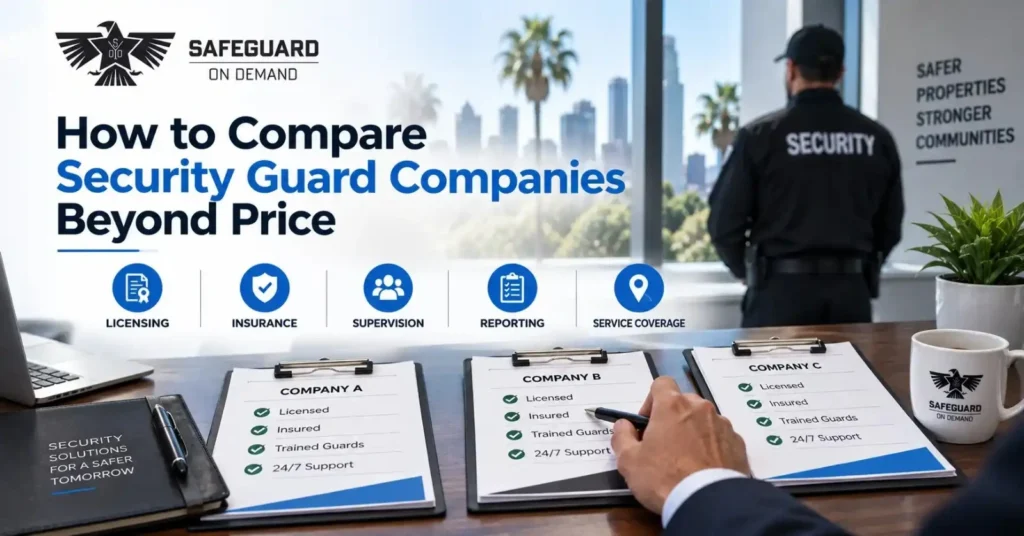
Two security companies can offer different hourly rates while providing very different levels of service. When you choose a security guard company, compare what is actually included rather than focusing only on the cheapest quote.
Check the company’s licensing, officer verification, insurance, and supervision structure. Ask how the team handles response time, written post orders, daily communication, and incident reporting. Review the contract for coverage hours, responsibilities, cancellation terms, and other conditions. You should also check references and recent reviews to understand how the company performs for similar clients.
A BSIS consumer guide advises buyers to compare prices by getting three or more estimates for similar services and checking referrals before signing a contract.
The goal is simple: compare the complete service, not just the hourly number. A lower quote may leave out supervision, reporting, coverage, or other important parts of the agreement.
Red Flags to Watch For Before Signing a Security Contract
Before you hire a security provider, watch for warning signs that can create problems later. A company that avoids sharing its PPO license information or a clear BSIS verification path deserves closer review.
Unclear guard registration is another concern. The company should be able to explain how it verifies the credentials of officers assigned to your property. Ask for current insurance documentation as well. A provider that cannot show appropriate coverage leaves important questions unanswered.
Do not rely on a verbal agreement. A proper written contract should clearly state duties, pricing, coverage hours, cancellation terms, and responsibilities. You should also know who supervises guards during each shift and how incident reporting and daily activity records are handled.
Be careful with unusually low pricing. A low quote may leave out supervision, reporting, or other services. Finally, ask whether the company uses subcontractors and who is responsible for supplying and supervising the officers.
What a Professional Security Company Should Provide Before Deployment
A professional security company should prepare your assignment before the first officer arrives. The process should begin with a property or site assessment to understand the location, risks, access points, and coverage needs. From there, the company should create a written security plan with clear duties, post orders, patrol expectations where needed, and a defined reporting process.
You should also know who supervises the officers, who to contact during an urgent situation, and how the emergency escalation process works. Each shift should have clear documentation, including incident reports and other activity records.
Safeguard On Demand states that its deployments include site assessments, written security plans, site specific post orders, guard supervision, GPS tracking, and Detailed Activity Reports after each shift.
Before deployment, review the contract and billing terms so coverage, responsibilities, and costs are clear.
How to Choose Between Unarmed and Specialized Security Services in California
Choosing between unarmed vs armed security guards california should start with the property and its actual security needs, not simply the most expensive option. Consider the site, risk level, officer duties, operating environment, and applicable California requirements before deciding what type of coverage fits.
Retail stores and office properties may need visible access control, observation, and routine monitoring. Construction sites may need overnight security, access checks, and patrol services. Events may require personnel who can manage entrances, monitor crowds, and respond to incidents.
Higher risk properties may need specialized security personnel based on the assessment. The key is to match the service to the situation so you get appropriate coverage without paying for capabilities your property does not require.
Why Safeguard On Demand
Safeguard On Demand focuses on security coverage that is planned around the property and its actual needs. The company states that it operates as a California licensed Private Patrol Operator and uses BSIS licensed officers who are background checked and trained for their assigned duties.
Before deployment, Safeguard provides a security needs assessment, written security plan, and site specific post orders. Officers are also GPS tracked during their shifts, and clients receive Detailed Activity Reports documenting activity and incidents.
Safeguard provides services across California and offers 24 hour operations with flexible service options, including no long term contract requirements.This approach gives property owners a clearer view of who is providing the service, what officers are expected to do, and how coverage is documented.
Final Thoughts
Choosing a security company should start with your property, coverage needs, risk level, and service expectations, not just the lowest hourly rate. Check the company license, verify officer credentials, review insurance, and make sure supervision, post orders, reporting, and contract terms are clear before you hire.
Need help deciding what security coverage your property needs? Contact Safeguard On Demand for a free security assessment and written quote. Call (800) 640 2327 or email info@safeguardondemand.com to discuss your location, coverage needs, and service expectations.
Frequently Asked Questions
How do I verify that a security guard company is licensed in California?
Use the official BSIS Verify a License tool and search for the company under Private Patrol Operator. Match the legal business name and license details with the provider you are considering.
What license does a security company need to operate in California?
A company providing contract security services generally needs a Private Patrol Operator (PPO) license from BSIS, unless an exemption applies. BSIS licenses and regulates PPO businesses under California law.
Is it illegal to hire an unlicensed security guard company in California?
California law prohibits a person from operating a private patrol operator business without the proper license, unless an exemption applies. The rule primarily addresses the provider’s operation, so buyers should verify licensing rather than assume that a company advertising security services is properly licensed.
What is the difference between a security guard registration and a PPO license?
A PPO license applies to the security company. A security guard registration, often called a guard card, applies to the individual officer. BSIS requires security guards to have valid registration and complete required screening and training.
How much does it cost to hire a security guard company in California?
Safeguard On Demand publishes estimated pricing from $30 to $75 per hour, depending on the service. Its published ranges vary by unarmed security, mobile patrol, fire watch, event security, and other coverage needs.
What questions should I ask before signing a contract with a security guard company?
Ask about the PPO license, officer registration, insurance, supervision, post orders, incident reporting, staffing, hourly charges, and contract terms. These details help you compare the actual service rather than price alone.