
Updated October 2026 · 5 min read · Reviewed by Safeguard On Demand
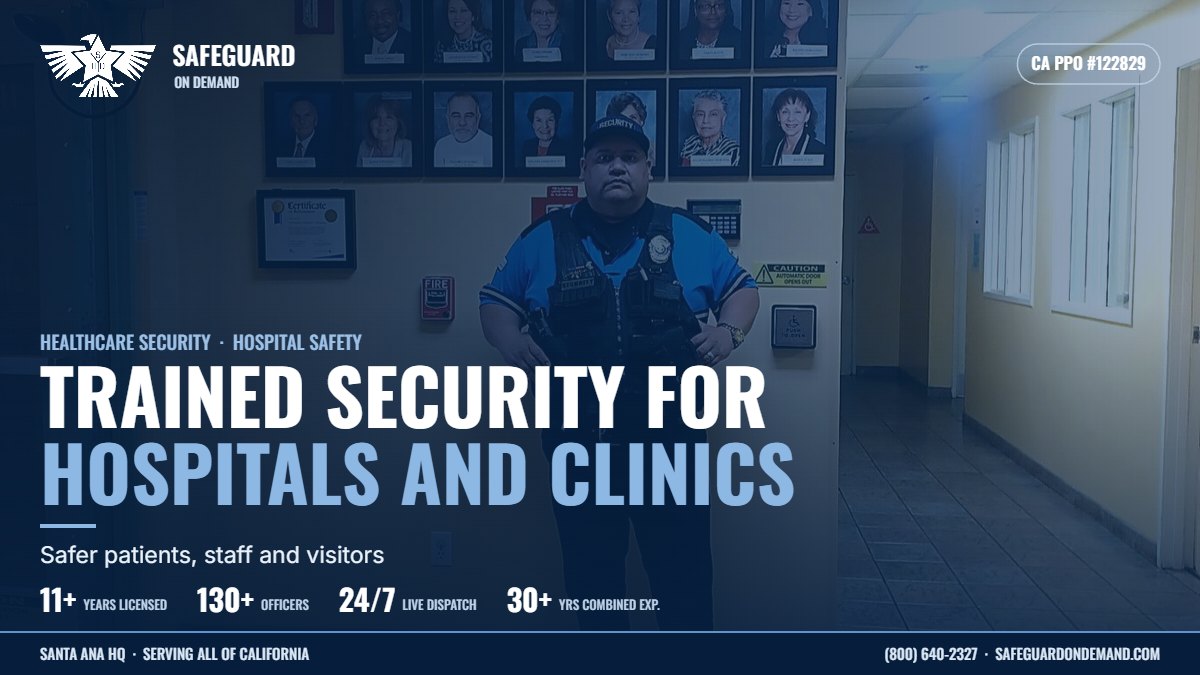
Hospitals and healthcare facilities are open around the clock, see people at their most stressed, and must stay welcoming while protecting patients, staff, medications, and equipment. Crowded waiting rooms, visitor restrictions, frustrated families, and exhausted staff all add pressure on hospital security teams.
Those lessons have stayed with the healthcare industry. Today, trained security officers are a core part of how California hospitals, urgent care centers, and community clinics manage workplace violence risk, control access, and keep operations running safely. This article explains the benefits of trained healthcare security officers and what sets them apart from general security.
Key Takeaways
- ✓Healthcare workers face a higher risk of workplace violence than most other professions.
- ✓Trained officers de-escalate tense situations before they turn into assaults.
- ✓Security supports access control, visitor management, and infection-control policies.
- ✓California hospitals have specific security planning and workplace violence prevention requirements.
Why Healthcare Facilities Need Specialized Security
Healthcare workers experience workplace violence at significantly higher rates than workers in most other industries, and emergency departments and behavioral health units are especially affected. Long waits, pain, fear, intoxication, and mental health crises can all lead to aggression toward staff. At the same time, hospitals must remain open to the public and treat everyone who comes through the door.
California requires general acute care hospitals to conduct security and safety assessments and maintain a security plan, and Cal/OSHA’s Workplace Violence Prevention in Health Care standard requires covered facilities to have a written prevention plan, training, and incident logging. Trained security officers are a central part of meeting those expectations in practice.
Key Benefits of Trained Hospital Security Officers
De-escalation
Officers trained to calm agitated patients and visitors protect staff without unnecessary force.
Access control
Visitor screening, badge checks, and secured units keep the right people in the right places.
Staff protection
Escorts to parking, response to duress alarms, and presence in high-risk units.
Emergency readiness
Support during codes, evacuations, lockdowns, and mass-casualty events.
Asset protection
Securing pharmacies, equipment, and supplies against theft.
Documentation
Incident reports that support Cal/OSHA logging and hospital security plans.
De-Escalation Protects Everyone
The most valuable skill a healthcare security officer brings is the ability to prevent a situation from escalating. Officers trained in verbal de-escalation, crisis communication, and awareness of mental health and substance use issues can often calm a frustrated visitor or an agitated patient before anyone is hurt. When physical intervention is unavoidable, trained officers work with clinical staff according to hospital policy, prioritizing safety and patient dignity.
Access Control and Visitor Management
Hospitals rely on security officers to screen visitors, enforce visiting policies, and manage entry points. Officers manage main entrances and emergency department entries, verify visitors, issue badges, secure maternity and pediatric units, and keep restricted areas such as pharmacies and data rooms locked down. Strong access control reduces both security incidents and infection risks.
Emergency Department Coverage
Emergency departments see the highest rates of violence in most hospitals. A visible officer presence in the waiting room and treatment areas deters aggression and allows rapid response when staff call for help. Read our in-depth guide on the importance of hospital security guards in emergency rooms and our analysis of whether hospital security officers should be armed.
Supporting Staff, Parking, and After-Hours Safety
Nurses, physicians, and support staff come and go at all hours. Officers provide escorts to parking areas, patrol garages and lots, and respond to duress alarms. At outpatient clinics and medical office buildings, a single officer can make a significant difference in how safe staff feel opening and closing each day.
Healthcare Security Coverage by Facility Type
| Facility | Common risks | Typical coverage |
|---|---|---|
| General acute care hospital | ED violence, access control, theft | 24/7 officers, ED post, patrols, escorts |
| Urgent care center | Agitated patients, after-hours risk | Officer during evening and peak hours |
| Community health clinic | Disruptive visitors, staff safety | Lobby officer during operating hours |
| Behavioral health facility | Aggression, elopement risk | Specially trained officers on units |
| Medical office building | After-hours access, parking safety | Lobby officer plus mobile patrol |
In a clinic or a hospital, our officers are part of the care team. They know the staff, they know the patients who come in every week, and they know how to calm a situation down long before anyone needs to call for help.
— David Nawabi
President & CEO, Safeguard On Demand
What to Look for in a Healthcare Security Provider
- BSIS-licensed officers and an active California Private Patrol Operator license.
- Training in de-escalation, crisis intervention, and patient privacy awareness.
- Experience with hospitals, clinics, and community health centers.
- Reporting that supports your workplace violence prevention plan and incident logs.
- Officers who can work respectfully with patients, families, and clinical teams.
Safeguard On Demand has protected community health centers in Southern California for years, including family practice, pediatric, and OB/GYN clinics, giving our officers deep experience in patient-facing environments.
Healthcare Security Across California
As a licensed California private patrol operator, Safeguard On Demand provides healthcare and hospital security for hospitals, clinics, and medical offices across Los Angeles, Orange County, San Diego, the Inland Empire, Fresno, the Bay Area, and Sacramento. We build security solutions around each facility’s patients, staff, and risks, and we coordinate closely with clinical leadership. Learn about our officer training.
Frequently Asked Questions
Why do hospitals need security guards?
Hospitals face elevated workplace violence risk, must control access to sensitive areas, protect medications and equipment, and respond to emergencies around the clock. Trained officers help with all of these while keeping the facility welcoming.
What training should hospital security officers have?
In addition to the BSIS Guard Card, healthcare officers should be trained in de-escalation, crisis intervention, patient privacy awareness, emergency codes, and the facility’s workplace violence prevention plan.
Are California hospitals required to have security?
California requires general acute care hospitals to conduct security and safety assessments and maintain a security plan, and Cal/OSHA requires covered healthcare facilities to maintain a workplace violence prevention plan. Specific staffing depends on each facility’s assessment.
Should hospital security officers be armed?
Most healthcare facilities use unarmed officers trained in de-escalation. Armed coverage is a facility-specific decision based on risk. Read our article on whether hospital security officers should be armed for a full discussion.
Can clinics and medical offices hire security part-time?
Yes. Many clinics use an officer during operating hours or peak times, with mobile patrol or monitoring after hours.
Trained security officers help healthcare teams focus on patients instead of threats. To discuss security for your hospital, clinic, or medical office, request a free quote or call Safeguard On Demand at (800) 640-2327.
Get a free security assessment
Licensed armed and unarmed officers, patrols and fire watch across California. Call (800) 640-2327 or request a quote online.