

Updated October 2026 · 9 min read · Reviewed by Safeguard On Demand
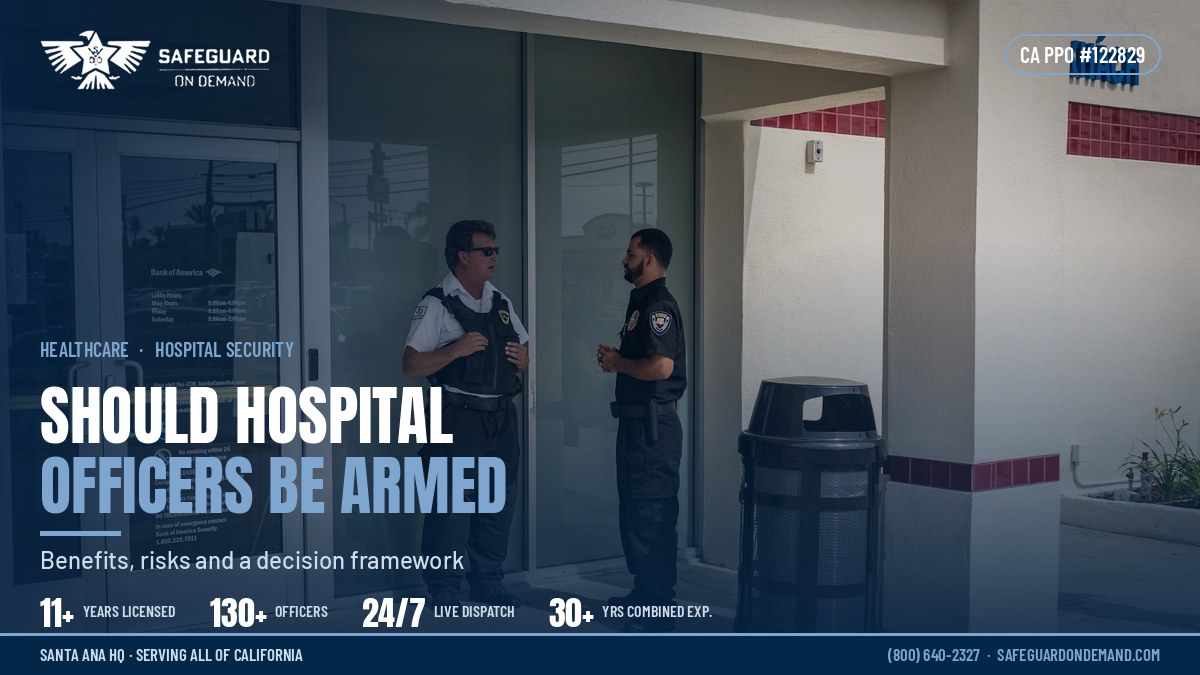
Few security questions divide hospital leaders like this one. Supporters of armed officers point to rising concern about violence against healthcare workers and the possibility of an active shooter. Skeptics worry about weapons in behavioral health units, patient trust, and liability. Both sides are describing real risks.
The honest answer to whether hospital security officers should be armed is: it depends on the facility, and the decision should come from a documented risk assessment rather than a headline. This article lays out the evidence, the benefits and risks, what California requires of armed officers, and a practical framework many hospitals use to decide between unarmed, armed, and hybrid hospital security coverage.
Key Takeaways
- ✓Healthcare workers were about five times as likely as workers overall to suffer a workplace violence injury, according to BLS data for 2018.
- ✓Armed officers can respond immediately to weapons threats, but they require stricter screening, training, and policies than unarmed officers.
- ✓In California, an armed guard must hold a BSIS firearms permit, pass a firearms assessment, and requalify on the range twice every 12 months.
- ✓Weapons in behavioral health and pediatric areas raise real concerns about retention, patient trust, and escalation.
- ✓Many hospitals choose a hybrid model, keeping unarmed officers in clinical areas and placing armed officers at specific posts identified by assessment.
Why Hospitals Are Asking Whether Security Officers Should Be Armed
The question has grown more urgent because violence in healthcare is well documented. The U.S. Bureau of Labor Statistics found that healthcare workers accounted for 73 percent of all nonfatal workplace injuries and illnesses due to violence in 2018. Their injury rate from violence was 10.4 per 10,000 full-time workers, compared with 2.1 for all private industry. BLS also counted 156 workplace homicides of private healthcare workers from 2011 through 2018.
California treats the issue seriously. Cal/OSHA’s Title 8 section 3342 requires general acute care and acute psychiatric hospitals to maintain a workplace violence prevention plan, keep a violent incident log, report serious incidents to Cal/OSHA, and provide sufficient staffing, including security personnel, to respond in a timely manner. Health and Safety Code section 1257.7 requires an annual security and safety assessment and a security plan. Neither rule requires armed officers, which leaves the choice to each hospital’s assessment.
Reasons Hospital Security Officers Should Be Armed
Where the risk profile supports it, armed officers offer capabilities an unarmed team cannot.
Immediate response to weapons threats
An armed officer on site can confront an armed attacker in the minutes before police arrive, when lives are most at risk.
Visible deterrence
A trained, uniformed armed officer at the entrance discourages people from bringing violence into the building.
High-risk campuses
Hospitals in high-crime areas, trauma centers, and facilities with prior weapons incidents may face threats unarmed staff cannot stop.
Forensic and custody patients
Facilities that regularly treat patients in law enforcement custody may want armed backup at specific posts.
Staff confidence
Clinicians who feel protected are more likely to stay, which matters in a profession with heavy turnover.
Armed, Unarmed, and Hybrid Hospital Security Compared
| Model | Strengths | Trade-offs |
|---|---|---|
| Unarmed only | Patient-friendly presence, strong de-escalation focus, lower cost | Limited ability to stop an armed attacker before police arrive |
| Armed only | Immediate response to weapons threats, strong deterrence | Retention risk in clinical areas, higher cost, possible patient discomfort |
| Hybrid | Armed response at high-risk posts with unarmed officers in care areas | Requires clear post orders and coordination between officers |
Risks and Concerns of Arming Hospital Security
Arming officers is not a simple upgrade. It changes the culture of the security program and introduces new risks that leadership must manage.
Weapon retention
Behavioral health and ER patients may grab for equipment during a struggle, so retention training and holster standards are essential.
Patient trust
Some patients and families feel intimidated by visible firearms, which can hinder care and escalate tense encounters.
Use-of-force liability
Any discharge of a firearm in a clinical environment carries serious legal, insurance, and reputational consequences.
Training and cost
Armed officers need more screening, range time, and supervision, and their bill rates are higher than unarmed coverage.
What California Requires of Armed Security Officers
Any armed officer working in a California hospital as a contract guard must meet Bureau of Security and Investigative Services (BSIS) requirements on top of the basic guard card:
- A current security guard registration, which requires a DOJ and FBI background check, Power to Arrest training, 32 hours of skills training within six months of employment, and 8 hours of continuing training each year.
- A BSIS firearms permit for the specific caliber carried.
- A firearms assessment, required since July 1, 2018, to show appropriate judgment, restraint, and self-control. Since January 1, 2022, it must be completed before applying for the initial permit.
- Range requalification twice in each 12-month period, at least four months apart, under California regulations.
- A separate BSIS baton permit if the officer carries a baton.
Hospitals should confirm each armed officer’s credentials on the BSIS online license lookup and require the contractor to provide proof of current qualifications. This summary is general information, not legal advice.
The firearm is not the security program. Hospitals that get this right start with a clear assessment, train every officer to de-escalate, and place armed officers only where the risk truly calls for them.
— David Nawabi
President & CEO, Safeguard On Demand
A Risk-Based Framework for Deciding
Use the annual security assessment that California already requires to answer the armed question with evidence:
- Review incident data. Look at the violent incident log for weapons, assaults, and threats by location and time.
- Map the campus. Identify which entrances, units, and parking areas generate the most serious incidents.
- Assess response times. Measure how quickly local police typically arrive and what happens in the gap.
- Consult clinical leaders. Behavioral health, pediatrics, and ER managers will know where firearms would help or harm.
- Write the policy first. Define use of force, weapon retention, and when armed officers may enter patient-care areas before anyone is armed.
An outside security risk advisory can facilitate the assessment and recommend post-by-post staffing.
The Hybrid Model: Armed and Unarmed Officers Working Together
Many hospitals settle on a hybrid approach. Unarmed officers handle the ER waiting room, behavioral health standbys, visitor management, and patrols, where de-escalation is the primary tool. Armed officers are assigned to specific posts, such as the main entrance, the ambulance bay, a cashier area, or overnight perimeter patrol, where a weapons threat is most likely and patient contact is lower.
This model keeps clinical areas calm while ensuring armed response is minutes, not miles, away. It also pairs well with remote video monitoring of parking structures and mobile patrol of outlying clinics, and with parking lot and garage security for staff walking to their cars after night shifts.
Role of Armed Hospital Security Officers on Duty
When armed officers are used as part of contract security guard services, their duties should be written into post orders and coordinated with the hospital’s emergency plan. Typical responsibilities include monitoring high-risk entrances, responding to weapons or active threat codes, supporting unarmed colleagues during escalations, escorting cash or controlled deliveries where required, and working with arriving law enforcement. Like every officer, armed staff should treat de-escalation as the first tool and force as the last resort, and every incident should be documented in a report that feeds the hospital’s violent incident log. Officers assigned to reception and lobby posts should also be trained in customer service, since they are often the first person a patient sees.
Frequently Asked Questions
Do California hospitals have to use armed security?
No. California rules require hospitals to have sufficient security personnel and a security plan, but they do not require armed officers. The decision should follow the hospital’s risk assessment. Learn about our healthcare security services.
What permits does an armed hospital security guard need in California?
A BSIS guard registration plus a BSIS firearms permit for the caliber carried, a passing firearms assessment, and range requalification twice a year. Read about our officer training.
Are armed officers safe in psychiatric units?
Many hospitals keep firearms out of behavioral health units because of weapon retention risks and instead use unarmed officers trained in de-escalation. See our unarmed security officers.
Does armed security reduce hospital liability?
It can reduce the risk of an unanswered violent attack, but it also adds use-of-force liability. Strong policies, training, and documentation matter more than the weapon. Our management team can help you design the program.
Can Safeguard On Demand provide armed officers for hospitals?
Yes. Our armed officers hold BSIS exposed-firearm permits and can be placed at specific posts as part of a hybrid plan. Contact us for a free site assessment.
So, should hospital security officers be armed? For some posts at some hospitals, yes, and for many clinical areas, no. The right answer comes from your incident data, your campus, and your policies. Safeguard On Demand provides BSIS-licensed armed and unarmed officers, 24/7 live dispatch, and daily activity reports for healthcare facilities across our California service areas. Learn why clients choose us. Call (800) 640-2327 or request a free quote and site assessment.
Get a free security assessment
Licensed armed and unarmed officers, patrols and fire watch across California. Call (800) 640-2327 or request a quote online.