

Updated October 2026 · 9 min read · Reviewed by Safeguard On Demand
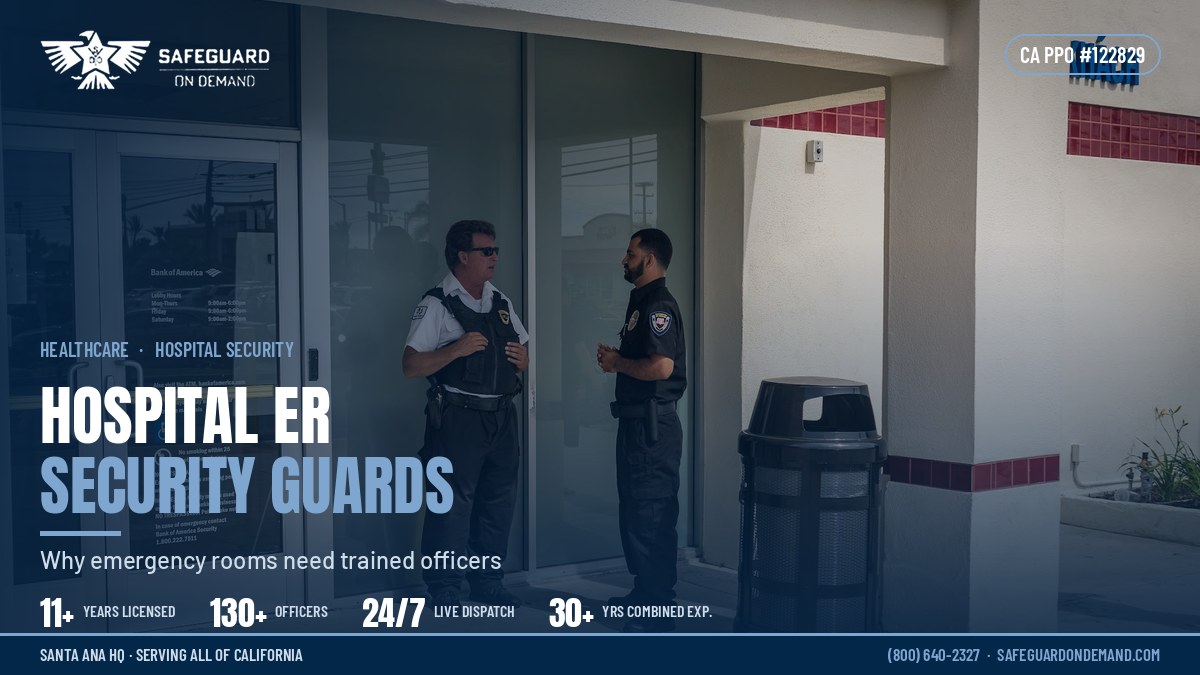
The emergency department is the one part of a hospital that never closes and never chooses who walks in. Patients arrive in pain, intoxicated, in mental health crisis, or straight from a violent scene, often with frightened or angry family members behind them. Nurses and physicians have to make fast decisions in that environment, and they cannot do it well if they are also worried about their own safety.
That is why hospital security guards in emergency rooms are not an optional extra. This article explains why ER security matters, what officers actually do on shift, which other hospital areas need protection, how California law addresses hospital violence, when armed coverage is appropriate, and what to expect from a professional healthcare security provider.
Key Takeaways
- ✓Healthcare workers face a far higher risk of workplace violence injuries than workers overall, and the ER is where much of that risk concentrates.
- ✓Trained ER officers control access, de-escalate conflict, support clinical staff during codes, and document every incident.
- ✓California hospitals must follow Cal/OSHA’s Title 8 section 3342, which calls for security personnel who can respond to workplace violence in a timely manner.
- ✓Health and Safety Code section 1257.7 requires hospitals to assess security at least annually and maintain a security plan with sufficient trained personnel.
- ✓Many hospitals use a layered model, with unarmed officers in public areas and armed coverage only where the risk assessment supports it.
Why Is Emergency Room Security So Important?
Healthcare carries one of the highest workplace violence burdens of any industry. According to the U.S. Bureau of Labor Statistics, healthcare workers accounted for 73 percent of all nonfatal workplace injuries and illnesses due to violence in 2018, and their rate of such injuries was 10.4 per 10,000 full-time workers, compared with 2.1 across all private industry. That makes healthcare workers about five times as likely to suffer a workplace violence injury.
The ER concentrates the factors behind those numbers: long waits, pain, substance use, psychiatric emergencies, and patients brought in by police or after assaults. Security officers in the department exist to keep a tense situation from becoming a violent one, and to respond immediately if it does.
De-escalation before violence
Officers recognize agitation early and use calm, practiced communication to defuse it before staff are hurt.
Access and crowd control
Officers manage the entrance, waiting room, and treatment areas so only authorized people reach patients and staff.
Protection for clinicians
A visible officer lets nurses and physicians focus on care instead of watching the door.
Rapid emergency response
Officers respond first to combative patients, weapons, elopement attempts, and lockdowns, and coordinate with police.
Hospital Security Guard Duties in the Emergency Room
ER security is a skilled role that blends customer service, observation, and crisis response. A typical shift includes:
- Entrance screening: monitoring the ambulance bay and walk-in entrance, and conducting weapons screening where hospital policy requires it.
- Visitor management: verifying visitors, enforcing visitor limits, and issuing badges.
- Patrolling the department: walking the waiting room, triage, hallways, and treatment areas on a regular schedule.
- Responding to codes: many hospitals use color or plain-language codes, such as Code Gray for a combative person and Code Silver for a person with a weapon; the exact codes vary by facility.
- Patient safety support: standing by for patients on psychiatric holds or at risk of elopement, as directed by clinical staff and hospital policy.
- Documentation: writing clear incident reports that feed the hospital’s violent incident log and investigations.
Officers also handle routine but important tasks, such as escorting staff to the parking structure at shift change and keeping the waiting room orderly during surges.
Hospital Security Coverage Options
| Coverage | Typical use | Key strengths |
|---|---|---|
| Unarmed ER officer | Waiting room, triage, and treatment areas | De-escalation, access control, patient standby, reporting |
| Armed officer | High-risk campuses or specific posts identified by assessment | Response to weapons threats and visible deterrence |
| Lobby and visitor officer | Main entrances and reception | Visitor screening, badging, wayfinding |
| Mobile patrol | Parking structures, perimeter, outbuildings | Randomized, GPS-verified checks and escorts |
| Remote video monitoring | Cameras covering lots and entrances | Live observation and dispatch after hours |
Security-Sensitive Areas in a Hospital Beyond the ER
The emergency department is usually the most unpredictable area, but a hospital security plan has to cover the entire campus. Officers are commonly posted or patrol in these zones:
Behavioral health units
Patients in crisis may become aggressive, so officers support staff during escalations and transfers.
Labor, delivery, and nursery
Access control and alarm response help prevent infant abduction and family disputes.
Pharmacy and storage
Controlled substances and high-value supplies need restricted access and regular checks.
ICU and trauma units
Grieving or angry families and patients connected to violent events can create volatile situations.
Lobbies and entrances
Reception and lobby security controls who enters the building and sets a professional tone.
Parking structures
Parking lot and garage security protects staff and visitors walking to their cars, especially at night.
What California Law Requires of Hospitals
California has some of the most specific hospital violence rules in the country. Two are especially relevant to ER security.
Cal/OSHA Title 8, section 3342 (Violence Prevention in Health Care) requires covered health facilities, including general acute care and acute psychiatric hospitals, to maintain an effective workplace violence prevention plan that is in effect at all times. The plan must address hazard identification and correction, and the regulation calls for sufficient staffing, including security personnel, who can maintain order and respond to workplace violence incidents in a timely manner. Hospitals must keep a violent incident log, provide initial and annual refresher training, and report incidents involving physical force or weapons to Cal/OSHA within 24 hours when there is injury or an urgent threat, and within 72 hours otherwise.
Health and Safety Code section 1257.7 requires hospitals to conduct a security and safety assessment at least annually, develop and update a security plan to protect personnel, patients, and visitors from aggressive or violent behavior, and have sufficient personnel to provide security under that plan. Personnel regularly assigned to hospital security must be trained on the role of security in hospital operations.
A qualified contract security provider helps hospitals meet these obligations with trained officers, consistent incident reports, and staffing that matches the plan. This summary is general information, not legal advice.
In an emergency department, the best security outcome is the incident that never happens. Our officers are trained to read the waiting room, step in early, and let the clinical team keep working.
— David Nawabi
President & CEO, Safeguard On Demand
Armed vs. Unarmed Hospital Security Officers
Most hospital security work is done by unarmed security officers trained in de-escalation and patient-centered response. In a clinical setting, a calm officer who can talk a patient down is usually more valuable than a weapon.
Some facilities add armed security officers where a documented risk assessment supports it, such as campuses with prior weapons incidents, high-crime surroundings, or frequent forensic patients. In California, armed officers must hold a BSIS firearms permit, which requires passing a firearms assessment and requalifying on the range twice every 12 months. A layered model is common: unarmed officers in public and clinical areas, with armed coverage limited to specific posts or hours. You can find more healthcare security guidance on the Safeguard On Demand security blog.
Benefits of Partnering With a Professional Hospital Security Company
Running an in-house hospital security department is demanding, and the same is true for outpatient clinics, pharmaceutical facilities, and medical office buildings. Outsourcing some or all of it to a licensed provider gives administrators flexibility and a single accountable partner.
- Trained, licensed officers: every Safeguard On Demand officer is BSIS-licensed and receives site-specific instruction through our security guard training program.
- Scalable staffing: add officers for surges, construction, or a new clinic without a recruiting cycle.
- Supervision and dispatch: 24/7 live dispatch and supervisors who check on posts around the clock.
- Reliable documentation: daily activity reports and incident reports that support Cal/OSHA logging.
- Technology support: remote video monitoring and mobile patrol for parking areas, perimeters, and outbuildings.
- Experienced leadership: our management team brings 30+ years of combined law enforcement and private security experience.
Frequently Asked Questions
Why do emergency rooms need security guards?
ERs serve anyone who walks in, at any hour, often during the worst moment of their lives. Officers prevent violence, control access, and support staff during combative incidents. Learn about our hospital security services.
What does a hospital security guard do in the ER?
Officers monitor entrances, manage visitors, patrol the department, respond to codes, stand by with at-risk patients as directed by staff, and write incident reports. See our security guard services.
Are California hospitals required to have security personnel?
Cal/OSHA’s Title 8 section 3342 calls for sufficient staffing, including security personnel, to respond to workplace violence, and Health and Safety Code section 1257.7 requires sufficient personnel to carry out the hospital’s security plan. Our security consulting team can review your plan.
Should hospital security guards be armed?
It depends on the facility’s risk assessment. Many hospitals use unarmed officers in clinical areas and armed officers only at specific posts. Compare options with our armed security guard services.
How quickly can Safeguard On Demand staff a hospital post?
Posts are typically staffed within 24 to 48 hours after a free site assessment and agreement on post orders. Contact our team to start.
Hospital security guards in emergency rooms protect the people who protect everyone else. With trained, BSIS-licensed officers, 24/7 dispatch, and reporting that supports California’s hospital violence rules, Safeguard On Demand helps healthcare facilities keep their ERs safe and functioning. Call (800) 640-2327 or request a free quote and site assessment for your hospital or clinic.
Get a free security assessment
Licensed armed and unarmed officers, patrols and fire watch across California. Call (800) 640-2327 or request a quote online.