
Quick answer: For most California HOAs, an HOA security patrol (a marked vehicle making several unannounced visits a night) is the right starting point: it covers the whole community, deters the vehicle break-ins and package theft that make up most HOA incidents, and costs a fraction of a posted officer. Onsite guards earn their cost when the community has a staffed gate, a history of serious incidents, a clubhouse or amenity that needs enforcement during set hours, or a board that has been put on notice of a specific risk. Many communities land on a hybrid: a gate or evening officer plus overnight patrol, with live camera monitoring covering the hours in between.
Key takeaways
- Patrol buys coverage and deterrence across a large area at low cost per door. Onsite buys presence, response time and enforcement at one place.
- The decision turns on four things: what incidents the community actually has, whether there is a gate, what the amenities require, and the board’s duty of care once a risk is known.
- California HOA boards have a duty to keep common areas reasonably safe and are protected by the Business Judgment Rule only when they make informed, documented decisions.
- A security program the board cannot see is a program the board cannot defend. Insist on GPS-verified visits, timestamped reports and a single account manager.
- Orange County’s planned communities, gated enclaves and coastal HOAs each tilt the answer differently; the county’s recent run of organized residential burglaries has changed the math for high-value hillside and gated communities.
What HOA boards are actually buying
Boards tend to frame this as “patrol or guards,” but what they are buying is a mix of three things: deterrence (would-be offenders see a presence and move on), response (how quickly someone trained arrives when a resident calls), and enforcement (parking, pool hours, gate access, noise). Patrol and onsite officers deliver those three things in different proportions, and the right choice is the one that matches the community’s problems, not the one that sounds most reassuring at a board meeting.
HOA security patrol: how it works
A patrol service assigns a marked, GPS-tracked vehicle to a route of several communities. The officer visits yours a set number of times per shift, typically three to six times a night, at randomized times so the pattern cannot be learned. Each visit follows a checklist the board agrees to in advance: drive every street, check the pool and clubhouse, walk the mail and package areas, confirm gates and amenity doors are secured, note parking violations, and log anything out of the ordinary. The officer is also on call between visits, so a resident report of suspicious activity gets a response within minutes rather than a next-day email.
What patrol does well: it covers a lot of ground, it is visible in exactly the hours most HOA incidents happen (10 PM to 5 AM), and because the cost is shared across a route, it is affordable for communities of 50 doors as well as 500. What it does not do: it is not present every minute, so it cannot staff a gate, check in guests, or enforce a pool rule at 2 PM on a Saturday.
Onsite HOA guards: how they work
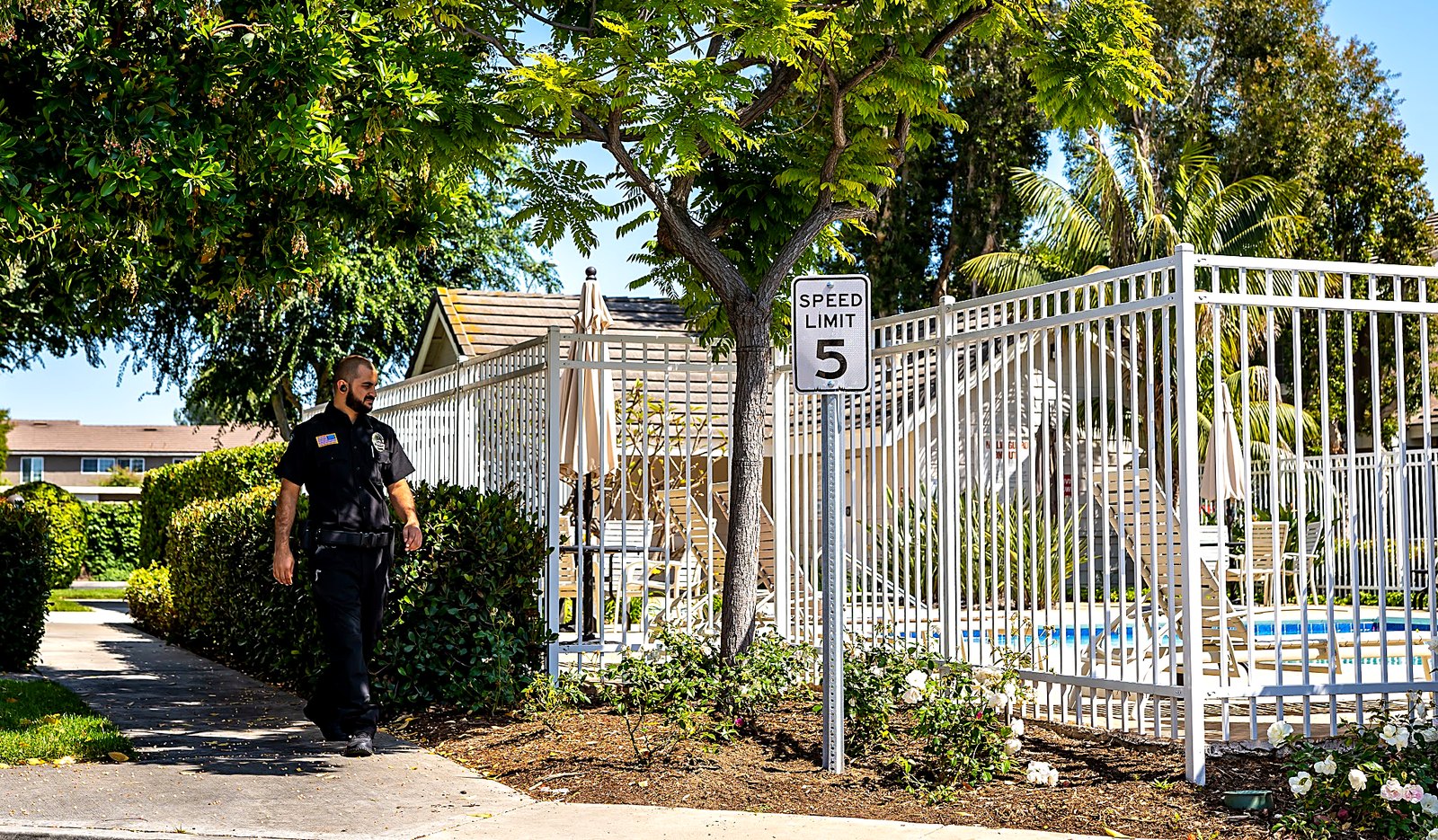
An onsite officer is posted at the community for a fixed shift. The most common HOA posts are a gate officer controlling vehicle entry, a standing officer at a clubhouse, pool or amenity center during open hours, and an evening foot patrol inside a townhome or condominium community where streets are too tight for a vehicle. The officer knows the residents, the vendors and the regulars, and that familiarity is most of what makes a gate work.
What onsite does well: immediate response, access control, consistent enforcement, and a human presence residents can see and talk to. What it costs: a dedicated officer for every hour of coverage, which is why most HOAs that use onsite guards do so for defined windows rather than around the clock.
Side by side
| Factor | Patrol | Onsite guard |
|---|---|---|
| Coverage | Whole community, several visits a night | One post, continuous during the shift |
| Response time | Minutes (officer on route) | Immediate |
| Deterrence | High for overnight property crime; marked car is visible and unpredictable | High at the post; limited beyond line of sight |
| Access control | None | Full: gate, guest log, vendor check-in |
| Rule enforcement | Parking and after-hours amenity checks on each visit | Continuous during open hours |
| Best for | Open or remote-gated communities, package and vehicle theft, vandalism, after-hours pool use | Staffed gates, high-value or high-incident communities, amenity centers, special events |
| Typical cost basis | Per visit or per month for a set visit count | Per officer-hour |
| Reporting | GPS-verified visit log, photo reports | Shift reports, gate logs, incident reports |
How to decide: four questions for the board
1. What is actually happening here?
Pull twelve months of incident data before you shop: resident complaints, police calls, management reports. In most California HOAs the list is dominated by vehicle break-ins, package theft, after-hours pool use, parking disputes and the occasional vandalism. That profile points to patrol. If the list includes burglaries of occupied homes, assaults, repeated trespass by the same people, or threats against staff, the board is on notice and the answer shifts toward onsite coverage.
2. Is there a gate, and who is it for?
A transponder gate with a call box does not need a guard. A gate that is supposed to screen guests, vendors and deliveries does, at least during the hours that screening matters. Many Orange County communities run a staffed gate from early morning to late evening and switch to transponder-only plus patrol overnight, which captures most of the value at roughly half the cost of 24-hour staffing.
3. What do the amenities require?
Pools, spas, gyms and clubhouses create two problems: rule enforcement during open hours and unauthorized use after close. The first is an onsite job on busy days (weekends, summer). The second is a patrol job every night. Boards often over-buy here by staffing a pool full time when a weekend officer plus nightly lock-up checks would solve the actual complaints.
4. What does the board’s duty of care require now?
California HOA boards have a duty to maintain common areas in a reasonably safe condition, and California courts have long held that an association can be liable for failing to take reasonable security measures once it knows of a risk. The board’s protection is the Business Judgment Rule (Corporations Code § 7231), which shields directors who act in good faith, with reasonable inquiry, and in the association’s interest. In practice that means: look at the incident data, get proposals, make a documented decision in the minutes, and revisit it when conditions change. A board that received repeated burglary reports and did nothing has a problem; a board that reviewed the reports, chose patrol with a defined escalation plan and minuted why is doing its job. The Davis-Stirling Act governs the rest of the association’s obligations, including how security costs are budgeted and disclosed.
The hybrid most communities end up with
Few HOAs are purely one or the other. The patterns we see most across California:
- Open community, 100 to 400 doors: nightly vehicle patrol with four to six visits, pool and clubhouse lock-up checks, weekend amenity officer in summer.
- Gated community with guest traffic: staffed gate 6 AM to 10 PM, transponder-only overnight, nightly patrol inside the gates.
- High-value or hillside community after a burglary series: onsite roving officer overnight for a defined period, patrol on the perimeter and greenbelt edges, live camera monitoring on entry points, then step down to patrol once the pattern breaks.
- Condominium or townhome community with tight streets: evening foot patrol officer plus overnight drive-by, lock-up of garages and amenity doors.
Live camera monitoring deserves a specific mention. For communities with cameras at entries, pools or package rooms, a monitored feed with a live operator who can issue a voice warning and dispatch patrol covers the gaps between patrol visits without adding officer hours. It does not replace a gate officer, but it often replaces the case for an overnight post.
“When a board tells me they want a guard at the gate 24 hours, I ask what happens at the gate at 3 AM. Usually nothing. So we staff the gate when guests and vendors are coming through, run patrol inside the community overnight, and put the savings toward the camera monitoring that actually catches the 3 AM problem. The board gets more coverage, not less, and the community manager gets one report instead of three.”
David Nawabi, President & CEO, Safeguard On Demand
What drives the cost
- Patrol: number of visits per night, length of each visit (a 400-door community with three amenity areas takes longer than a 60-door cul-de-sac), and whether the route is shared or dedicated. More visits and longer checklists cost more; a dedicated route costs the most.
- Onsite: hours per week, armed vs. unarmed (HOA posts are almost always unarmed), and whether the post needs a vehicle. A 16-hour gate is roughly four times the cost of a nightly patrol for the same community.
- Both: reporting and supervision standards, response guarantees, and contract term. Safeguard provides HOA proposals at a fixed monthly rate so the board can budget, with no long-term contract.
For the factors behind guard pricing generally, see what affects the cost of security guards in California.
Mistakes HOA boards make
- Buying presence instead of coverage. A single daytime gate officer looks like security and does nothing about the overnight break-ins residents are complaining about.
- No written post orders. “Keep an eye on things” is not a scope of work. The board should approve the exact checklist, the parking policy, and when the officer calls police versus management.
- No way to verify the service. If the vendor cannot show GPS-timestamped visit logs, the board cannot tell whether it is paying for four visits or one.
- Ignoring the perimeter. Greenbelts, trails and hillside edges are where burglary crews enter gated communities. Patrol routes and cameras should cover them, not just the front gate.
- Letting the program go stale. Incident patterns change. The security scope should be on the agenda once a year and after any serious incident.
- Multiple points of contact. Community managers need one account manager who knows the property, attends board meetings on request and owns the reports.
Orange County focus
Orange County is HOA country. Master-planned communities in Irvine, Mission Viejo, Lake Forest, Rancho Santa Margarita and Aliso Viejo sit alongside gated enclaves in Newport Beach, Laguna Niguel, Yorba Linda and Tustin, coastal associations in Dana Point, San Clemente and Huntington Beach, and older condominium communities across Santa Ana, Anaheim, Costa Mesa and Garden Grove. Each type tilts the patrol-versus-onsite answer.
Two local realities shape board decisions right now. First, Orange County communities have been targets of organized residential burglary crews. Irvine Police publicly described a series of break-ins at gated hillside communities in late 2024, with crews entering from greenbelt edges, targeting unoccupied homes and in some cases disabling Wi-Fi and placing hidden cameras; police characterized it as a statewide pattern aimed at high-value communities. For boards in those neighborhoods, that is exactly the kind of known risk that moves a community from patrol-only to a period of onsite overnight coverage plus perimeter cameras. Second, the county’s large master-planned associations already run staffed gates and amenity centers, and their managers are typically looking to tighten scope and cost rather than add posts, which is where the hybrid model and live monitoring fit.
Safeguard On Demand serves Orange County HOAs from our Santa Ana headquarters at 200 N Tustin Ave, Suite 210, with patrol routes running nightly across the county and officers available for gate, amenity and roving posts. Community managers get a single account manager, fixed-rate proposals, GPS-verified reporting and board meeting attendance on request. Our HOA security page covers the full service set, and property managers in Los Angeles can see the apartment and HOA security checklist we built for LA communities.
HOA security scope checklist
- ☐ Twelve months of incident data reviewed and summarized for the board
- ☐ Gate hours and screening needs defined (if gated)
- ☐ Amenity open hours and after-hours lock-up list defined
- ☐ Perimeter and greenbelt access points mapped
- ☐ Patrol visit count, timing window and per-visit checklist agreed
- ☐ Onsite post hours, duties and parking policy written
- ☐ Escalation rules: when the officer calls police, management, the board
- ☐ Reporting: GPS-verified visit logs, photo reports, monthly summary to the board
- ☐ Single account manager named; board meeting attendance available
- ☐ Fixed monthly rate and contract term confirmed
- ☐ Decision and reasoning recorded in the minutes
- ☐ Annual review date set
Frequently asked questions
Is HOA security patrol or an onsite guard better?
Patrol is better for broad overnight coverage of property crime across a whole community at low cost. An onsite guard is better when the community needs access control at a gate, enforcement at an amenity during set hours, or an immediate response because of a known risk. Most California HOAs use a hybrid: a staffed gate or amenity officer during busy hours and vehicle patrol overnight.
How many patrol visits a night does an HOA need?
Three to six randomized visits a night is typical. Communities with several amenity areas, a history of after-hours pool use or recent vehicle break-ins sit at the higher end. The visit count and the checklist for each visit should be written into the agreement so the board can verify them against GPS logs.
Can an HOA be held liable for inadequate security in California?
Yes. California HOAs have a duty to keep common areas reasonably safe, and an association that knows of a security risk and fails to take reasonable measures can be liable for resulting harm. Boards are protected by the Business Judgment Rule when they make informed, good-faith decisions, so the key is to review incident data, get proposals, decide, and document the decision in the minutes.
Do HOA security guards need to be armed?
Almost never. HOA posts are unarmed as a rule. Armed officers are reserved for communities with a documented history of violent incidents or specific threats, and the decision should be made with counsel and the association’s insurer.
What should an HOA security contract include?
A written scope: visit count or post hours, the checklist or post orders, parking and amenity enforcement policy, escalation rules, reporting standards (GPS-verified logs and photo reports), a named account manager, insurance certificates naming the association, the rate, and the term. Safeguard provides HOA agreements at a fixed monthly rate with no long-term contract.
Can live camera monitoring replace HOA security guards?
It can replace some overnight posts, not a gate officer. A monitored camera system with a live operator covers entries, pools and package areas between patrol visits, issues voice warnings and dispatches patrol. It works best alongside nightly patrol rather than instead of all human presence.
Get a security plan your board can approve
Safeguard On Demand builds HOA security programs around your community’s actual incidents: patrol, gate and amenity officers, live camera monitoring, or the right mix. Fixed monthly rate, GPS-verified reporting, one account manager, board meeting attendance on request, and no long-term contract.
Call (800) 640-2327 or request a free quote online. Serving Orange County and all of California.