Retail & Shopping Centers
Uniformed officers, lot patrols and incident documentation that deter repeat theft, protect your staff and help turn incidents into cases — for stores, shopping centers and retail corridors.
Uniformed presence at entrances.
Detailed reports with photos and times.
Your employees should not confront thieves.
Vehicle crime and loitering deterred.
Quick answer
Retail security in California focuses on deterrence, staff safety and documentation. Uniformed officers at entrances and on the floor deter theft, lot patrols reduce vehicle crime and loitering, and detailed incident reports help police and prosecutors. California’s organized retail theft law (Penal Code §490.4), Proposition 36 and 2025’s AB 2943 let thefts be combined toward felony thresholds — which makes consistent, accurate reports more valuable than ever.
The challenge
Retailers face repeat offenders, coordinated thefts and staff safety concerns all at once.
The same people return again and again, and group “flash” thefts hit in seconds.
Employees should never be put in danger trying to stop a theft.
Without solid reports and evidence, incidents rarely become prosecutions.
Coverage options
From one storefront to a regional center.
Our standards
Deterrence and documentation.
When to observe, when to step in, when to call police.
Details prosecutors and insurers need.
Professional presence that does not scare shoppers.
Guard Card and background check.
For store and center managers
Here is how we answer.
| Ask the vendor | Safeguard On Demand |
|---|---|
| Will your officers chase or tackle shoplifters? | No. Officers follow written intervention rules focused on safety, deterrence and documentation. |
| Do your reports help prosecutions? | Yes — times, descriptions, photos and witness details in every incident report. |
| Can you cover the parking lot too? | Yes, with lot patrols or a dedicated officer. |
| Do you offer armed officers? | Yes, for high-value or cash-heavy locations. |
| Can you cover holiday peaks? | Yes — add officers for peak seasons. |
| Is there a long-term contract? | No long-term contract. |
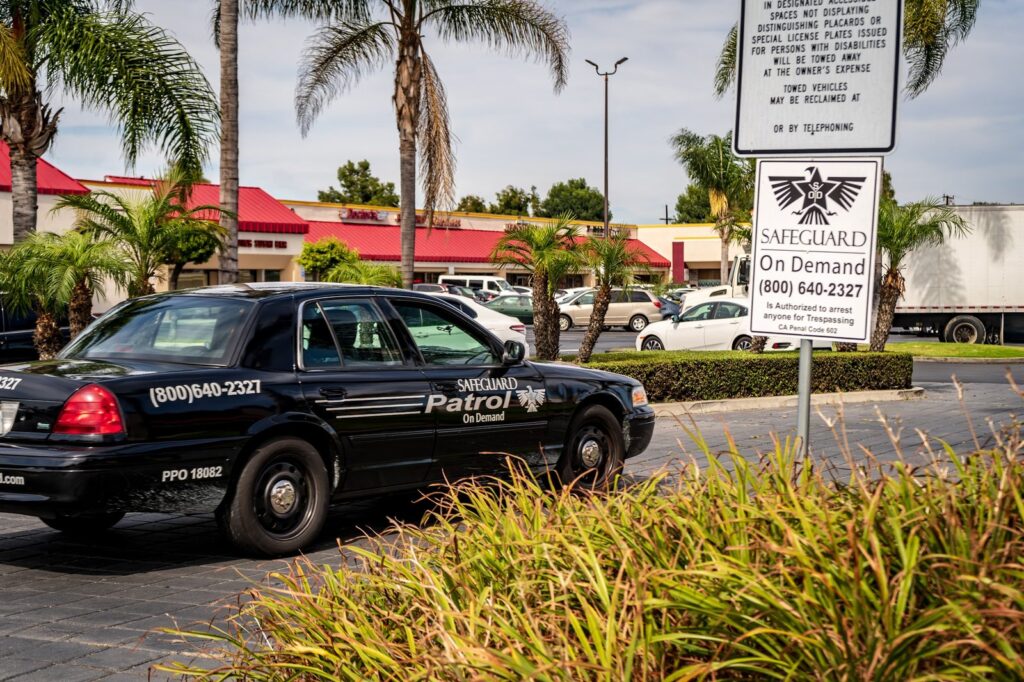
Retailers we protect
Storefronts to regional centers.
Statewide
Served from the office nearest your site, with officers across 13 California counties.
How it works
Fast to start, built around your store.
01
Entrances, high-theft areas, lot and incident history.
02
Written rules for observing, stepping in and calling police.
03
Officers oriented on your store and staff.
04
Incident reports and trend reviews.
Choosing coverage
A uniformed officer at the entrance is the most effective deterrent for most stores. Higher-value merchandise or cash handling may justify an armed security guard. Shopping centers often combine officers in the common areas with lot patrols and remote video monitoring after closing.
Whatever the mix, the plan should protect employees first: staff should report, not confront. See our parking lot safety tips.
California law
Organized retail theft — stealing with others to resell or return goods, or recruiting and directing thieves — can be charged as a felony, including when thefts occur on two or more occasions within 12 months totaling more than $950 (Penal Code §490.4).
Proposition 36 (December 2024) allows theft to be charged as a felony for people with two or more prior theft convictions, and allows the value of multiple thefts to be combined toward the $950 threshold. AB 2943 (2025) also allows aggregation across victims and counties and lets officers arrest for shoplifting they did not witness when they have probable cause.
Retail employers are covered by SB 553 (Labor Code 6401.9), which requires a written workplace violence plan explaining how employees get help from security and law enforcement. Every officer must hold a BSIS Guard Card and work for a licensed private patrol operator — 8 hours of Power to Arrest and Appropriate Use of Force training before registration, 32 more hours within six months, and 8 hours of continuing training every year.
Budgeting
Priced to your store.
Open hours, peak hours or 24/7.
Entrances and floor size.
High-value merchandise.
Patrols or a dedicated officer.
Holiday staffing.
Multi-location programs.
Our officers deter theft and follow written intervention rules focused on safety. They document incidents and call police rather than chase or tackle.
Stealing with others to resell or return goods, or directing thieves; it can be a felony under Penal Code §490.4.
Yes. It allows felony charges for repeat offenders and combining thefts toward the $950 threshold.
Yes, with patrols or a dedicated lot officer.
Most posts within 24–48 hours.
Across 13 California counties from offices in Santa Ana, Los Angeles (Northridge), San Diego, the Inland Empire, Sacramento and Silicon Valley.