

Updated October 2026 · 8 min read · Reviewed by Safeguard On Demand
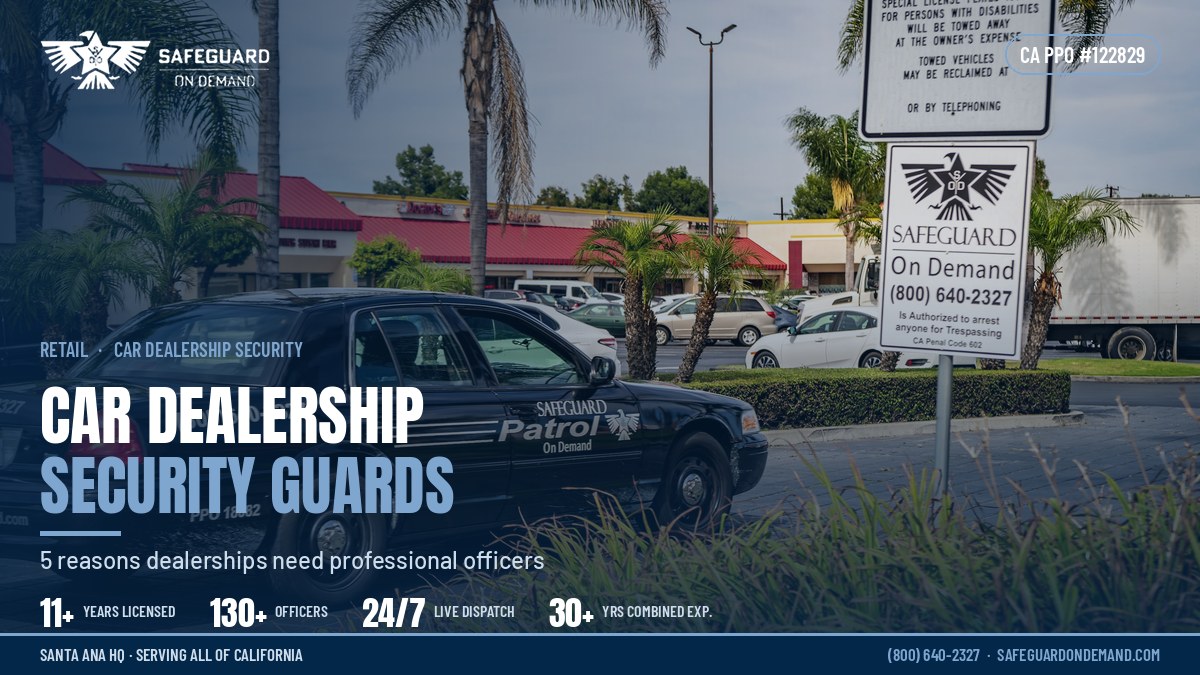
A car dealership keeps millions of dollars of inventory outdoors, often behind nothing more than a low fence and a row of cameras. Add a service department full of customer vehicles, a parts room, catalytic converters, wheels and tires, and a key cabinet that can unlock the entire lot, and it is easy to see why dealerships are attractive targets.
California dealers face that risk at scale. The National Insurance Crime Bureau reported that California recorded 136,988 stolen vehicles in 2025, more than any other state and over 20 percent of the national total, even as U.S. thefts fell 23 percent from 2024. Below are five reasons car dealerships need professional security guards, and how to combine officers with technology into a plan that actually stops losses.
Key Takeaways
- ✓Cameras and alarms record crimes, but a trained officer can interrupt one while it is happening.
- ✓Visible, uniformed security is a strong deterrent to lot thieves, vandals, and parts strippers.
- ✓Strict key and access control protects against both outside theft and internal losses.
- ✓Live remote monitoring paired with on-site or mobile officers gives dealerships 24/7 layered protection.
- ✓After-hours patrols close the window when lots are empty and thieves expect no one to respond.
Dealership Security Is More Than Cameras and Locks
Most dealerships already have cameras, alarms, and gates. Those tools are valuable, but they are passive. A camera records a thief cutting a catalytic converter; it does not stop the cut. An alarm alerts a monitoring center that may call the police, but the response gap between detection and arrival is exactly the window professional thieves count on.
Professional security guards turn passive tools into active protection. An officer can see a suspicious vehicle circling the lot, challenge a trespasser, lock down a gate, and call police with specific, real-time information. The five reasons below explain where officers add the most value.
1. Criminals Fear Presence, Not Cameras
Thieves look for easy targets. A lot with a uniformed officer, a marked patrol vehicle, and active lighting signals that someone is watching and will respond. Many would-be thieves move on before they ever step onto the property.
Officers also deter daytime problems: test-drive scams, customers who become aggressive over financing or repairs, and loitering near the service drive. Because California’s SB 553 (Labor Code section 6401.9) has required most employers to maintain a written workplace violence prevention plan since July 1, 2024, many dealers also count on unarmed security officers to support staff when a confrontation on the sales floor escalates.
Dealership Security Options at a Glance
| Option | What it covers | Best for |
|---|---|---|
| Standing guard | Continuous on-site presence, access control, and key area oversight | Large lots, high-value inventory, or prior incidents |
| Mobile patrol | Randomized, GPS-verified checks and gate lockups | Smaller lots or dealer groups with several locations |
| Remote video monitoring | Live camera watch with audio warnings and dispatch | Lots with good camera coverage and after-hours exposure |
| Armed officer | Response to armed threats and visible deterrence | Sites with a history of armed robbery or violent incidents |
2. Controlled Access Prevents Internal and External Threats
The key cabinet is the most valuable object on many lots. If someone gains access to keys or fobs, multiple vehicles can disappear in a single night. Officers enforce access control around the places that matter most:
Key and fob control
Officers verify who enters key storage areas, log access, and report anything out of procedure.
Service and parts areas
Restricted entry to the service bay and parts room helps prevent theft of parts, tools, and customer property.
Gate and lot access
Officers manage after-hours entry for transport trucks, vendors, and staff, and confirm every gate is secured.
Visitor and vendor check-in
Logging visitors and contractors creates a record that helps investigators if something goes missing.
3. Loss Prevention Protects Your Margins
Dealership losses are rarely just stolen cars. They include catalytic converters, wheels and tires, batteries, diagnostic equipment, fuel, and damage from vandalism or break-ins. Small losses that go unnoticed add up over a year and can raise insurance costs.
Officers protect margins by patrolling the inventory lot and service areas, documenting damage and suspicious activity in daily activity reports, and providing evidence that supports insurance claims and police investigations. A security partner with equipment and materials protection experience understands how parts thieves operate, and a professional security assessment can identify gaps in lighting, fencing, and procedures.
Officers also help with the quieter side of loss prevention. They notice when a vehicle is moved without paperwork, when a side gate is repeatedly left unlocked, or when the same unfamiliar car keeps parking near the back fence, and they report it so management can act before a pattern becomes a loss.
Dealers do not lose money because they lack cameras. They lose it in the minutes between an alarm and a response. Our job is to close that gap with officers and monitoring that act in real time.
— David Nawabi
President & CEO, Safeguard On Demand
4. Remote Video Monitoring Provides 24/7 Protection
The strongest dealership security programs layer people and technology. With remote video monitoring, live operators watch your cameras in real time, issue audio warnings through on-site speakers, and dispatch officers or police the moment someone enters the lot after hours.
Live operators, not just recordings
Trained staff watch the feeds and act during an intrusion instead of reviewing footage the next morning.
Audio talk-down
Many intruders leave as soon as a live voice tells them they are being watched and police are on the way.
Verified dispatch
Operators can confirm a real event, which helps police prioritize the call.
Coordinated patrol response
A mobile officer can be sent to check the lot, secure a gate, or meet police on scene.
5. After-Hours Security Prevents Late-Night Thefts
Dealerships are most exposed after closing, when the showroom is dark, staff have gone home, and vehicles sit in long rows. That is when organized thieves, converter cutters, and vandals expect the least resistance.
Overnight coverage can take several forms. A standing guard can stay on site all night, a foot patrol officer can walk the inventory rows, or mobile patrol can make randomized, GPS-verified checks across several rooftops in the same dealer group. Officers check gates and doors, confirm lighting works, and report anything unusual. For dealerships with prior armed incidents, armed security guards may be appropriate at specific hours.
Building a Proactive Dealership Security Plan
Effective dealership security is proactive, not reactive. A good plan starts with a free site assessment that maps entrances, lighting, fencing, camera coverage, key procedures, and past incidents. From there, a provider recommends the right mix of officers, patrol, and monitoring for each hour of the day.
Write the plan into clear post orders so every officer handles the lot the same way. At a minimum, they should cover:
- Opening and closing procedures, including gate lockups and a walk of every inventory row.
- Who may enter key storage, the service bay, and the parts room after hours, and how that access is logged.
- How to handle transport deliveries, early service drop-offs, and vendors who arrive outside business hours.
- Escalation steps for suspicious vehicles, trespassers, and alarms, with names and numbers for managers and police.
- What goes into the daily activity report and when incident reports reach the general manager.
Review the plan after any incident and at least once a year, because thieves adapt and so should your coverage.
Safeguard On Demand supports dealerships with BSIS-licensed officers, 24/7 live dispatch, GPS-verified patrols, and daily activity reports. Our leadership team brings 30+ years of combined law enforcement and private security experience, and we serve dealers from offices in Santa Ana, Northridge, San Diego, Mountain View, Sacramento, and Corona. Explore our parking lot security and retail security experience to see how we protect high-value outdoor inventory.
Frequently Asked Questions
Why do car dealerships need security guards?
Dealerships hold high-value inventory outdoors, along with keys, parts, and customer vehicles. Officers deter theft, control access, and respond in real time. Learn about our security guard services.
Is remote monitoring enough for a dealership?
It works well for many lots, especially when paired with a mobile patrol that can respond on site. See how our patrol services complement monitoring.
Should dealership security guards be armed?
Most dealerships use unarmed officers. Armed coverage is worth considering where there has been armed robbery or violent activity. Compare options with our armed security guards.
How much does dealership security cost?
Cost depends on armed or unarmed coverage, hours, lot size, and whether monitoring is included. Request a free quote after a no-cost site assessment.
Do you provide dealership security across California?
Yes. Safeguard On Demand serves dealers throughout the state; see our service areas for coverage.
Car dealerships need professional security guards because inventory, keys, and parts are too valuable to protect with recordings alone. With licensed officers, live monitoring, and after-hours patrols, Safeguard On Demand helps dealers stop losses before they happen, with no long-term contract required. Call (800) 640-2327 or request a free quote and site assessment.
Get a free security assessment
Licensed armed and unarmed officers, patrols and fire watch across California. Call (800) 640-2327 or request a quote online.