

California businesses covered by SB 553 must have a written Workplace Violence Prevention Plan.
Employers must also provide required training. They must identify and correct workplace violence hazards. They must have clear reporting and response procedures. They must investigate incidents and keep required records.
SB 553 became enforceable on July 1, 2024. The law created California Labor Code Section 6401.9 and added new workplace violence prevention requirements for covered employers.
Cal/OSHA is also developing a permanent workplace violence prevention standard for general industry. The Occupational Safety and Health Standards Board must adopt the new standard by December 31, 2026.
This guide explains the main SB 553 requirements for California businesses in 2026. It covers the WVPP, workplace violence types, training, records, penalties, compliance steps, and the role of security services.
Important: This article provides general information. It is not legal advice. Employers should review their specific situation with a qualified workplace safety or legal professional.
SB 553 Key Takeaways
California employers should understand these key requirements:
- Written WVPP: Covered employers must establish, implement, and maintain an effective written Workplace Violence Prevention Plan.
- Site specific plan: The WVPP must address the hazards and corrective measures for each work area and operation.
- Employee involvement: Employees must have a role in the workplace violence prevention process.
- Training: Covered employees must receive effective workplace violence prevention training.
- Incident log: Employers must maintain a Violent Incident Log for workplace violence incidents.
- Recordkeeping: Employers must maintain required workplace violence records.
- Reporting: Employers must provide procedures for reporting workplace violence hazards and incidents.
- Plan access: The WVPP must be available and accessible to employees and other authorized parties.
- Cal/OSHA enforcement: Cal/OSHA can enforce applicable SB 553 requirements.
- 2026 standard: California must adopt a permanent general industry workplace violence prevention standard by December 31, 2026.
What Is California SB 553?
California SB 553 is a workplace safety law.
The law was signed on September 30, 2023. It amended California Labor Code Section 6401.7 and created Section 6401.9.
The law requires covered employers to establish and maintain a written Workplace Violence Prevention Plan.
The plan must address workplace violence hazards. It must also explain how the employer will prevent, report, respond to, and investigate workplace violence.
The requirements became enforceable on July 1, 2024.
What Is the Purpose of SB 553?
SB 553 gives employers a framework for preventing workplace violence.
The requirements focus on:
- Identifying workplace violence hazards
- Correcting identified hazards
- Reporting workplace violence concerns
- Training employees
- Responding to incidents
- Investigating incidents
- Keeping required records
- Reviewing and updating the workplace violence prevention plan
SB 553 is not simply a requirement to create a document. The WVPP must be effective and specific to the workplace.
What Is a Workplace Violence Prevention Plan?
A Workplace Violence Prevention Plan is commonly called a WVPP.
It is a written plan that explains how an employer will prevent and respond to workplace violence.
Covered employers must establish, implement, and maintain an effective written WVPP.
The plan must be specific to the hazards and corrective measures for each work area and operation. It must remain in effect at all times.
A company can include its WVPP as a separate section of its Injury and Illness Prevention Program. It can also maintain the WVPP as a separate document.
Who Must Comply With SB 553?
SB 553 applies broadly to California employers, employees, places of employment, and employer provided housing.
However, the law includes specific exceptions.
Employers should review California Labor Code Section 6401.9 before deciding whether their workplace is covered.
The rules can also differ for workplaces covered by other workplace violence requirements.
For example, certain health care locations are subject to separate Cal/OSHA workplace violence requirements.
Does SB 553 Apply to Small Businesses?
Business size alone does not determine whether SB 553 applies.
A small California business should review the law and its applicable exceptions.
Employers should not assume that a workplace is exempt because it has a small number of employees.
Does SB 553 Apply to Non Union Workplaces?
Yes.
Cal/OSHA states that the requirements apply to covered workplaces whether or not employees are represented by a union.
Who Is Exempt From SB 553?
SB 553 includes specific exceptions in California Labor Code Section 6401.9.
The exceptions depend on the employer, workplace, and circumstances.
Some workplaces are subject to other workplace violence requirements.
Employers should review the specific statutory exceptions instead of assuming that their business is exempt.
If coverage is unclear, a qualified workplace safety professional or legal adviser can help review the situation.
What Are the 4 Types of Workplace Violence?
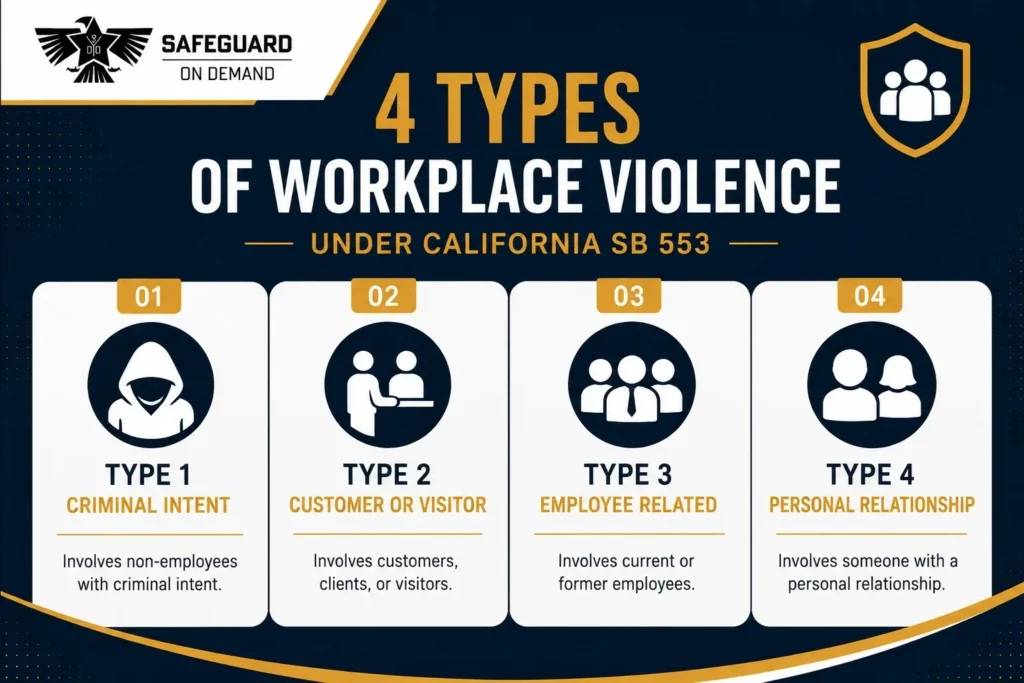
Cal/OSHA identifies four types of workplace violence under Labor Code Section 6401.9.
Type 1 Violence
Type 1 violence involves a person who has no legitimate business at the workplace.
This can include a person who enters or approaches the workplace with the intent to commit a crime.
Type 2 Violence
Type 2 violence involves customers, clients, patients, students, inmates, or visitors.
The violence is directed at employees.
Type 3 Violence
Type 3 violence involves a present or former employee, supervisor, or manager.
The violence is directed at another employee.
Type 4 Violence
Type 4 violence involves a person who does not work at the workplace but has or is known to have had a personal relationship with an employee.
These four types help employers identify different workplace violence risks and plan appropriate prevention measures.
What Must a California WVPP Include?
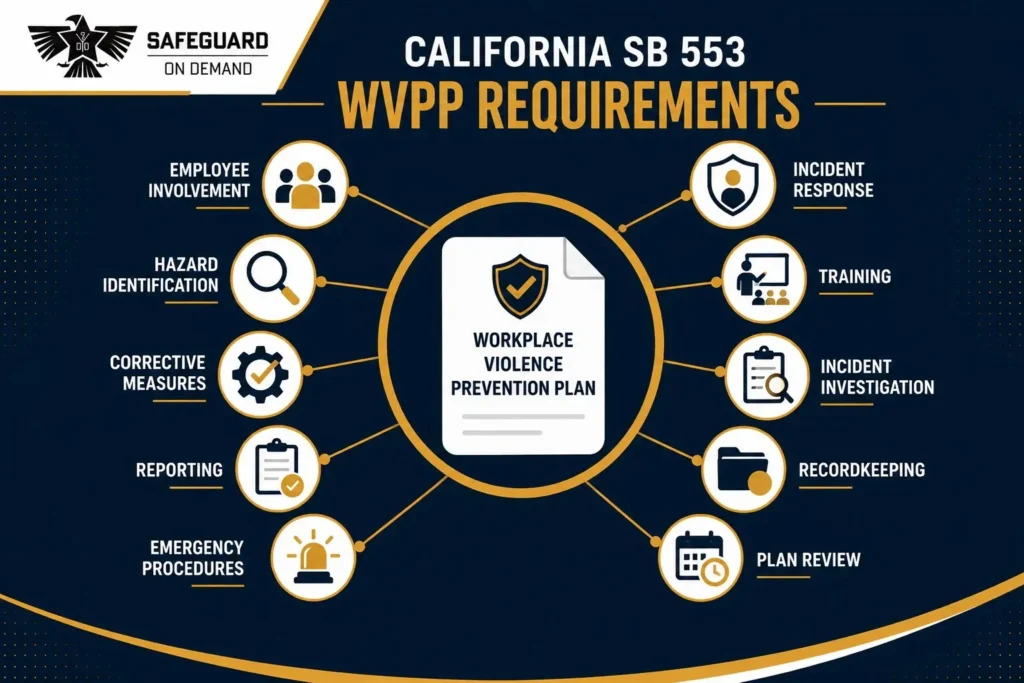
A covered employer must create a written WVPP that meets the requirements of California Labor Code Section 6401.9.
The plan should clearly explain how the workplace will prevent and respond to workplace violence.
Important areas include:
- Employer responsibility for the plan
- Employee involvement
- Workplace violence reporting procedures
- Communication with employees
- Workplace violence hazard identification
- Hazard evaluation
- Corrective measures
- Emergency procedures
- Response procedures
- Incident investigation
- Training
- Recordkeeping
- Plan review and updates
- Access to the plan
The plan must address the actual workplace.
A generic document may not address the hazards of a particular location. Cal/OSHA states that the WVPP must be specific to the hazards and corrective measures for each work area and operation.
Why Must the WVPP Be Site Specific?
Workplaces have different risks.
A retail store may face customer related risks. An office may face visitor or employee related risks. A facility with public access may have different entry and security concerns.
A useful WVPP should reflect the actual workplace.
Employers should consider:
- The physical location
- Work areas
- Job duties
- Employee activities
- Visitor access
- Customer interactions
- Known workplace violence risks
- Emergency procedures
- Reporting methods
- Physical security measures
- Corrective actions
Cal/OSHA states that each work area and operation must be addressed based on its hazards and corrective measures. A single corporate plan may be used only when it meets this requirement for the applicable locations.
SB 553 Training Requirements
Covered employers must provide effective workplace violence prevention training.
The training requirements became enforceable on July 1, 2024.
Training should be connected to the employer’s WVPP.
Employees should understand the workplace violence risks they may face.
Training should also explain the employer’s procedures for reporting and responding to workplace violence.
Training materials should be appropriate for the employees’ educational level and language.
Employers should also provide additional training when required by changes in workplace conditions, hazards, or the workplace violence prevention plan.
Training should not be treated as a generic presentation that is separate from the actual workplace.
Violent Incident Log Requirements
Covered employers must maintain a Violent Incident Log.
The log records information about workplace violence incidents.
Information can include:
- Date
- Time
- Location
- Type of workplace violence
- Description of the incident
- Consequences
- Other information required by the law
Employers must protect personal information when maintaining these records.
Cal/OSHA allows employers to create their own Violent Incident Log if it contains the information required by California Labor Code Section 6401.9.
A workplace violence incident may also need to be recorded on Cal/OSHA Form 300 if it meets the applicable injury or illness recording requirements.
The Violent Incident Log and Form 300 serve different purposes. Employers should review both requirements when an incident occurs.
SB 553 Recordkeeping Requirements
Employers must maintain required workplace violence records.
These records can include:
- Workplace violence hazard identification records
- Hazard evaluation records
- Corrective action records
- Training records
- Violent Incident Logs
- Workplace violence investigation records
Records must be maintained for the periods required by California Labor Code Section 6401.9.
Employers must also make required records available to the Division, employees, and authorized employee representatives when applicable.
Good recordkeeping helps an employer show that its workplace violence prevention process is active and maintained.
SB 553 Penalties and Cal/OSHA Enforcement
Cal/OSHA can enforce applicable workplace safety requirements.
The penalty depends on the type and classification of the violation.
Under the current Cal/OSHA penalty schedule:
- General and regulatory violations: Up to $16,285 per violation.
- Serious violations: Up to $25,000 per violation.
- Willful violations: Up to $162,851.
- Repeat violations: Up to $162,851.
These are maximum penalty amounts. They do not mean that every SB 553 violation will receive the maximum penalty.
Cal/OSHA considers the classification and circumstances of the violation when assessing a penalty.
Employers should review their WVPP and related procedures regularly. They should address identified problems before they become larger compliance issues.
What Is Changing for SB 553 in 2026?
SB 553 requirements are already enforceable.
At the same time, California is developing a permanent workplace violence prevention standard for general industry.
Cal/OSHA states that the Occupational Safety and Health Standards Board must adopt the new standard by December 31, 2026.
What Should Employers Do in 2026?
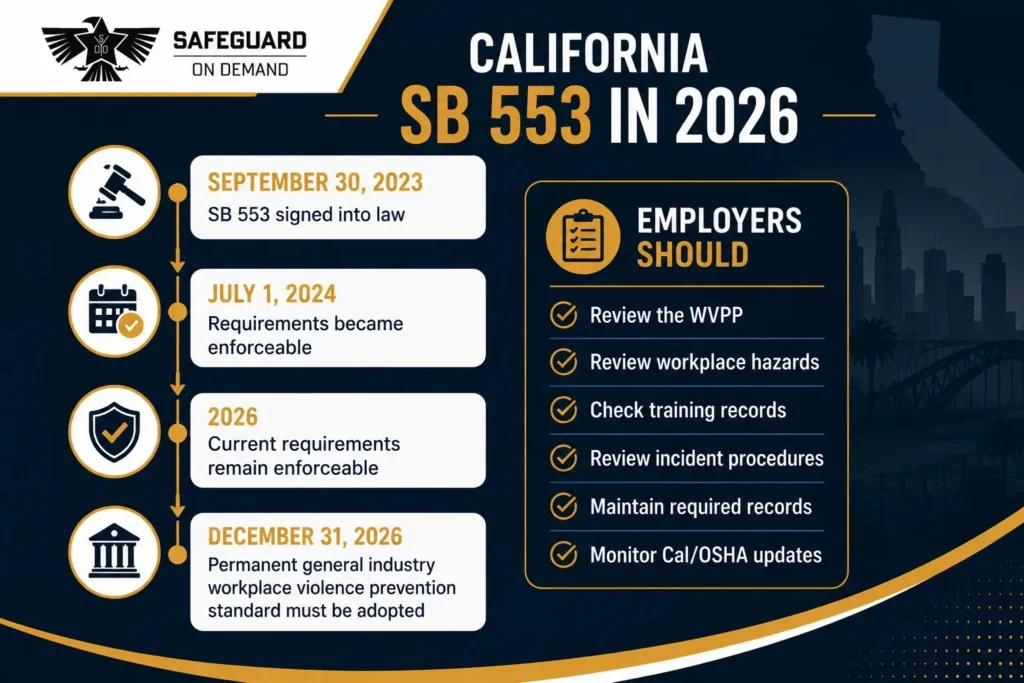
Employers should not wait for the permanent standard before reviewing their current workplace violence prevention program.
Businesses should:
- Review the current WVPP
- Check whether the plan is specific to each work area
- Review workplace violence hazards
- Update corrective measures
- Review employee reporting procedures
- Check training records
- Review the Violent Incident Log process
- Review required records
- Confirm that employees can access the WVPP
- Monitor official Cal/OSHA updates
The goal is to maintain an effective program while California moves toward the permanent general industry standard.
How Security Guards Can Support Workplace Violence Prevention
Security services can support the physical security side of a workplace violence prevention program.
Security guards do not replace the employer’s WVPP.
They also do not automatically make a business compliant with SB 553.
Security personnel can support workplace safety through:
- Access control
- Visitor management
- Security patrols
- Monitoring of entrances
- Incident reporting
- Security presence
- Identification of physical security concerns
- Support during emergency situations
- Monitoring of higher risk areas
- Support for workplace safety procedures
The right security measures depend on the workplace.
A business should first understand its risks and then select security measures that support its prevention plan.
Common SB 553 Compliance Mistakes
Some employers may focus only on creating a written plan.
That is not enough.
Common problems can include:
Using a Generic WVPP
A generic plan may not address the hazards of a specific workplace.
Ignoring Employee Involvement
Employees should have a way to participate in identifying and correcting workplace violence hazards.
Failing to Update the Plan
Workplace conditions can change.
The WVPP should be reviewed and updated when required.
Treating Training as a One Time Task
Training should be connected to the employer’s current plan, workplace hazards, and required updates.
Poor Recordkeeping
Missing training records, incident logs, or hazard records can create compliance problems.
Ignoring Physical Security Risks
A workplace violence plan should consider the physical conditions of the workplace.
Access points, visitor areas, lighting, parking areas, and other physical conditions may need review based on the workplace risk.
Assuming Security Guards Replace Compliance
Security guards can support a workplace violence prevention strategy.
They do not replace the written WVPP, employee training, reporting procedures, investigation procedures, or required records.
Frequently Asked Questions
What is California SB 553?
SB 553 is a California workplace safety law that created workplace violence prevention requirements under Labor Code Section 6401.9.
The requirements became enforceable on July 1, 2024.
Who needs a Workplace Violence Prevention Plan in California?
Covered California employers generally need a written WVPP.
The law includes specific exceptions.
Employers should review the applicable requirements and exceptions before deciding whether their workplace is covered.
What are the four types of workplace violence?
The four types are Type 1, Type 2, Type 3, and Type 4 violence.
They cover violence involving people with no legitimate business at the workplace, customers or visitors, current or former employees, and people with a personal relationship with an employee.
What must a WVPP include?
The WVPP must meet the requirements of California Labor Code Section 6401.9.
It must address areas such as employee involvement, hazard identification, reporting, communication, corrective measures, emergency response, training, incident investigation, and recordkeeping.
Does the WVPP need to be site specific?
Yes.
Cal/OSHA requires the plan to be specific to the hazards and corrective measures for each work area and operation.
Can the WVPP be part of an IIPP?
Yes.
An employer may include the WVPP as a separate section of its written IIPP.
The employer may also maintain the WVPP as a separate document.
Does SB 553 require workplace violence training?
Yes.
Covered employers must provide effective workplace violence prevention training.
The training requirements became enforceable on July 1, 2024.
What is a Violent Incident Log?
A Violent Incident Log is a record of workplace violence incidents.
It contains information required by California Labor Code Section 6401.9.
Employers may create their own log if it meets the legal requirements.
What are the SB 553 penalties?
The penalty depends on the violation classification.
The current maximum is $25,000 for a serious violation and $162,851 for a willful or repeat violation.
What happens to SB 553 in 2026?
The current requirements remain enforceable.
California is also developing a permanent workplace violence prevention standard for general industry.
The Occupational Safety and Health Standards Board must adopt the standard by December 31, 2026.
Can security guards help with SB 553 compliance?
Security guards can support physical security measures.
They may help with access control, visitor management, patrols, incident reporting, and other security functions.
However, security services do not replace the employer’s WVPP or other SB 553 requirements.
Conclusion
SB 553 requires covered California employers to take workplace violence prevention seriously.
A written WVPP is a central part of the requirements.
Employers must also address workplace violence hazards. They must provide required training. They must establish reporting and response procedures. They must investigate incidents and maintain required records.
The WVPP should reflect the actual workplace.
Employers should also monitor Cal/OSHA developments during 2026 as California moves toward a permanent general industry workplace violence prevention standard.
Taking action now can help businesses build a stronger workplace violence prevention program and respond to changing California requirements.