
Updated October 2026 · 9 min read · Reviewed by Safeguard On Demand

“Security guard” covers a lot of ground. The officer checking badges in a Los Angeles office lobby, the marked patrol car circling an Inland Empire warehouse at 2 a.m., and the fire watch officer logging rounds in a Sacramento building with a disabled sprinkler system are doing very different jobs under different rules, at different price points.
This guide breaks down the 10 types of security guard services California businesses hire most often, what each one actually involves, how the state’s BSIS licensing framework applies, and what you should expect to pay. If you are comparing security guard services for a property anywhere from San Diego to Redding, start here.
Key Takeaways
- ✓Every security guard in California must hold a BSIS guard card; armed officers also need a BSIS exposed firearms permit with semi-annual requalification.
- ✓The 10 core service types are armed, unarmed, mobile patrol, residential, commercial/corporate, event, construction site, fire watch, reception/front desk, and remote video monitoring.
- ✓Unarmed guard services in California typically bill around $28 to $45 per hour; armed services typically run $40 to $75 per hour depending on market and scope.
- ✓Most properties get the best results from a layered program: a standing or concierge officer, mobile patrol off-hours, and remotely monitored cameras.
- ✓Since July 1, 2024, most California employers must maintain a Cal/OSHA workplace violence prevention plan, which shapes how guard services are specified.
How California Regulates Security Guard Services
Before looking at the service types, it helps to understand the rules every one of them operates under. In California, private security is regulated by the Bureau of Security and Investigative Services (BSIS). Security companies must hold a Private Patrol Operator license, and every individual officer must hold a security guard registration, commonly called a guard card.
Getting and keeping a guard card is not a formality. Applicants must be at least 18, pass a DOJ and FBI criminal history check via Live Scan, and complete an 8-hour Power to Arrest and Appropriate Use of Force course before registration is issued. BSIS then requires 32 hours of security officer skills training within the first six months (16 of those hours within the first 30 days of employment), followed by 8 hours of continuing training every year, including at least 2 hours on appropriate use of force.
Armed officers carry an additional BSIS exposed firearms permit, which requires separate firearms training and range requalification twice a year. When you evaluate any of the services below, ask how the company tracks these requirements for each officer. Our training program adds refresher training on top of the state minimums.
1–3: Armed Guards, Unarmed Guards, and Mobile Patrol
Armed security guards are assigned where the threat profile justifies a firearm: cash-handling environments, dispensaries, jewelry and high-value retail, certain healthcare settings, and executive protection details. Armed security guard services cost more per hour because the officers carry additional permits, insurance exposure, and training obligations, and because the hiring pool is smaller.
Unarmed security guards make up the majority of posts in California. They handle access control, visitor screening, patrols, incident reporting, and customer service at offices, apartment communities, retail centers, and schools. Most properties need a trained, visible, well-supervised officer who writes a clear report, not a firearm. Our guide to armed vs. unarmed security guards in California walks through the decision in detail.
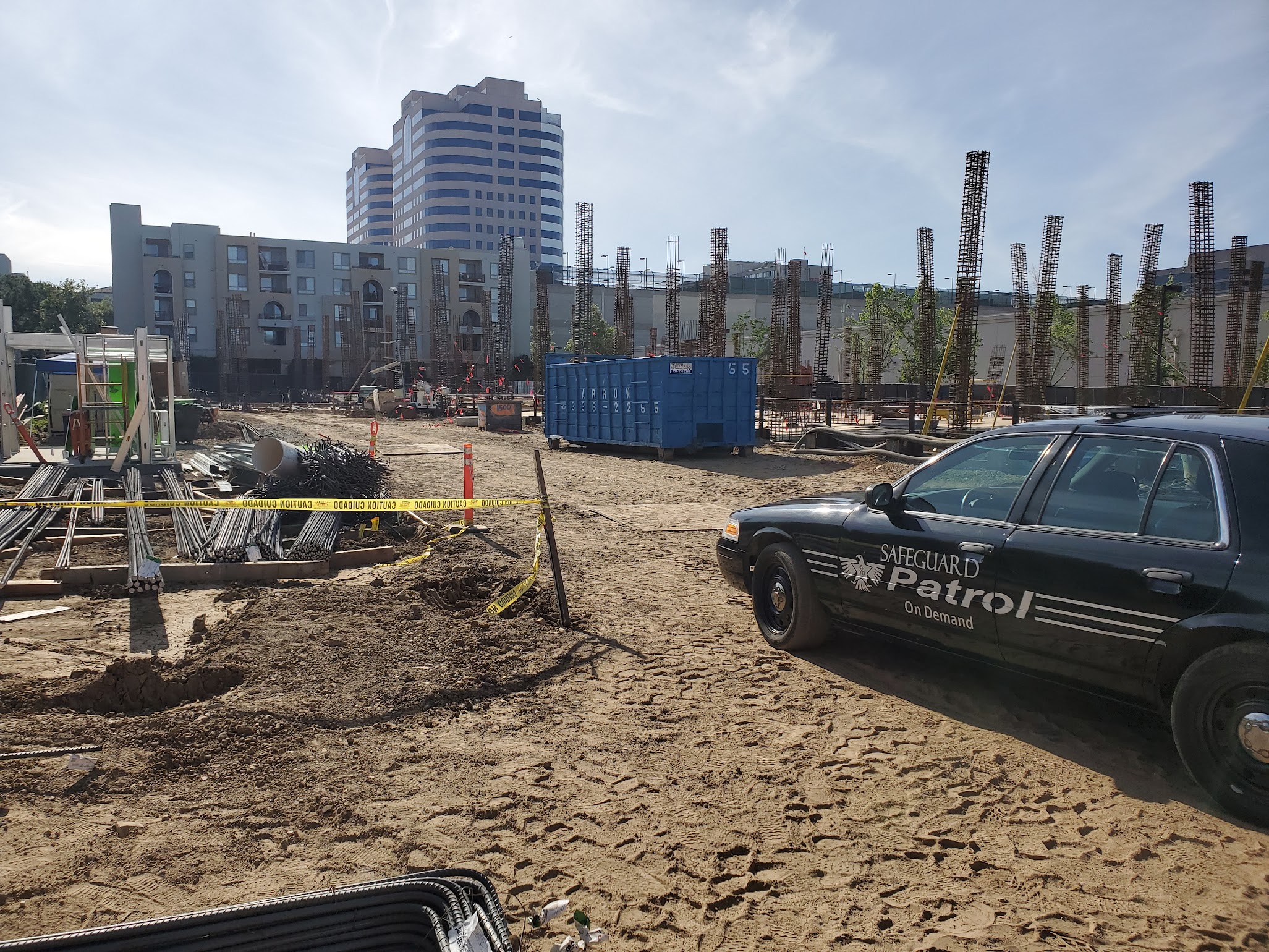
Mobile patrol security replaces a fixed post with a marked vehicle that visits your property on a randomized schedule, several times per shift. An officer checks doors, gates, lighting, and parking areas, posts a timestamped photo report, and responds to alarms. Mobile patrol services are the most cost-effective option for HOAs, business parks, and warehouses that need overnight coverage but cannot justify a 12-hour standing guard.
4–6: Residential, Commercial and Corporate, and Event Security
Residential security covers gated communities, HOAs, apartment complexes, and condominium towers. Typical duties include gate access control, guest and vendor logging, parking enforcement, amenity checks, and noise and trespass response. Programs for HOA security and apartment security usually blend a gate officer during peak hours with vehicle patrol overnight.
Commercial and corporate security spans office buildings, high-rises, business parks, and campuses. Officers manage lobby access, badge systems, loading docks, after-hours entry, and emergency response coordination. For tenants, visible commercial security guard services are part of what they pay rent for; for owners they are a documented liability control.
Event security is temporary and intensive: crowd management, bag checks, credential verification, alcohol-area monitoring, and incident response for concerts, festivals, corporate functions, sporting events, and private parties. Staffing depends on headcount, venue layout, alcohol service, and risk, covered in how many security guards you need for an event. Event security services are also where on-demand and temporary security guards are most common.
7–8: Construction Site Security and Fire Watch Services
Construction site security protects materials, tools, copper, and equipment that are easy to resell and hard to trace. A typical program combines a standing officer during off-hours, perimeter patrol, access logs for subcontractors and deliveries, and increasingly a solar camera trailer. Jobsite theft ripples into schedule delays and insurance claims, so construction site security is one of the fastest-growing requests we see from general contractors. The different approaches are covered in types of construction site security.
Fire watch services are code-driven. When a building’s fire alarm or sprinkler system is out of service, or is generating repeated false alarms, the local fire code official can require trained fire watch personnel on site until the system is restored. Local fire department guidelines typically require the officer to patrol the entire premises at set intervals (often every 30 minutes), carry a means to contact the fire department, be able to alert and evacuate occupants, have no other duties, and keep a written log. Fire watch services are usually urgent, 24-hour assignments, which is why 24/7 dispatch matters.
9–10: Reception and Front Desk Security, and Remote Video Monitoring
Reception and front desk security, often called concierge security, puts a professionally dressed officer at the first point of contact in an office tower, luxury residential building, medical office, or hotel. The officer greets visitors, verifies appointments and credentials, issues badges, manages deliveries, and quietly screens for anyone who should not be there. Concierge security guards are chosen for communication skills as much as security skills, and reception and lobby security has become the default for Class A buildings.
Remote video monitoring, sometimes called a virtual guard, uses your existing cameras or a deployed mobile surveillance unit watched live by trained operators who can issue voice-down warnings, dispatch a patrol officer, and call police with a live description. It does not replace an officer where a physical presence is needed, but remote video monitoring is the most efficient way to cover large perimeters, vacant properties, and overnight hours at a fraction of the cost of a standing post.
We rarely recommend a single service type. Our officers get the best results when a standing post, a mobile patrol route, and remote camera monitoring are written into one set of post orders and one reporting chain. That way the client sees the whole property, not just the lobby.
— David Nawabi
President & CEO, Safeguard On Demand
How to Choose the Right Mix for Your Property
Most properties need two or three service types layered together. The right combination comes from a site assessment that looks at hours of operation, traffic, incident history, neighboring land use, lighting, and what your insurer and tenants expect. These are the questions our security consulting team works through before recommending a program.
Start with the hours that hurt
Map when incidents actually happen. Many properties need a standing officer only during business hours and can shift to mobile patrol plus camera monitoring overnight.
Match the officer to the audience
A client-facing lobby needs a concierge-style officer. A loading dock needs someone comfortable enforcing rules with drivers. Specify the profile in your post orders.
Decide on armed vs. unarmed deliberately
Arm a post because the threat assessment and your insurer support it, not because it feels safer. Armed coverage raises cost and liability for every hour.
Use technology to extend, not replace
Cameras and remote monitoring cover perimeters and off-hours well. A trained officer is still what de-escalates a confrontation or helps an injured visitor.
Demand reporting you will read
Timestamped patrol reports with photos, same-shift incident reports, and a monthly summary let you measure the program instead of guessing.
What Each Type of Security Guard Service Typically Costs in California
Billing rates vary by market (Los Angeles and the Bay Area run higher than the Central Valley), shift length, whether the post is armed, and weekly hours committed. The ranges below are typical for licensed, insured California companies in 2026; a real quote depends on scope. For a deeper breakdown, see how much a security guard costs in California.
Typical hourly billing ranges for security guard services in California (2026)
| Unarmed standing guard | $28–$45/hr | Offices, apartments, retail, schools, lobbies |
| Armed security guard | $40–$75/hr | Cash handling, dispensaries, high-value retail, executive details |
| Mobile vehicle patrol | Priced per visit or per route; often a fraction of a standing post | HOAs, business parks, warehouses, overnight coverage |
| Fire watch officer | Unarmed rate, usually 24-hour minimums | Buildings with impaired fire alarm or sprinkler systems |
| Event security officer | Unarmed or armed rate with 4–6 hour minimums | Concerts, festivals, corporate events, private parties |
| Remote video monitoring | Monthly fee per camera or per site | Perimeters, vacant property, construction sites, after hours |
Compliance Considerations: Workplace Violence Plans and Liability
Two legal realities should shape how you specify security guard services in California. First, since July 1, 2024, Labor Code section 6401.9 (enacted by SB 553) has required most California employers to maintain a written Workplace Violence Prevention Plan, train employees, keep a violent incident log, and retain incident records for five years. Security officers usually respond to and document the incidents that go into that log, so post orders and reporting should be written with your plan in mind. We cover the practical side in our SB 553 guide.
Second, premises liability. California property owners owe a duty of reasonable care to people on their property, and when a crime is foreseeable based on prior incidents, litigation turns on whether reasonable security measures were in place. Patrol logs, incident reports, and trained officers are strong evidence that they were. Choosing a licensed security guard company in California with verifiable insurance is the first step; defining the scope in writing is the second.
Security Guard Services Across California
Safeguard On Demand delivers all 10 of these service types across Southern, Central, and Northern California, with approximately 130 officers working in 13 counties. From our headquarters in Santa Ana we serve Orange County and the surrounding region, and our Los Angeles branch in Northridge supports security guard services in Los Angeles, the San Fernando Valley, and the South Bay. Our Inland Empire office in Corona covers Riverside County and San Bernardino County, where warehouse, logistics, and construction site security are in constant demand.
Our San Diego branch supports San Diego security guards for hospitality, biotech, and residential clients. In Northern California, our Sacramento office handles security guard services in Sacramento, and our Silicon Valley office in Mountain View supports technology campuses with security guards in San Jose and across the Bay Area. We also staff posts and patrol routes in the Central Valley, including Fresno, Bakersfield, Stockton, and Modesto, with 24/7 dispatch coordinating every region.
Frequently Asked Questions
What is the most common type of security guard service in California?
Unarmed standing guard services are the most common, covering offices, apartment communities, retail centers, schools, and lobbies. Mobile vehicle patrol is the second most requested because it covers large properties overnight at a lower cost than a fixed post.
Do all security guards in California need a license?
Yes. Every security guard must hold a BSIS guard card, which requires a background check, an 8-hour Power to Arrest and Appropriate Use of Force course, 32 hours of skills training within six months, and 8 hours of continuing training each year. Armed officers also need a BSIS exposed firearms permit.
How much do security guard services cost in California?
Unarmed guard services typically bill around $28 to $45 per hour and armed services $40 to $75 per hour, with higher rates in Los Angeles and the Bay Area. Mobile patrol and remote monitoring are usually priced per visit or per month. Final pricing depends on hours, scope, and location.
Can I hire security guards for a single day or event?
Yes. On-demand and temporary security guards are common for events, emergency fire watch, short construction phases, and coverage gaps. Expect a minimum shift length, typically four to six hours, and share venue details and expected headcount so staffing can be planned.
Is remote video monitoring a replacement for security guards?
Not entirely. Remote video monitoring is excellent for perimeters, vacant properties, and after-hours coverage, and operators can dispatch a patrol officer when something is seen. It cannot de-escalate a confrontation in person, so most programs pair it with an officer or patrol route. Learn more about remote monitoring services.
Not sure which of these services your property needs? We will walk the site, review your incident history, and recommend a security program that fits your hours and budget. Request a free quote or call (800) 640-2327 today.
Get a free security assessment
Licensed armed and unarmed officers, patrols and fire watch across California. Call (800) 640-2327 or request a quote online.