
Updated October 2026 · 7 min read · Reviewed by Safeguard On Demand
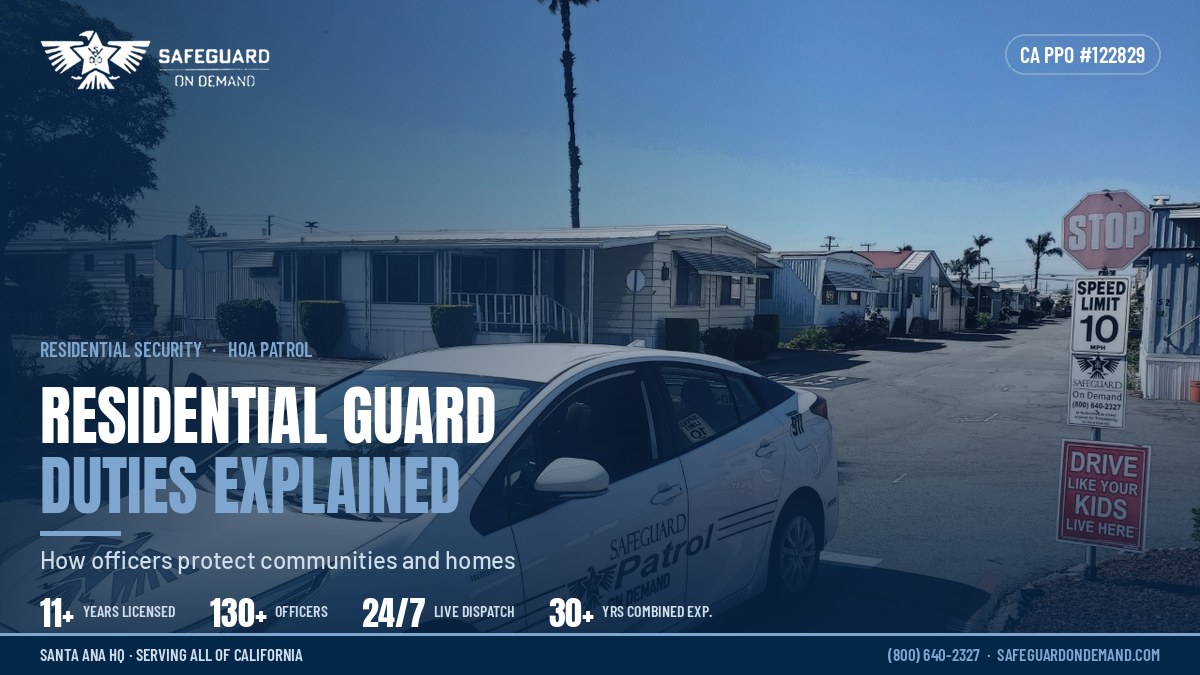
A home is where people expect to feel safest, yet residential properties face a steady stream of security problems: package theft, vehicle break-ins, trespassing, vandalism, unauthorized guests, and disputes between neighbors. Locks and cameras help, but they cannot greet a visitor, question a stranger in the parking garage, or calm an argument before it escalates.
That is the job of a residential security guard. This guide explains the core duties of residential security officers, how their work prevents crime, what California law does and does not allow them to do, and how property managers and boards can choose the right coverage.
Key Takeaways
- ✓Residential security guards control access, patrol common areas, enforce community rules, and respond to incidents and emergencies.
- ✓Visible, unpredictable patrols deter the opportunistic crimes that most often affect residential properties.
- ✓Guards document everything in daily activity reports, giving managers and boards an accurate record of what happens on site.
- ✓California guards have no police powers; they observe, report, and call law enforcement, using force only when reasonable and necessary.
- ✓The right mix of standing posts, mobile patrol, and remote monitoring depends on the property’s size, layout, and incident history.
What Does a Residential Security Guard Do?
Residential security officers protect people and property where they live, whether that is an apartment or condominium community, a homeowners association, or a gated community. Their duties are defined in post orders written with the property manager or board, but most assignments include the core responsibilities below.
Access control
Verifying residents, guests, vendors, and delivery drivers at gates, lobbies, and entrances, and logging every visitor.
Property inspections
Checking doors, gates, lighting, fences, and amenities for damage or weaknesses and reporting them for repair.
Common-area patrols
Walking or driving parking areas, garages, pools, gyms, and walkways on irregular schedules.
Rule enforcement
Addressing parking violations, amenity misuse, noise, and loitering according to community rules.
Incident response
Responding to alarms, disturbances, and suspicious activity, and calling police or emergency services when needed.
Reporting
Recording patrols, incidents, and maintenance issues in daily activity reports for management.
How Residential Security Guards Prevent Crime
Most residential crime is opportunistic. Someone notices an unlocked garage gate, an unattended package, or a vehicle with valuables in sight, and acts when no one seems to be watching. Professional guards remove that opportunity in three ways.
- Visible presence. A uniformed officer at the entrance or a marked vehicle making rounds signals that the property is watched. Marked vehicle patrols are especially effective in large communities and parking areas.
- Unpredictable patrols. Officers vary routes and timing so that no one can learn a pattern and wait for a gap. GPS-verified patrol services let managers confirm that each check actually happened.
- Early intervention. Guards engage loiterers politely, check unfamiliar vehicles against resident and guest lists, and report hazards before they become incidents.
When something does happen, a trained officer responds in real time rather than leaving residents to discover the damage the next morning. That response, and the detailed report that follows, is often what allows police and insurers to act.
Professional Guards vs. DIY Security Measures
| Capability | Cameras and alarms only | Professional security guards |
|---|---|---|
| Deterrence | Passive; easily ignored | Visible, active presence |
| Response | Records incidents for later review | Responds in real time and calls police |
| Access control | Relies on residents and codes | Verifies and logs every visitor |
| Judgment | None | Assesses situations and de-escalates conflicts |
| Reporting | Raw footage | Written daily activity and incident reports |
How Residential Security Services Improve Community Safety
Security officers do more than deter crime. They help create a calmer, more orderly community where residents feel comfortable using shared spaces.
In multi-unit buildings, concierge security officers at the lobby desk manage visitors, accept deliveries, and keep unauthorized people out of elevators and hallways. In parking garages, patrols reduce vehicle break-ins and give residents someone to call when they feel unsafe walking to their cars at night. Officers also respond to non-criminal emergencies such as medical calls, water leaks, and fire alarms, directing first responders to the right unit.
For boards and property managers, consistent reporting turns security into a measurable service. Daily activity reports show trends such as repeated gate failures or after-hours trespassing at the pool, which helps decide where to invest in lighting, cameras, or additional coverage.
How Residential Guard Duties Differ by Property Type
The core duties stay the same, but priorities shift with the property.
Apartment and condominium buildings. The focus is on lobbies, garages, mailrooms, and package areas, where tailgating and package theft are common. Officers often work closely with leasing and maintenance staff and help enforce towing and guest-parking policies.
Homeowners associations. Officers enforce the association’s rules consistently and document violations for the board, which protects the HOA from complaints of selective enforcement. Pools, clubhouses, and parks typically receive extra attention after hours.
Gated communities. The gatehouse is the center of the operation. Officers verify every visitor against resident authorizations, manage contractor access, and watch for vehicles following residents through the gate.
Communities under construction. New phases bring equipment, materials, and open structures that attract theft and trespassing, so many developers add construction site security until homes are occupied.
In residential security, the officers who prevent the most problems are the ones residents know by name. Consistent faces, predictable courtesy, and unpredictable patrol times make a community hard to target.
— David Nawabi
President & CEO, Safeguard On Demand
What Residential Security Guards Cannot Do
Residents and boards sometimes expect guards to act like police. California law does not allow that, and understanding the limits prevents liability for the community.
- Guards have no police powers. Their arrest authority is the same as any private person’s under Penal Code Section 837, and any restraint must be reasonable under Penal Code Section 835.
- Guards cannot search residents, guests, or vehicles without consent.
- Guards cannot enter a resident’s unit without permission or a genuine emergency.
- Guards cannot issue legally enforceable tickets; they enforce community rules through warnings, reports, and the property’s own procedures.
Every California guard must hold a Security Guard Registration from the Bureau of Security and Investigative Services, which requires a Department of Justice and FBI background check, training in arrest powers and appropriate use of force before registration, 32 hours of skills training within six months, and eight hours of continuing training each year.
Choosing the Right Residential Security Coverage
The right coverage depends on the property, its layout, and its history. Most residential properties use one or a combination of these models:
Standing guard posts
Standing guards at a gatehouse or lobby for continuous access control.
Foot patrol
Foot patrol officers for walkways, courtyards, and amenities in dense communities.
Mobile patrol
Scheduled and random vehicle checks across large or multiple properties at a lower cost than a full-time post.
Remote monitoring
Remote video monitoring that watches cameras live and dispatches help, ideal for overnight hours.
Professional Residential Security with Safeguard On Demand
Safeguard On Demand is a California private patrol operator, with more than 11 years in business and 130+ BSIS-licensed officers statewide. Our residential programs combine trained officers with 24/7 live dispatch, GPS-verified patrols, and daily activity reports, so managers and boards always know what happened on site.
Every engagement starts with a free site assessment. We write post orders around your community’s rules, staff most posts within 24 to 48 hours, and require no long-term contract. Learn about our officer training, read why clients choose us, or find your community among our California service areas.
Frequently Asked Questions
What are the main duties of a residential security guard?
Access control, patrols of common areas, rule enforcement, incident response, and daily reporting. Learn more about our apartment and condominium security.
Can a residential security guard remove trespassers?
A guard may ask a trespasser to leave and call police if the person refuses. Guards have private-person arrest authority only, so most communities rely on observation, documentation, and police response. See our HOA security services.
Is mobile patrol enough for a residential community?
For many smaller communities, yes. Larger properties or those with frequent incidents often add a standing post or gatehouse officer. Explore options for gated community security.
Do residential security guards carry weapons?
Most residential posts are unarmed. Armed coverage requires a BSIS Firearms Permit and is recommended only when a risk assessment supports it. Read more about Safeguard On Demand.
How much does residential security cost?
Rates depend on armed or unarmed coverage, hours, and the property’s risk profile. We provide a free site assessment and quote; start on our contact page.
Residential security guards protect far more than property lines; they protect the daily sense of safety that makes a community worth living in. To discuss coverage for your apartment building, HOA, or gated community, request a free quote or call Safeguard On Demand at (800) 640-2327.
Get a free security assessment
Licensed armed and unarmed officers, patrols and fire watch across California. Call (800) 640-2327 or request a quote online.