
Updated October 2026 · 9 min read · Reviewed by Safeguard On Demand

Ask any property manager in Los Angeles where their incident reports come from and the answer is usually the same: the parking lot. Catalytic converter thefts, smash-and-grab break-ins, confrontations over spaces, slip-and-falls in poorly lit stairwells, and the occasional assault all tend to happen in the one part of the property that has the most people, the least supervision, and the clearest escape routes.
That is why parking lot and garage security has become one of the most requested security guard services in Los Angeles. This guide covers who needs it, what parking lot security guards actually do shift to shift, how to choose between a standing post, patrol, and camera-based coverage, and what you should expect to pay.
Key Takeaways
- ✓California recorded 166,319 motor vehicle thefts and 528,818 larceny-thefts in 2024 according to the state Department of Justice; a large share of both begin in parking areas.
- ✓Under California premises liability law, owners who know of prior crimes on or near a parking facility can be held responsible for failing to take reasonable security measures.
- ✓The core duties of a parking lot security guard are patrol, access control, visible deterrence, visitor assistance, incident response, and documentation.
- ✓Most Los Angeles properties get the best value from a mix: a visible officer during peak hours, marked vehicle or golf cart patrol off-peak, and remotely monitored cameras overnight.
- ✓Unarmed parking security typically bills around $28 to $45 per hour in the Los Angeles market; mobile patrol is priced per visit and costs far less than a 24-hour post.
Who Needs Parking Lot Security Guards in Los Angeles
Any property where strangers park, walk alone, and carry valuables has a parking security problem to manage. In Los Angeles County the list is long. Shopping center and retail security programs almost always start in the lot, because that is where shoppers load purchases into cars and where organized theft crews stage. Office buildings and business parks need garage coverage for employees arriving early and leaving late. Apartment communities and condominium towers need it because residents park the same car in the same stall every night, which makes them predictable targets.
Healthcare is a special case. Hospitals and medical office buildings run 24 hours, with nurses and clinicians walking to their cars at 3 a.m. and visitors arriving under stress. Hospital security programs in Los Angeles routinely assign officers specifically to parking structures and shuttle stops. Auto dealerships face the inverse problem: the inventory is the parking lot. Hotels, event venues, and schools round out the list, each with its own peak hours and risk profile.
Why Parking Areas Are a Liability Hot Spot
The numbers explain the concern. The California Department of Justice’s Crime in California 2024 report counted 166,319 motor vehicle thefts statewide in 2024 (down 15.1% from 2023) and 528,818 larceny-thefts, a category that includes theft from vehicles. Even with the decline, that is more than 450 vehicles stolen per day across the state, and Los Angeles County carries a large share of the total.
The legal exposure is just as real. California property owners owe a duty of reasonable care to invitees, and courts weigh the foreseeability of crime, typically shown through prior similar incidents on or near the property, against the burden of the security measure a plaintiff says should have been in place. Parking facilities with a history of break-ins, poor lighting, and no security presence are a recurring fact pattern in negligent-security lawsuits. A documented program of patrols, lighting checks, and incident reports is both a deterrent and a defense. Our post on four ways to make your parking lot safer covers the low-cost design fixes that should accompany any guard program.
What Parking Lot Security Guards Actually Do
A well-run parking security post is far more than a person in a booth. The duties below are written into the post orders for every security guard services contract we run at parking facilities in Los Angeles, and each one produces a record your management team and insurer can use.
Patrols on a randomized schedule
Officers walk or drive every level, stairwell, and perimeter on an unpredictable cycle, checking for propped doors, broken lighting, loiterers, and vehicles with visible valuables.
Access control
At gated garages and permit lots, officers verify permits and visitor passes, manage vendor and delivery access, and prevent tailgating through gates and pedestrian doors.
Visible deterrence
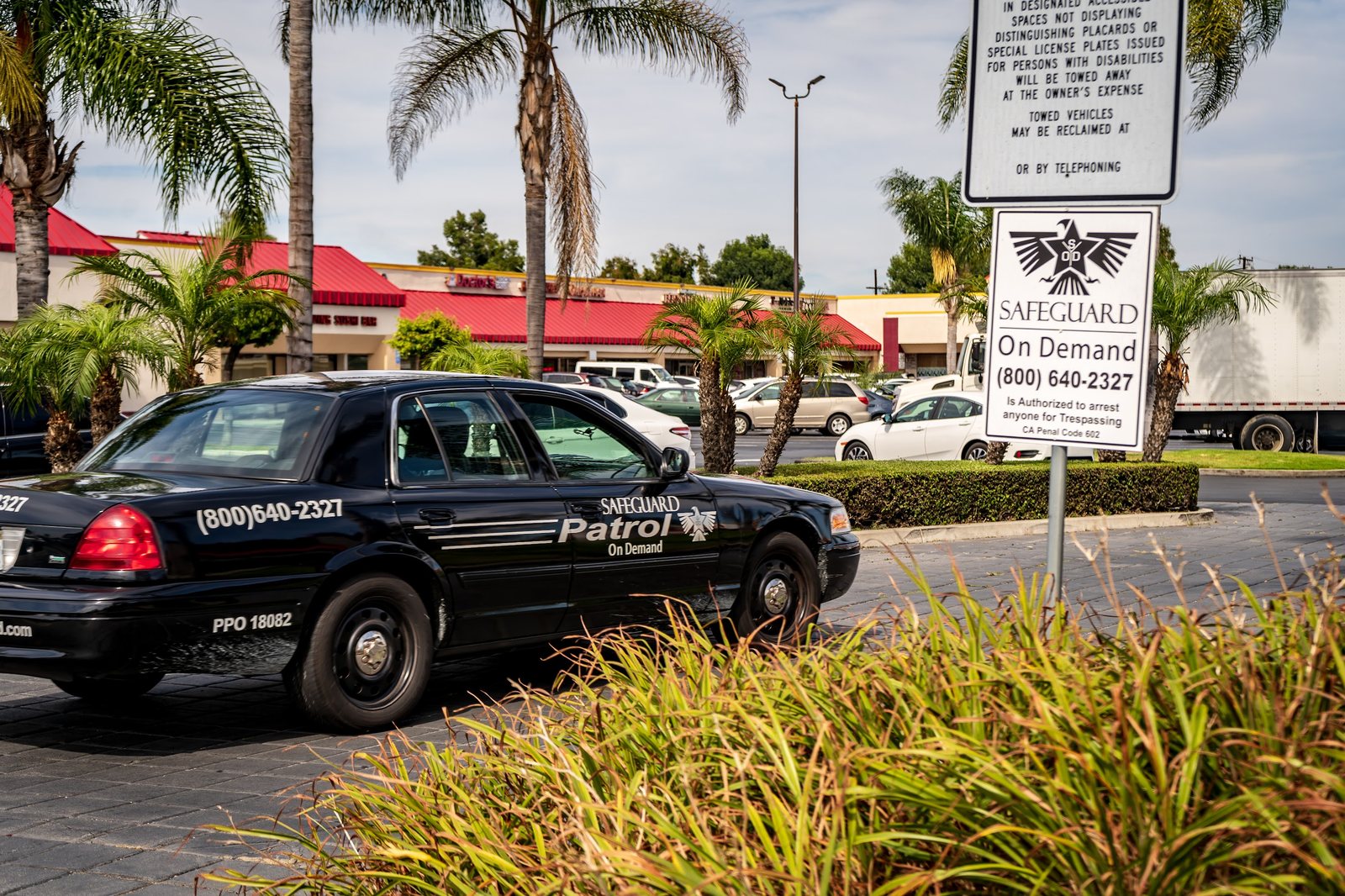
A marked patrol vehicle and a uniformed officer change the calculus for thieves who choose targets by how quickly they can get in and out unnoticed.
Visitor assistance
Escorts to vehicles after hours, jump starts, directions, and help for lost or distressed visitors. This is where customer service and security overlap most.
Incident response and de-escalation
Officers respond to disputes, break-ins in progress, medical events, and suspicious activity, call 911 when warranted, and secure the scene for police.
Documentation and reporting
Timestamped patrol logs with photos, incident reports completed within the shift, and lighting and hazard reports that feed maintenance and your workplace violence log.
Our officers treat a parking structure as a building with no walls. Every stairwell, ramp, and corner gets walked on a randomized schedule, lighting failures get photographed and reported the same night, and anyone who asks for an escort to their car gets one. That consistency is what changes behavior in a lot.
— David Nawabi
President & CEO, Safeguard On Demand
Choosing the Right Coverage Model for Your Lot or Garage
There is no single right answer for parking security. A six-level downtown garage, a strip-center lot in the San Fernando Valley, and a surface lot behind a Westside medical building each call for a different mix. The table below compares the options we deploy most often. In practice, many Los Angeles properties combine two or three. For a broader look at patrol formats, see types of security patrols.
Parking lot security coverage models compared
| Standing guard at entry or booth | Gated garages, hospitals, permit lots | Constant access control, immediate response, visitor help | Covers one point; cannot see upper levels |
| Foot patrol officer | Multi-level garages, campus lots | Reaches stairwells and corners; strong deterrent | Slower to cover large surface lots |
| Marked vehicle patrol | Large surface lots, overnight coverage, multiple sites | High visibility, fast response across a route, lower cost | Intermittent presence between visits |
| Bike or golf cart patrol | Retail centers, campuses, event parking | Covers ground quickly, approachable, quiet | Weather and terrain dependent |
| Remote video monitoring | Overnight hours, vacant or low-traffic lots | Live operators, voice-down warnings, dispatches patrol | No physical presence until patrol arrives |
| Parking enforcement | HOAs, apartments, permit lots | Keeps spaces for residents and customers; reduces disputes | Enforcement only; pair with patrol for safety |
Lighting, Design, and Technology That Make Guards More Effective
A security officer can only respond to what can be seen. Before adding hours to a guard contract, walk the lot at night with the officer and look at what the officer sees. Burned-out fixtures, landscaping that blocks sightlines, stairwells without glass, and dead-end corners all reduce the value of every patrol hour. Fixing them is usually cheaper than adding another post.
Technology closes the gaps between patrols. Fixed cameras with good overnight image quality, license plate capture at entries, and emergency call stations give the officer and our dispatch team eyes on the whole facility. For surface lots without camera infrastructure, a solar-powered mobile surveillance unit can be deployed in a day and monitored live. Pairing cameras with remote video monitoring means a trained operator can issue a voice-down warning to someone testing door handles and dispatch the marked patrol vehicle before a window is broken, rather than filing a report afterward.
Post Orders, Reporting, and Cal/OSHA Compliance
The difference between a parking security program that works and one that simply bills hours is the post orders. Good post orders for a Los Angeles parking facility specify patrol frequency by level and time of day, the exact gate and permit rules, escort procedures, how to handle homeless encampment contacts respectfully and lawfully, when to call LAPD versus handle on site, and what gets photographed and logged on every round. They also list the property contacts to notify and the time limits for submitting incident reports.
Since July 1, 2024, most California employers have been required under Labor Code section 6401.9 to maintain a written Workplace Violence Prevention Plan, keep a violent incident log, and retain related records for five years. Parking areas are where many of those incidents occur, and your security officers are usually the first to document them. We write parking post orders so the incident report fields line up with what the plan requires, which we explain further in our SB 553 compliance guide.
What Parking Lot Security Guards Cost in Los Angeles
In the Los Angeles market, unarmed parking security officers typically bill around $28 to $45 per hour depending on shift length, hours per week, and whether the post requires a vehicle. Armed officers, which are rarely necessary for parking facilities outside cash-handling or high-value environments, typically run $40 to $75 per hour. Mobile patrol is priced per visit or per route rather than per hour, which is why a lot that needs six checks overnight can be covered for a fraction of a 12-hour standing post.
Two things move the price more than anything else: how many hours you commit each week and how many sites share a patrol route. A property management company with several Los Angeles properties can often fund visible overnight coverage at all of them for the cost of one dedicated post. For a full breakdown of what drives pricing, read how much a security guard costs in California, and for help vetting providers, see our guide to choosing a security guard company in Los Angeles.
Parking Lot Security Guards Across California
Safeguard On Demand provides parking lot and garage security across Southern, Central, and Northern California with approximately 130 officers in 13 counties. Our Los Angeles branch in Northridge dispatches officers and patrol vehicles for security guard services in Los Angeles, including the San Fernando Valley around Northridge, the Westside, downtown, and the South Bay down to Long Beach. We also cover the San Gabriel Valley, with parking programs for retail and medical properties in Pasadena and neighboring cities.
From our headquarters in Santa Ana we serve parking facilities throughout Orange County, and our Inland Empire office in Corona supports Riverside and San Bernardino County retail centers and logistics yards. Our San Diego branch handles hospitality and downtown garage work, and in Northern California our Sacramento office and Silicon Valley office in Mountain View support corporate campuses and medical centers with security guards in San Jose and the greater Bay Area. Every region reports through the same 24/7 dispatch center.
Frequently Asked Questions
Do parking lot security guards in Los Angeles need to be licensed?
Yes. Every security officer in California must hold a BSIS guard card, which requires a DOJ and FBI background check, an 8-hour Power to Arrest and Appropriate Use of Force course, 32 hours of skills training within six months, and 8 hours of annual continuing training. The company must hold a Private Patrol Operator license.
Can a security guard tow or ticket cars in my lot?
Security officers can enforce your posted parking rules, document violations, and coordinate with a licensed tow operator under a signed agreement, but towing from private property must follow California Vehicle Code notice and signage requirements. Our parking enforcement services are set up around those rules.
Is a guard or a camera system better for a parking garage?
They solve different problems. Cameras record and, when monitored live, allow operators to warn intruders and dispatch patrol. Only an officer can escort an employee to a car, de-escalate a dispute, or help an injured visitor. Most Los Angeles garages use both: cameras for continuous coverage and an officer or patrol route for response.
How often should a parking lot be patrolled?
It depends on size, traffic, and incident history. A typical overnight mobile patrol program includes four to eight randomized visits per night, while a staffed garage may have an officer walk every level once or twice per hour. Patrol frequency should be written into the post orders and verified through timestamped reports.
Can I hire parking security for a short-term need?
Yes. Temporary and on-demand security guards are common for holiday retail seasons, events, construction phases that displace parking, and periods following a break-in. Expect a minimum shift of four to six hours and share a site map so the officer arrives with a patrol plan.
If your parking lot or garage is generating incident reports, insurance questions, or tenant complaints, we can help. Our team will survey the facility, review lighting and access points, and design a parking security program with the right mix of officers, patrol, and cameras. Request a free quote or call (800) 640-2327.
Get a free security assessment
Licensed armed and unarmed officers, patrols and fire watch across California. Call (800) 640-2327 or request a quote online.