

Updated October 2026 · 6 min read · Reviewed by Safeguard On Demand
Key Takeaways
- ✓The five main types of security patrols are foot, vehicle, random, escort and virtual (remote) patrols.
- ✓Foot patrols give the closest inspection, while vehicle patrols cover large areas and multiple sites quickly.
- ✓Random patrol timing is one of the most effective deterrents because offenders cannot plan around it.
- ✓Most properties get the best value from a combination, such as remote monitoring overnight backed by a patrol officer who responds in person.
- ✓Property size, crime risk, operating hours and budget should drive the choice, ideally after a professional site assessment.
What Is Patrolling in Security?
Patrolling is the systematic movement of trained security officers through a property to prevent incidents, detect problems early and respond quickly. Officers follow routes that cover entrances, perimeters, parking areas, common spaces and other vulnerable points, and they document what they see along the way.
Patrols can be performed on foot, by bicycle, in marked patrol vehicles or virtually through live camera feeds. Whatever the method, the goal is the same: create a visible, unpredictable presence that discourages crime and puts a trained person close enough to act when something goes wrong.
What Do Security Guard Patrol Services Include?
A professional patrol service is more than a drive-by. Depending on the property, a patrol program can include these duties.
Property Inspections
Officers check doors, gates, fences, lighting and equipment, then report hazards and maintenance issues.
Alarm Response
Officers are dispatched to verify alarms, secure the area and coordinate with police or fire when needed.
Policy Enforcement
Officers enforce parking, amenity and property rules through warnings and documented reports.
Escorts
Officers walk employees, residents or visitors to their vehicles, especially after dark.
Lock and Unlock Service
Officers open and secure buildings, gates and amenities at scheduled times.
Event Support
Patrol officers can add coverage around parking areas and perimeters during busy events.
Types of Security Patrols Compared
| Patrol Type | Best For | Main Strength | Limitation |
|---|---|---|---|
| Foot patrol | Apartments, offices, retail centers, campuses | Close inspection and personal contact | Covers less ground per hour |
| Vehicle patrol | Business parks, industrial sites, large lots, multiple sites | Fast coverage of large areas | Less detailed inspection of interiors |
| Random patrol | Any property with recurring incidents | Unpredictable presence that deters planning | Coverage between visits depends on frequency |
| Escort patrol | Hospitals, banks, residential communities | Protects people and assets in transit | Serves specific requests, not general coverage |
| Virtual patrol | After-hours sites with camera coverage | Continuous watch at lower cost | Requires a field officer for physical response |
5 Main Types of Security Patrols
Each patrol type has a clear role. Understanding the strengths and limits of each one is the first step toward the right plan.
- 1. Foot patrol. Officers walk the property, which allows close inspection of doors, stairwells, hallways and common areas and easy conversation with residents, tenants and visitors. Foot patrol suits apartment communities, office buildings, retail centers and campuses. Bicycle patrols are a variation that covers more ground while keeping officers approachable.
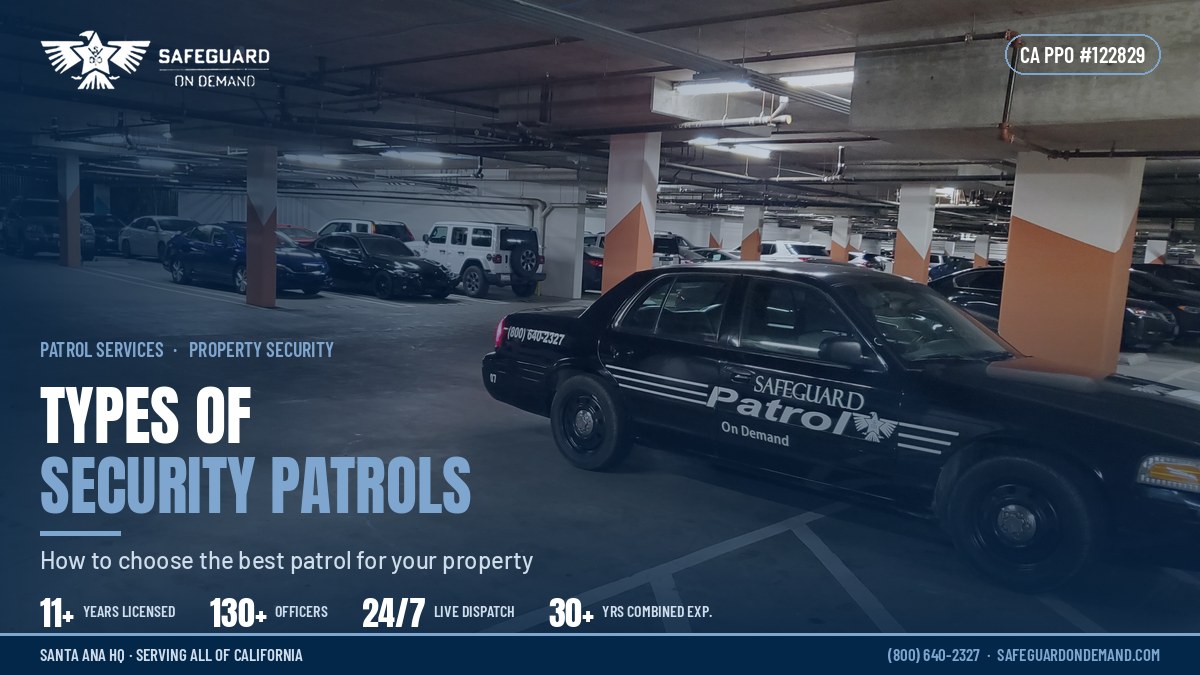
- 2. Vehicle patrol. Officers in marked vehicles cover large properties quickly and can visit several sites in one shift. Vehicle patrols work well for business parks, industrial areas, construction sites and large parking lots, especially at night.
- 3. Random patrol. Rather than visiting at fixed times, officers arrive on an unpredictable schedule and vary their routes. This makes it very difficult for anyone watching the property to plan around the officer, which is why random timing is a core part of most patrol programs.
- 4. Escort patrol. Officers accompany people, vehicles or valuable items while they move across or between properties. Escorts are common at hospitals, financial institutions and residential communities where staff or residents travel to parking areas late at night.
- 5. Virtual patrol (remote monitoring). Trained operators watch live camera feeds and sensors, speak to intruders through two-way audio and dispatch officers or police when activity is confirmed. Remote video monitoring provides constant coverage at a lower cost than continuous on-site staffing.
When Should You Hire a Security Patrol?
Patrols are worth considering whenever risk is spread across a property or concentrated in certain hours. These are the most common triggers.
Recurring Incidents
Vandalism, break-ins, loitering or disturbances that keep returning signal the need for a regular presence.
High-Value Assets
Inventory, equipment and vehicles stored outdoors or after hours need routine checks.
Large or Multiple Sites
One patrol officer can cover ground that would otherwise take several fixed posts.
After-Hours Exposure
Properties that are empty at night or on weekends need someone checking them.
Resident and Tenant Concerns
Communities that want visible security without a full-time guard often start with patrols.
The best patrol type is the one built around when and where your problems actually happen. We look at the incident history first, then decide whether that means boots on the ground, a vehicle, cameras or all three.
— David Nawabi
President & CEO, Safeguard On Demand
How to Choose the Right Patrol Type for Your Property
The best patrol plan is built from the property outward. Start with these questions.
- How large is the property? Compact buildings favor foot patrol. Large or spread-out sites favor vehicle patrols or a combination.
- Where and when do incidents happen? Incident history shows which areas and hours need the most attention, and random patrols can be concentrated there.
- What does the industry require? Retail centers, warehouses, apartment communities and business parks each have different access patterns and risks.
- What is the budget? Remote monitoring with patrol response often costs less than continuous on-site staffing. Rates depend on armed or unarmed coverage, hours and site risk.
- Do you need someone on site at all times? If a single access point must be controlled continuously, a standing guard may be needed alongside patrols.
A free site assessment from our security consulting team is the fastest way to match patrol types to your property.
What a Professional Patrol Service Should Deliver
In California, companies that provide patrol officers must be licensed by the Bureau of Security and Investigative Services (BSIS) as private patrol operators, and every officer must hold a BSIS security guard registration. BSIS requires 8 hours of Power to Arrest and Appropriate Use of Force training before registration, 32 more hours within the first six months and 8 hours of continuing training every year.
Safeguard On Demand meets those standards and adds the tools that make patrols accountable: GPS-verified checkpoints, 24/7 live dispatch and daily activity reports with time-stamped notes and photos. Our 130+ BSIS-licensed officers and leadership team with 30+ years of combined law-enforcement and private-security experience have protected California properties for more than 11 years. Learn about our patrol security services and officer training.
Frequently Asked Questions
What are the three most common types of security patrols?
Foot patrols, vehicle patrols and random patrols are the most common. Many properties now add virtual patrols through remote monitoring for overnight coverage.
What does a patrol security officer do?
A patrol officer inspects the property, deters trespassing and theft, responds to alarms and incidents, enforces property rules and documents everything in reports. See our security guard services for details.
Is foot patrol or vehicle patrol better?
Foot patrol is better for close inspection of buildings and common areas. Vehicle patrol is better for large or multiple sites. Many properties use both, and our marked vehicle patrols can be combined with foot checks at each stop.
Which properties need security patrols?
Apartment communities, HOAs, retail centers, business parks, warehouses, construction sites and parking facilities are among the most common. Browse the industries we serve.
How do I know which patrol type is right for my property?
Start with property size, incident history, operating hours and budget. A free site assessment will turn those into a specific plan. Contact us to schedule one.
The right patrol strategy protects your property without paying for coverage you do not need. Safeguard On Demand requires no long-term contract, is fully bonded and insured and typically has new patrols running within 24 to 48 hours anywhere in our California service areas. Request a free quote or call (800) 640-2327 to schedule your free site assessment.
Get a free security assessment
Licensed armed and unarmed officers, patrols and fire watch across California. Call (800) 640-2327 or request a quote online.