
by Safeguard On Demand · Updated November 2026
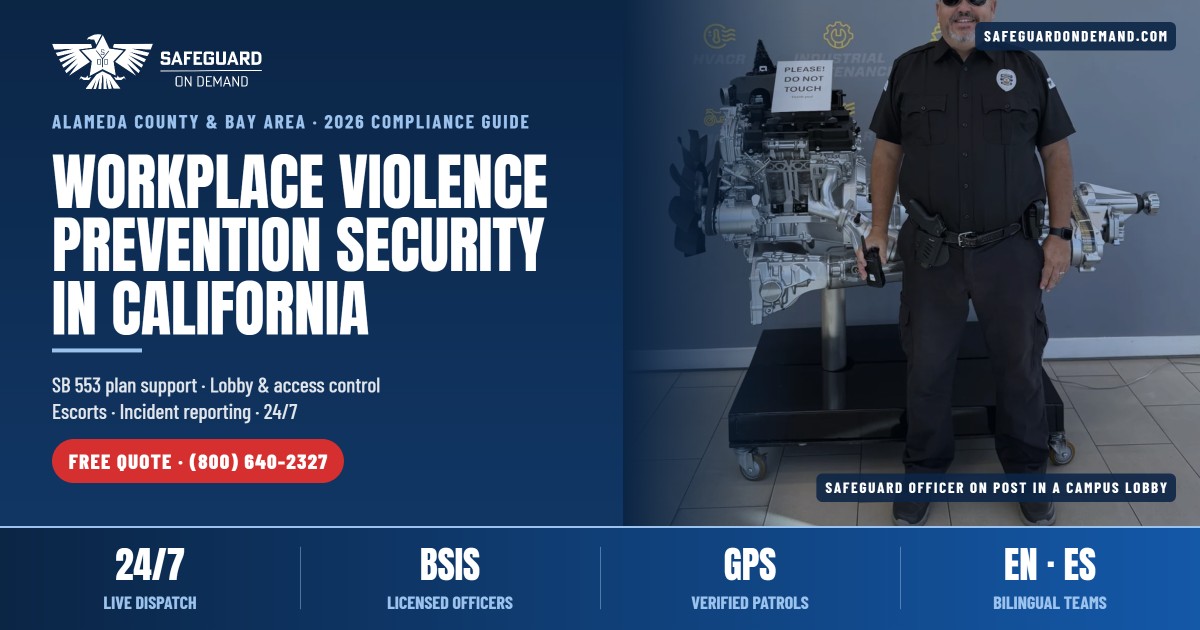
Quick answer: Workplace violence prevention security means using licensed security officers to carry out the controls written into your SB 553 plan: screening who comes in, responding to threats, documenting incidents and enforcing restraining orders. California has required most employers to keep a written Workplace Violence Prevention Plan since July 1, 2024. Officers do not replace that plan, but they are often the people who make it work on the ground.
Key takeaways
- The plan is the law; officers are a control. Labor Code 6401.9 requires a written, site-specific plan, training and a violent incident log. Security officers are one way to correct the hazards your plan identifies.
- Type 1 and Type 2 violence are where officers help most: outsiders with criminal intent, and angry customers, clients or visitors.
- Write the officer’s role into the plan. Post orders, escalation steps and reporting should match the plan word for word.
- Officer reports feed your violent incident log, which must be kept for at least five years.
- A permanent Cal/OSHA standard is coming. The Standards Board must adopt it by December 31, 2026, so plans and post orders will need another review.
Workplace violence prevention security is the part of California’s SB 553 compliance that happens at the front door, in the parking lot and at the reception desk. Most employers now have a written plan on file. Far fewer have checked whether the people who are supposed to carry it out—front-desk staff, managers and, where they’re on site, security officers—know what the plan says. This guide covers how officers fit into a plan, what the law requires, how to set the role up step by step, and the mistakes we see most often. For a full walk-through of the law itself, see our earlier guide, Cal/OSHA SB 553: What California Businesses Must Do in 2026.
What the law requires (and what it doesn’t)
SB 553 added Labor Code section 6401.9, which Cal/OSHA has enforced since July 1, 2024. It defines workplace violence as “any act of violence or threat of violence that occurs in a place of employment,” and it applies to almost every California employer. The exceptions are narrow. They include healthcare settings covered by Cal/OSHA’s separate healthcare standard (Title 8, section 3342), employees teleworking from a place the employer doesn’t control, and places with fewer than 10 employees on site at any time that are not open to the public and comply with the employer’s Injury and Illness Prevention Program.
According to Cal/OSHA’s employer fact sheet, covered employers must:
- Keep a written plan that is in effect at all times and covers every work area, either as part of the IIPP or as a separate document.
- Name the people responsible for running the plan and involve employees in building it.
- Identify, evaluate and correct workplace violence hazards, with inspections when the plan starts, on a schedule, after any incident and when a new hazard becomes known.
- Keep a violent incident log for every incident, even ones with no injury.
- Train employees when the plan starts and every year after that.
- Keep hazard records, incident logs and investigation records for at least five years, and training records for at least one year.
What the law does not require is a security guard. No section of 6401.9 says you must hire officers. But when your hazard assessment finds a real risk—an open lobby, a cash office, after-hours shifts, a history of threats—you have to correct it, and trained officers are often the most practical correction.
The four types of workplace violence, and where officers fit
The statute sorts workplace violence into four types. Your plan has to address the ones that apply to your site, and your officers’ role is different for each.
| Type | Who commits it | Typical example | What officers can do |
|---|---|---|---|
| Type 1 | Someone with no legitimate business at the site, often with criminal intent | Robbery, burglary, trespass in a parking structure | Visible deterrence, access control, patrols, lock-up and alarm response |
| Type 2 | Customers, clients, patients, students or visitors | An upset tenant or customer threatening front-desk staff | De-escalation, separating the person from staff, removal, calling police when needed |
| Type 3 | A current or former employee, supervisor or manager | A terminated employee returning to the building | Badge deactivation checks, be-on-the-lookout notices, presence during terminations |
| Type 4 | Someone who doesn’t work there but has a personal relationship with an employee | A former partner showing up at an employee’s workplace | Restraining order enforcement, escorts to vehicles, visitor screening |
In workplace violence prevention security terms, Type 1 and Type 2 make up most of what our officers deal with at commercial, retail and residential sites. Types 3 and 4 come up less often, but they carry the most risk and need the most planning, because the person may know the building, the schedule and the staff.
How to build officers into your plan, step by step
An officer who has never read your plan is just a uniform. These steps tie the security post to the written plan so the two match.
1. Start with the hazard assessment
Walk the site with whoever runs your plan. Note entrances that stay unlocked, places where staff work alone, cash handling, poor lighting, past incidents and the hours when risk peaks. A security assessment should end with a list of hazards and a proposed fix for each one, not a generic headcount.
2. Match coverage to the hazards you found
A busy lobby may need a standing unarmed officer during public hours. A business park with a few late shifts may only need patrol checks and escorts at closing. Coverage should follow the risk, which keeps protection where it matters and avoids paying for hours that don’t reduce any hazard.
3. Write post orders that mirror the plan
Post orders should use the same escalation steps, contact names and code words as your plan. If the plan says staff call a specific manager first, the officer’s orders should say the same. Mismatched instructions are where response breaks down.
4. Connect reporting to the violent incident log
Cal/OSHA’s log calls for the date, time, location, type of violence, a detailed description, who committed it, the circumstances, the consequences (including any police involvement) and the steps taken to protect employees. Officer incident reports should capture those same fields, so whoever keeps the log can complete it from the report without chasing details. Personal identifying information stays out of the log itself.
5. Train together and review after every incident
Your employees’ annual training should explain what the officers do and how to reach them. Officers should be briefed on your plan as part of site onboarding. After any incident, review what the officer did against what the plan said, and update one or both.
Restraining orders and high-risk situations
California employers have long been able to seek a workplace violence restraining order under Code of Civil Procedure section 527.8 on behalf of an employee who has been threatened. Since January 1, 2025, a collective bargaining representative can also petition, and the employee must first be given the option not to be named. When an order is in place, officers can help make it real:
- Keep a copy of the order and a photo of the restrained person at the post, shared only with those who need it.
- Screen visitors and watch entrances and parking areas during the protected employee’s shifts.
- Escort the employee to and from their vehicle when requested.
- Call police and document the event right away if the person appears; officers observe and report, they don’t make arrests for the court.
Terminations of employees with a history of threats deserve the same planning: schedule the meeting, have an officer nearby and out of sight, deactivate access before the meeting ends and walk the person out with dignity.
Unarmed, armed or patrol: choosing coverage
Most workplace violence prevention posts are unarmed. Officers trained in observation, de-escalation and reporting handle the bulk of Type 1 and Type 2 situations. Armed coverage makes sense only where the hazard assessment finds a serious, specific threat, such as cash or controlled products on site, and it adds licensing and liability considerations. Mobile patrol works for sites that need random checks, lock-ups and escorts rather than a full-time presence.
Cost depends on hours, number of posts, armed versus unarmed, and how much reporting and coordination the plan calls for. Our guide to what drives security guard cost in California breaks those factors down.
Common mistakes to avoid
- Treating a guard as the plan. Officers are a control. You still need the written plan, training, log and records.
- Generic post orders. Orders copied from another site won’t match your escalation list or hazards.
- Reports that don’t fit the log. If the officer’s report is missing the fields Cal/OSHA requires, someone has to reconstruct them later.
- Ignoring the parking lot. Many incidents happen outside the building, at shift change and closing.
- Skipping the post-incident review. The plan must be reviewed after a violent incident. Include the security response in that review.
- Waiting on the new standard. Labor Code 6401.9 is already enforceable. The coming regulation adds detail; it doesn’t start the clock.
What’s changing: the permanent Cal/OSHA standard
Cal/OSHA has been drafting a permanent workplace violence standard for general industry, and the Occupational Safety and Health Standards Board is required to adopt it by December 31, 2026. The latest public discussion draft, from July 2026, refines definitions such as “threat of violence” and “employer-provided transportation,” and addresses coordination at multi-employer worksites. The proposed rules aren’t in effect yet and may still change. When the final standard is adopted, plan to review your written plan, your officers’ post orders and your reporting forms together.
Workplace violence prevention security checklist
- ☐ Written plan is current, site-specific and easy for employees to access
- ☐ Hazard assessment names each risk and the control that addresses it
- ☐ Officer role, hours and posts are described in the plan
- ☐ Post orders match the plan’s escalation list and contacts
- ☐ Officer incident reports capture every violent incident log field
- ☐ Restraining order procedures are written down and briefed
- ☐ Employees know how to reach the officer and how to report without retaliation
- ☐ Plan, post orders and reports are reviewed after each incident and at least once a year
How Safeguard On Demand supports your plan
We start with a free site assessment and a copy of your current plan, then build post orders and reporting around it. Our officers are licensed by California’s Bureau of Security and Investigative Services (BSIS), dispatch is live 24/7, patrol checks are GPS-verified, and bilingual English/Spanish teams are available. Incident reports are written to give your plan administrator what the violent incident log requires. Contracts are month-to-month with no long-term commitment, and we cover offices, retail, warehouses, apartments and commercial properties across Southern, Central and Northern California.

Alameda County focus
Alameda County is a good example of why workplace violence prevention security has to be tailored. The county mixes port and logistics operations around the Port of Oakland and the I-880 corridor, a dense industrial belt through San Leandro and Hayward, manufacturing and tech in Fremont, Tri-Valley office parks in Pleasanton and Livermore, and busy retail and residential corridors in Oakland and Berkeley. Each brings a different mix of the four violence types.
- Logistics yards and warehouses near the port and along I-880 face Type 1 risk from cargo theft and trespass, plus Type 3 risk at gates and shift changes. Gate control and driver check-in procedures belong in the plan.
- Retail and public-facing offices in Oakland and San Leandro see more Type 2 incidents—confrontations with customers and visitors—where de-escalation and staff panic procedures matter most.
- Manufacturing and industrial sites in Hayward and Fremont often run night shifts with few people on site, so escorts, lone-worker check-ins and parking lot patrols carry weight.
- Tri-Valley office and business parks in Pleasanton and Livermore usually need reception screening and after-hours patrol more than full-time posts.
Healthcare facilities in the county generally fall under Cal/OSHA’s separate healthcare standard rather than SB 553, so check which rule applies before building a plan. Police response times vary by city and time of day, which is one more reason to write clear “call 911 and do this while waiting” steps into your post orders. If you’ve had cargo or yard incidents, our guide to port-adjacent warehouse security in Oakland and the East Bay covers those controls in more detail.
Safeguard On Demand serves Alameda County from our Silicon Valley office in Mountain View, with 24/7 dispatch backed by our Santa Ana headquarters.
Workplace violence prevention security: frequently asked questions
Does SB 553 require employers to hire security guards?
No. Labor Code 6401.9 requires a written workplace violence prevention plan, hazard assessment, training, a violent incident log and records. It does not require security officers. But if your assessment finds hazards such as an open lobby, cash handling or past threats, you must correct them, and officers are often the most practical control.
What can security guards do as part of a workplace violence prevention plan?
Officers can control access, screen visitors, patrol parking areas, de-escalate confrontations, escort employees, help enforce restraining orders, call police and write incident reports that feed the violent incident log. Their role and post orders should be written to match the plan.
Who is exempt from California’s workplace violence prevention law?
The main exceptions are healthcare settings covered by Cal/OSHA’s healthcare violence standard (Title 8, section 3342), employees teleworking from a location the employer doesn’t control, certain corrections and law enforcement employers, and places with fewer than 10 employees on site at any time that are not open to the public and comply with the employer’s IIPP.
How long must the violent incident log be kept?
Cal/OSHA requires violent incident logs, incident investigation records and hazard identification records to be kept for at least five years. Training records must be kept for at least one year.
Can a California employer get a restraining order on behalf of an employee?
Yes. Under Code of Civil Procedure section 527.8, an employer can seek a workplace violence restraining order for an employee who has been threatened or harmed. Since January 1, 2025, a collective bargaining representative can also petition, and the employee must first be offered the option not to be named.
Should workplace violence prevention officers be armed?
Usually not. Most posts are unarmed and focus on observation, de-escalation, access control and reporting. Armed coverage fits only when a hazard assessment finds a serious, specific threat, and it adds licensing and liability considerations.
Put trained officers behind your workplace violence prevention security plan
Get a free quote and site assessment for workplace violence prevention security. BSIS-licensed officers, live 24/7 dispatch and no long-term contract. Call (800) 640-2327 or request your free quote online.