
Updated October 2026 · 6 min read · Reviewed by Safeguard On Demand
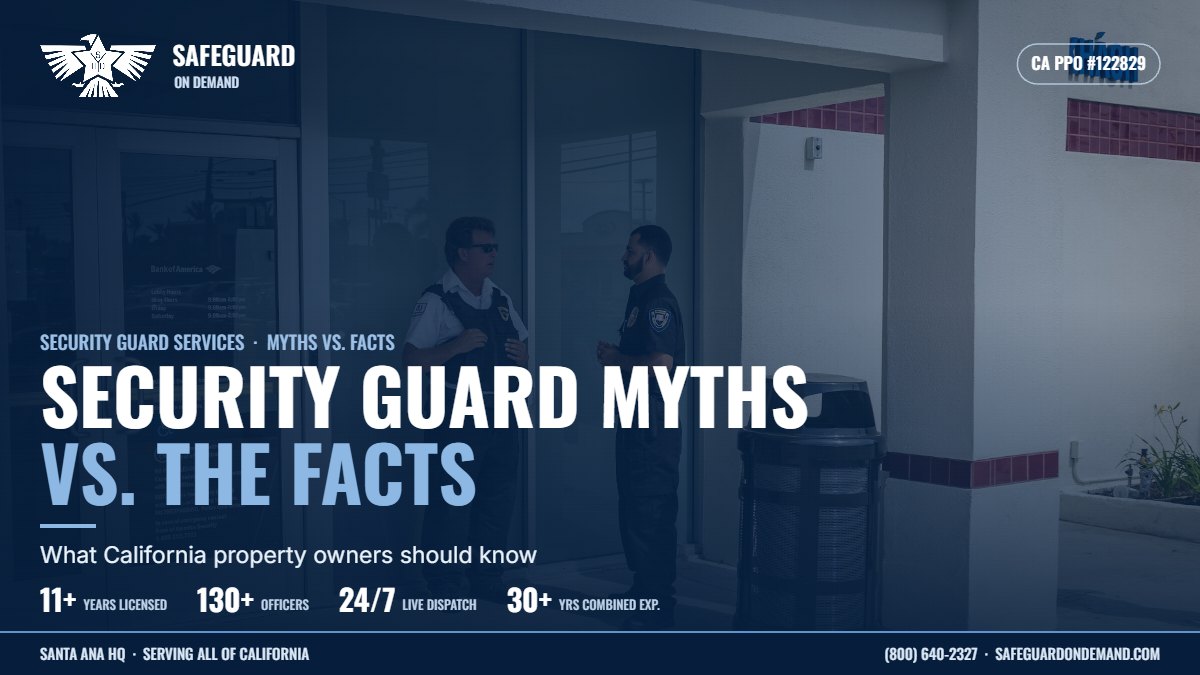
Security guards are some of the most visible professionals in daily life, yet many people, including business owners who hire them, misunderstand what they do. Some expect guards to act like police officers. Others see them as an expensive formality that only stands at the door. Both views lead to poor decisions, either by asking officers to do things they legally cannot, or by skipping security that would prevent real losses.
This article clears up the most common misunderstandings about security guard services in California: what officers can and cannot do, how they are trained and licensed, what security really costs, and how to get the most value from a security program.
Key Takeaways
- ✓Security officers are not police; their power comes from deterrence, observation, reporting, and private property authority.
- ✓California requires BSIS Guard Cards, mandatory training, and licensed employers for every guard.
- ✓Unarmed officers are the right choice for most properties; armed coverage is for specific, assessed risks.
- ✓A well-designed program prevents losses that often exceed what it costs.
Misunderstanding 1: Security Guards Have the Same Powers as Police
Security officers in California are private citizens working on behalf of a property owner. They cannot pull people over, search people without consent, or detain someone simply because they look suspicious. Like any private person, they can make a citizen’s arrest in limited circumstances under California law, but professional companies train officers to observe, report, and call law enforcement rather than take unnecessary risks.
What officers do have is the property owner’s authority to enforce site rules, ask trespassers to leave, control access, and document what happens. Combined with a visible presence, that is usually what prevents incidents in the first place. Our article on what security guards can and can’t do legally in California covers this in detail.
Misunderstanding 2: Anyone Can Be a Security Guard
In California, security work is regulated by the Bureau of Security and Investigative Services (BSIS). To work as a guard, a person must pass a Department of Justice and FBI background check, complete required training, and hold a valid Guard Card. Training includes Powers to Arrest and Weapons of Mass Destruction and Terrorism Awareness before licensing, additional required hours after hire, and ongoing annual refresher training.
Armed officers need a separate BSIS Firearms Permit, which requires additional training, range qualification, and periodic requalification. Officers must also work for a company with a Private Patrol Operator license. Reputable companies add their own site-specific and customer service training on top of the state minimums. Learn more about our security guard training.
Misunderstanding 3: Security Guards Just Stand Around
A good officer is busy throughout the shift, even when nothing dramatic happens. That is the point: their work prevents the dramatic moments.
Patrols and inspections
Checking doors, gates, lighting, fences, parking areas, and restricted rooms.
Access control
Verifying visitors, contractors, and deliveries and keeping restricted areas secure.
Customer service
Greeting visitors, giving directions, assisting employees, and escorting staff to cars.
Rule enforcement
Addressing trespassers, loitering, parking violations, and policy issues.
Emergency response
Responding to alarms, medical calls, fires, and disturbances and guiding first responders.
Reporting
Daily activity logs, incident reports, and photos that document every shift.
Misunderstanding 4: Every Property Needs Armed Guards
Armed officers are appropriate for specific risks, such as significant cash handling, high-value goods, or credible threats of violence. For most apartment communities, offices, retail centers, healthcare facilities, and construction sites, well-trained unarmed officers deliver the deterrence, customer service, and reporting the property needs, with lower cost and liability. The right decision comes from a risk assessment, not a default. Read our comparison of armed vs. unarmed security.
Misunderstanding 5: Security Is Too Expensive
Security is a cost, but so is a burglary, a stolen catalytic converter fleet, a lawsuit after an assault in your parking lot, or tenants who leave because they do not feel safe. Many property owners find that a well-designed program costs less than the losses it prevents.
There are also more options than a full-time officer. Mobile patrol visits a property several times per night for a fraction of the cost of a dedicated post. Remote video monitoring watches cameras live and dispatches response only when needed. Coverage can also be limited to the highest-risk hours.
Misunderstanding 6: Cameras Can Replace Security Officers
Cameras are valuable, but recorded footage mostly helps after something has happened. Someone has to be watching to stop an incident in progress, and someone has to respond. The strongest programs combine technology and people: cameras watched by live operators, backed by patrol officers who can arrive on scene.
Security Guard Services: Myth vs. Fact
| Myth | Fact |
|---|---|
| Guards have police powers | Guards act with the property owner’s authority and California citizen’s arrest law, and focus on deterrence and reporting |
| Anyone can be a guard | California requires background checks, BSIS training, a Guard Card, and a licensed employer |
| Guards just stand around | Officers patrol, control access, assist people, enforce rules, respond, and report |
| Armed is always better | Unarmed officers fit most sites; armed coverage follows a risk assessment |
| Security is unaffordable | Patrol, monitoring, and targeted hours make professional security accessible |
| Cameras replace guards | Cameras need live monitoring and a responder to stop incidents |
Most people have never seen what a good officer actually does on a shift, because when it is done right, nothing happens. Our job is to find the problem, solve it, and prove it with reports the client can read every morning.
— David Nawabi
President & CEO, Safeguard On Demand
How to Get the Most from Your Security Provider
Set clear post orders that describe duties, patrol routes, rules to enforce, and who to call for each type of incident. Ask for daily reports and review them. Meet with your provider regularly to discuss trends and adjust coverage. And choose a licensed company with real supervision, training, and accountability. Our guide on how to hire a security guard walks through the questions to ask.
Professional Security Guard Services Across California
Safeguard On Demand is a licensed California private patrol operator providing security guard services, mobile patrol, fire watch, and remote monitoring throughout the state, including Los Angeles, Orange County, San Diego, the Inland Empire, the Bay Area, the Central Valley, and Sacramento. We focus on security solutions that get to the heart of each client’s problem.
Frequently Asked Questions
Can security guards arrest people in California?
Security guards can make a citizen’s arrest in limited circumstances allowed for any private person under California law. Professional officers are trained to prioritize observation, reporting, and calling police, and to avoid unnecessary physical confrontation.
What training do California security guards need?
Guards must complete BSIS-required training, including Powers to Arrest and Weapons of Mass Destruction and Terrorism Awareness, plus additional hours after hire and annual refresher training. Armed officers need a Firearms Permit with additional training and requalification.
Are security guards worth the cost?
For properties with recurring theft, trespassing, or safety concerns, a security program often costs less than the losses, repairs, and liability it prevents. Patrol and monitoring options can lower costs further.
Can security guards search bags or people?
Generally, security officers need consent to search a person or their belongings. Businesses can set bag-check policies as a condition of entry, but officers cannot force a search.
What is the difference between a security guard and a security officer?
In California the terms are often used interchangeably; both require a BSIS Guard Card. Read our article on the difference between a security guard and a security officer for more.
Understanding what security officers really do helps you hire the right coverage and get full value from it. To talk through your property’s needs with a licensed California provider, request a free quote or call Safeguard On Demand at (800) 640-2327.
Get a free security assessment
Licensed armed and unarmed officers, patrols and fire watch across California. Call (800) 640-2327 or request a quote online.