

Updated October 2026 · 9 min read · Reviewed by Safeguard On Demand
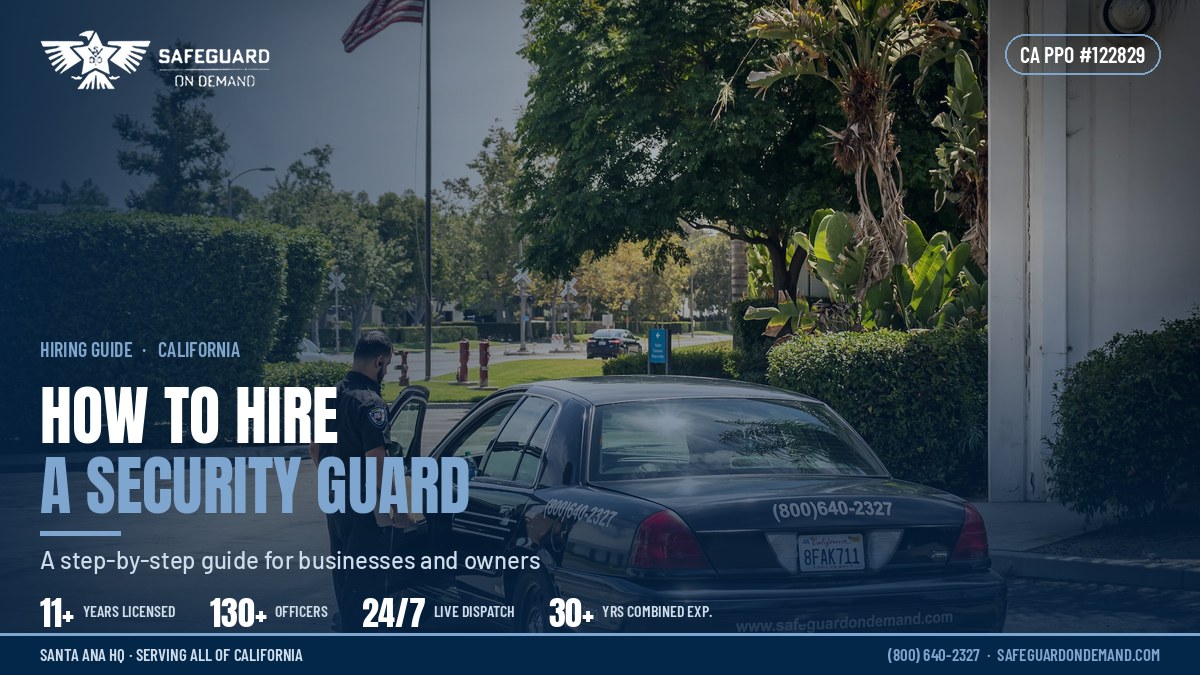
Hiring a security guard is easy. Hiring the right one, through a licensed, insured, and accountable company, takes more homework. The decision affects your liability, your insurance, your tenants or customers, and how quickly an incident is handled at 2 a.m. when nobody from management is on site.
This guide explains how to hire a security guard in California from start to finish: who benefits from coverage, which type of officer fits your site, what the law requires of every guard, how to compare companies, the red flags to walk away from, and a final checklist to use before you sign. It is written from the perspective of Safeguard On Demand, a California private patrol operator that has staffed posts across the state for more than 11 years.
Key Takeaways
- ✓Start with a written description of your risks, hours, and post duties before you call any security company.
- ✓Every unarmed guard in California must hold a current BSIS security guard registration, and armed guards also need a BSIS exposed-firearm permit.
- ✓Verify the company’s private patrol operator license and each officer’s credentials through the BSIS online license lookup.
- ✓Compare proposals on supervision, reporting, training, insurance, and response time, not on the hourly rate alone.
- ✓Get every term in a written contract, including post orders, scope, rates, and how replacements and complaints are handled.
Who Needs to Hire a Security Guard?
Security officers are no longer limited to banks and jewelry stores. Any site where people, inventory, equipment, or reputation are exposed to theft, trespass, or conflict can justify professional coverage. The common thread is a risk that cameras and locks record but cannot stop.
Property managers hire guards for apartment and condominium communities and homeowners associations that struggle with trespassing, vandalism, and package theft. Contractors protect tools and materials on construction sites, where losses spike after hours. Retailers, hospitals, warehouses, offices, and event organizers rely on officers for access control, customer safety, and incident response. California employers also have a compliance reason to think about security: Labor Code section 6401.9 (SB 553), enforceable since July 1, 2024, requires most employers to maintain a written workplace violence prevention plan, and trained officers are often part of how that plan works in practice.
Residential communities
Gate and patrol coverage for apartments, HOAs, and gated communities dealing with trespass, loitering, and vehicle break-ins.
Commercial and retail sites
Visible deterrence, loss prevention support, and customer assistance in stores, shopping centers, and offices.
Construction and industrial
After-hours protection for equipment, copper, fuel, and materials, plus fire watch when systems are impaired.
Healthcare and public venues
Access control and de-escalation in hospitals, clinics, schools, and events where crowds and emotions run high.
Types of Security Guards You Can Hire
The right officer depends on the threat level, the size of the property, and what you need the officer to do. Most sites fall into one of the categories below, and many use a combination, such as a fixed post at the lobby and a mobile patrol for the parking areas.
Unarmed officers
Unarmed security guards handle access control, patrols, customer service, and reporting at most commercial and residential sites.
Armed officers
Armed security guards hold a BSIS exposed-firearm permit and suit higher-risk sites such as cash handling, cannabis, or locations with prior violent incidents.
Standing and lobby posts
Standing guards and concierge security officers stay at a fixed post to screen visitors and give a professional first impression.
Mobile patrol
Patrol security services send a marked vehicle to multiple checks per night, a cost-effective option for large or multiple properties.
Fire watch
Fire watch officers patrol buildings when sprinklers or alarms are down or when a fire marshal requires a watch.
Remote video monitoring
Remote monitoring lets live operators watch cameras and intervene by audio, then dispatch a patrol or police.
Comparing Your Options for Security Coverage
| Option | Best for | What you manage |
|---|---|---|
| Licensed security company | Most businesses, HOAs, and property managers | Defining scope and reviewing reports; the company handles hiring, licensing, insurance, and scheduling |
| In-house security staff | Large organizations with dedicated security leadership | Recruiting, BSIS compliance, payroll, workers’ compensation, training, and shift coverage |
| Mobile patrol only | Multiple or lower-risk properties | Selecting patrol frequency and reviewing GPS-verified check reports |
| Remote video monitoring | Sites with good camera coverage and few people after hours | Camera placement and the escalation plan with the monitoring team |
What to Look For When You Hire a Security Guard in California
California regulates private security through the Bureau of Security and Investigative Services (BSIS) under the Private Security Services Act. Knowing the baseline requirements helps you spot a company that cuts corners.
- A current guard card. According to BSIS, a guard must be at least 18, pass a California Department of Justice and FBI background check through Live Scan fingerprinting, and complete Power to Arrest training before the registration is issued. The guard must carry the registration card while on duty.
- Completed skills training. BSIS requires 16 hours of additional training within 30 days of employment, another 16 hours within six months, and 8 hours of continuing training every year.
- Firearm permits for armed posts. An armed officer needs a BSIS firearms permit for the caliber carried. Since July 1, 2018, applicants must pass a BSIS firearms assessment, and under California regulations permit holders must requalify on the range twice in each 12-month period, at least four months apart. Batons require a separate BSIS baton permit.
- Relevant experience and site training. An officer who has worked hospital security or retail loss prevention already understands the pace and the people.
- Communication and judgment. Most of a guard’s day is observing, reporting, and talking people down. Clear writing and calm speech matter as much as presence.
The Best Way to Hire a Security Guard: Use a Licensed Security Company
You can technically employ a guard directly, but you would then carry the hiring, licensing checks, payroll, workers’ compensation, scheduling, supervision, and replacement burden yourself. For most businesses and associations, contracting with a licensed private patrol operator is simpler and safer, because the company is responsible for screening, training, insurance, and covering every shift.
A professional provider also brings infrastructure an individual guard cannot: live dispatch, field supervisors, and reporting tools. At Safeguard On Demand, that means 24/7 live dispatch, GPS-verified patrols, and daily activity reports, with officers trained through our security guard training program and overseen by leadership with 30+ years of combined law enforcement and private security experience. Posts are typically staffed within 24 to 48 hours, and no long-term contract is required.
The best time to ask hard questions is before the first shift. A good security company will show you its license, its insurance, sample reports, and how supervisors check on officers, and it will put all of that in writing.
— David Nawabi
President & CEO, Safeguard On Demand
Step-by-Step Process: How to Hire a Security Guard
A structured process keeps the comparison fair and the contract complete.
- 1. Assess your needs. List the problems you want solved, the hours that are most exposed, the entrances and areas to cover, and any incidents from the past year.
- 2. Choose the type of coverage. Decide between armed or unarmed officers, a fixed post or mobile patrol, and whether cameras should be monitored. A professional risk assessment helps if you are unsure.
- 3. Research licensed companies. Confirm the private patrol operator license on the BSIS online license lookup and look for experience in your industry and area.
- 4. Request a site assessment. A serious provider will walk the property before quoting. Safeguard On Demand offers this free of charge.
- 5. Compare written proposals. Review officer qualifications, supervision, reporting, insurance, and pricing side by side.
- 6. Clarify supervision and communication. Ask who your account manager is, how supervisors check on officers, and how you will receive reports.
- 7. Finalize the contract. Confirm scope, post orders, hours, rates, term, cancellation, and how complaints and replacements are handled.
- 8. Onboard the officers. Walk the site with the assigned officers, share emergency contacts, and review the post orders together.
Red Flags to Avoid When You Hire a Security Guard
Most problems with security vendors are visible before the contract is signed. Walk away, or ask much harder questions, if you see any of these warning signs.
No verifiable license
The company cannot give you a PPO number, or the number does not match its name on the BSIS lookup.
Vague answers on insurance
It hesitates to provide a certificate of insurance or to name your organization as additional insured.
Unrealistically low pricing
A rate far below the market usually means underpaid officers, thin supervision, or skipped training, and higher turnover.
No written contract or post orders
Verbal promises cannot be enforced, and officers without written orders do not know what you expect.
No reporting or supervision plan
If the company cannot show sample daily activity reports or explain supervisor checks, you will not know what happens on your site.
Final Checklist Before You Sign With a Security Guard Company
Use this list to confirm you are ready to move forward. If any item is unresolved, settle it in writing first.
- Your security goals, hours, and posts are defined in writing.
- You have chosen armed, unarmed, patrol, or a combination, and know why.
- The company’s PPO license is active and matches the business you are contracting with.
- Officers assigned to your site hold current guard cards, and armed officers hold firearms permits.
- You have a certificate of insurance and know the company is bonded.
- Pricing is itemized, including holiday and overtime rates.
- Post orders, emergency contacts, and escalation steps are agreed.
- You know how and when you will receive reports and who your account contact is.
If you manage several properties, ask how the provider covers each service area and whether a single point of contact can oversee all of them.
Frequently Asked Questions
How much does it cost to hire a security guard in California?
Rates depend on whether the officer is armed or unarmed, the number of hours, the site’s risk level, and any special duties. The U.S. Bureau of Labor Statistics reported a median annual wage of $38,020 for security guards in May 2025, but a company’s bill rate also covers payroll taxes, insurance, supervision, and training. For an exact figure, request a free quote.
How do I verify a security guard's license in California?
Use the BSIS online license lookup, searchable by name or license number, to confirm the guard registration, any firearms permit, and the company’s PPO license. A reputable provider will give you these numbers readily. Learn more about how we vet officers on our why choose us page.
Should I hire an armed or unarmed security guard?
Unarmed officers fit most residential, office, and retail sites. Armed coverage makes sense where there is cash, high-value inventory, or a history of violent incidents. A site assessment helps you decide; see our security guard services for the full range.
How quickly can a security guard start?
With a licensed company that has officers in your area, a post can often be staffed in 24 to 48 hours after the agreement and post orders are confirmed. Emergency coverage may be possible sooner. Our private security services are scheduled around your timeline.
Do I need a long-term contract to hire a security guard?
Not necessarily. Some providers require annual terms, but Safeguard On Demand does not require a long-term contract, which suits short projects, events, and trial periods. You can browse the industries we serve to see typical arrangements.
Knowing how to hire a security guard comes down to a clear scope, verified credentials, and a written agreement with a company that answers for its officers. Safeguard On Demand provides BSIS-licensed armed and unarmed officers, mobile patrol, and remote monitoring from offices in Santa Ana, Los Angeles (Northridge), San Diego, Mountain View, Sacramento, and Corona. Call (800) 640-2327 or request a free quote and site assessment today.
Get a free security assessment
Licensed armed and unarmed officers, patrols and fire watch across California. Call (800) 640-2327 or request a quote online.