

Updated October 2026 · 7 min read · Reviewed by Safeguard On Demand
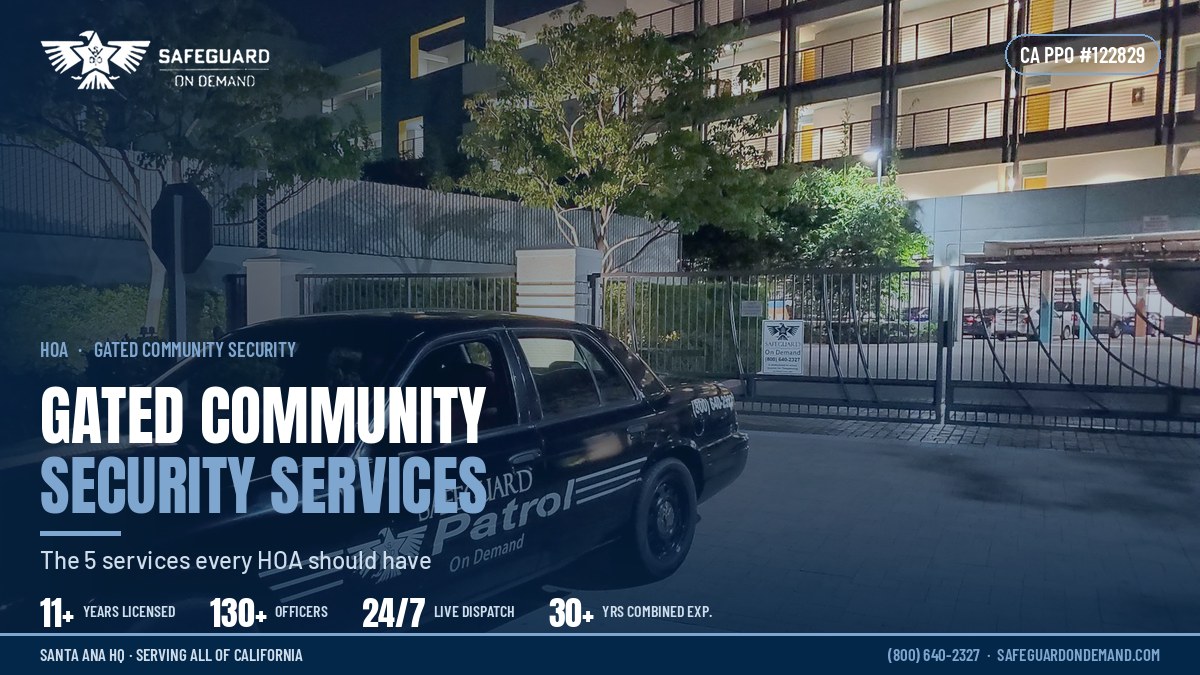
Key Takeaways
- ✓Gates slow down unwanted visitors, but without people and procedures behind them they are easy to defeat through tailgating and shared codes.
- ✓The five core gated community security services are gatehouse guards, patrols, remote video monitoring, access control management and alarm response.
- ✓Layering these services gives residents a visible presence at the entrance and coverage of the streets, amenities and perimeter inside.
- ✓The right mix depends on the community’s size, number of entrances, incident history, amenities and budget.
- ✓California security officers must hold a BSIS Guard Card, and they observe, report and deter rather than act as police.
Why a Gate Alone Is Not Enough
Gated communities do see fewer casual pass-through visitors, but they are not immune to crime or disorder. Some offenders target gated neighborhoods precisely because they expect valuable homes and vehicles behind the gate. The most common problems board members and managers report fall into a few categories.
Tailgating
Vehicles and pedestrians follow residents through the gate before it closes, bypassing every visitor check.
Package Theft
Deliveries left at doors and mail areas are easy targets for anyone who gets inside.
Vehicle Break-Ins
Cars parked in driveways, guest spaces and garages attract thieves, especially at night.
Vandalism
Damage to gates, landscaping, pools and clubhouses raises maintenance costs and frustrates residents.
Amenity Misuse
Non-residents using pools, gyms and parks create liability and crowd out the people who pay for them.
Rule Violations
Speeding, unauthorized parking and noise complaints need consistent documentation the board can act on.
5 Professional Security Services Every Gated Community Should Have
These five services form the foundation of a professional security program. Many communities start with one or two and add others as needs change.
- 1. Gatehouse and standing guards. A uniformed standing guard at the main entrance verifies visitors, logs vehicles, manages contractor and delivery access and gives residents a familiar face. Over time, gate officers learn who belongs, which makes unusual activity easier to spot.
- 2. Patrol security services. Officers on foot or in marked patrol vehicles cover the streets, perimeter walls, common areas and amenities that the gatehouse cannot see. Randomized patrol timing keeps anyone from learning the schedule.
- 3. Remote video monitoring. Live operators watch cameras at entrances, pools and perimeter areas, use two-way audio to warn trespassers and dispatch an officer when needed. Remote monitoring extends coverage cost-effectively during overnight hours.
- 4. Access control and gate management. Resident credentials, visitor pre-authorization and gate logs work best when officers manage them, deactivate lost credentials and watch for tailgating.
- 5. Alarm response. When a gate, clubhouse or amenity alarm activates, an officer is dispatched to verify the cause, secure the area and contact police or fire when an actual emergency is confirmed.
Gated Community Security Services Compared
| Service | What It Does | Best For |
|---|---|---|
| Gatehouse or standing guard | Verifies visitors, logs vehicles, manages deliveries | Main entrances with steady traffic |
| Patrol security | Checks streets, perimeter, amenities and common areas | Larger communities and overnight hours |
| Remote video monitoring | Live camera watch with two-way audio and dispatch | Secondary gates, pools and after-hours coverage |
| Access control management | Manages credentials, visitor lists and gate logs | Communities with tailgating or shared-code problems |
| Alarm response | Verifies alarms and secures the area | Clubhouses, amenities and gate equipment |
How These Services Work Together
Each service covers a gap in the others. The gatehouse controls the front door, but patrols see what happens inside. Cameras never get tired, but they cannot close a pool gate or speak with a resident. Access control creates records, but someone has to review them and act.
A typical layered program for a mid-sized community might include a gate officer during peak traffic hours, patrol security visits overnight, cameras monitored remotely at entrances and amenities, and alarm response on call. Every officer works from the same post orders and reports to the same dispatch center, so incidents are tracked from first observation to final report.
For communities that want a more hospitable feel, concierge security officers can combine visitor service with security duties at a front desk or clubhouse.
Does Your Gated Community Need All Five Services?
Not necessarily. Security should be sized to the community, not copied from another one. A professional assessment looks at these factors before recommending coverage.
Size and Layout
More streets, cul-de-sacs and perimeter wall mean more ground for patrols to cover.
Number of Entrances
Each vehicle and pedestrian gate is a potential gap that needs a person, a camera or both.
Incident History
Board minutes, resident complaints and police calls show where and when problems actually happen.
Amenities
Pools, gyms, clubhouses and parks often need dedicated checks, lock-up service or camera coverage.
Budget and Expectations
The board can balance live officers with remote monitoring to reach the level of service residents expect.
Residents judge their security by the gate, but most problems start inside it. The communities that get the best results treat the gatehouse, the patrol and the cameras as one program with one set of post orders.
— David Nawabi
President & CEO, Safeguard On Demand
What HOA Boards Should Look for in a Security Provider
In California, every security officer must hold a security guard registration (Guard Card) from the Bureau of Security and Investigative Services (BSIS), and the company must be a licensed private patrol operator. BSIS requires guards to complete Power to Arrest and Appropriate Use of Force training before registration, additional training within their first six months and 8 hours of continuing training each year.
It is also important to understand what officers can and cannot do. Security officers in California are not police. They observe, deter, report and enforce the community’s rules through documentation and communication with management. They can make a citizen’s arrest only under the limited circumstances allowed by state law, and a good provider trains officers to avoid confrontation and call police when needed. Our security guard training page explains how we prepare officers.
- Verify the PPO license number and certificate of insurance.
- Ask for sample post orders, daily activity reports and incident reports.
- Confirm patrols are GPS-verified and dispatch is staffed 24/7.
- Ask how officers handle rule violations, visitors and resident complaints.
- Review contract terms and how quickly coverage can change.
Why California Communities Choose Safeguard On Demand
Safeguard On Demand has protected California communities for more than 11 years. Our 130+ BSIS-licensed officers provide gated community security, HOA security and apartment and condominium security supported by 24/7 live dispatch, GPS-verified patrols and daily activity reports.
Our leadership brings more than 30 years of combined law-enforcement and private-security experience. We are fully bonded and insured, require no long-term contract and typically staff new posts within 24 to 48 hours. We serve communities statewide from offices in Santa Ana, Northridge, San Diego, Mountain View, Sacramento and Corona. Learn more about our company or see why clients choose us.
Frequently Asked Questions
What security services does a gated community need?
Most gated communities benefit from a gatehouse or standing guard, patrols, remote video monitoring, access control management and alarm response. The right mix depends on size and risk. See our gated community security options.
Can a gated community security guard stop a car from entering?
Officers can deny access under the community’s rules and gate procedures, and they document and report anyone who refuses to comply. They do not have police powers, so they call law enforcement when a situation requires it. Learn more about our unarmed security guards.
How do security guards prevent tailgating at gates?
Gate officers watch each entry, stop vehicles that follow residents through and verify them, while cameras record the gate for review. Parking and garage security uses similar controls.
Is remote video monitoring enough for a gated community?
It can work well for secondary gates and overnight hours, but most communities still need officers who can respond in person. Combining cameras with foot patrol officers covers both needs.
Do gated communities need armed security?
Most do not. Unarmed officers are the norm for residential communities. Armed coverage is an option for higher-risk situations, and California requires a BSIS exposed firearm permit for armed security guards.
A gate is only the first layer. With the right combination of officers, patrols, cameras and procedures, your community can feel as secure as it looks. Explore our HOA security services, then request a free quote or call Safeguard On Demand at (800) 640-2327 to schedule a free site assessment for your community.
Get a free security assessment
Licensed armed and unarmed officers, patrols and fire watch across California. Call (800) 640-2327 or request a quote online.