
by Safeguard On Demand · Updated November 2026
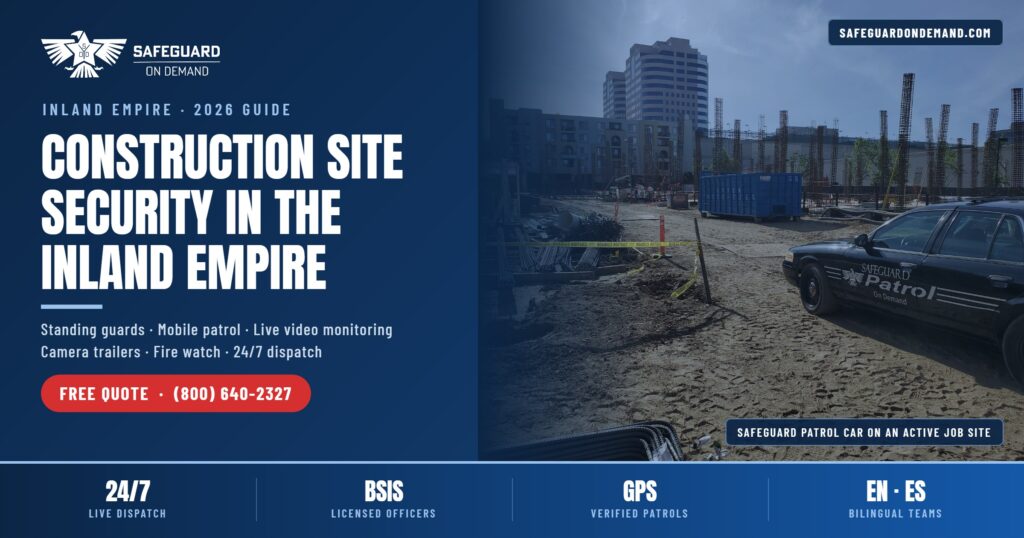
Construction site security Inland Empire builders can rely on starts with one fact: job sites in San Bernardino and Riverside counties sit open, spread out and full of resellable material for months at a time. Copper wire, tools, fuel, catalytic converters and compact equipment walk off fenced lots every week, and each loss can stall a schedule far longer than the item itself costs to replace. This guide explains which layers actually stop theft, what California rules apply, and how to build coverage that fits each phase of your project.
Quick answer
Construction site security Inland Empire contractors trust combines a licensed officer or marked patrol during the riskiest hours, live-monitored cameras for the rest of the night, and tight gate, key and material controls. Match the coverage to the project phase: heaviest during framing, rough-in and the weeks when copper and equipment are on site.
- Most job-site theft happens nights, weekends and holidays when no one is on site.
- Copper wire, tools, fuel and compact equipment are the top targets, so equipment theft prevention matters from day one.
- California security officers must hold a BSIS guard card; armed officers need a firearms permit.
- A 2025 state law (AB 476) tightened scrap-metal records and raised fines for stolen infrastructure metal.
- Layered coverage (patrol, standing guard and live remote monitoring) beats any single tool.
- Daily, GPS-verified reports give you proof for insurers, lenders and owners.
Why Inland Empire job sites are prime theft targets
The Inland Empire builds at a scale few regions match: big-box logistics buildings along the I-10 and I-15, master-planned housing tracts, utility-scale solar in the High Desert, and road and infrastructure upgrades across the valley floor. Those projects share traits thieves look for: long perimeters, temporary fencing, materials staged in the open and quiet hours after crews leave.
Freeway access matters too. A site within a few minutes of an on-ramp lets a crew load a trailer and disappear into regional traffic quickly. Remote parcels in the High Desert face the opposite problem: no neighbors, long police response distances and wide open approaches.
What gets stolen most
- Copper wire and cable: pulled from spools, conduit and temporary power.
- Power tools and generators: easy to carry, easy to resell.
- Fuel: siphoned from equipment and storage tanks overnight.
- Compact equipment: skid steers, mini excavators, light towers and trailers.
- Appliances and fixtures: staged inside nearly finished homes and units.
- Catalytic converters: cut from work trucks and parked equipment.
Effective equipment theft prevention starts before the first machine is unloaded. Record serial numbers, photograph every unit, fit GPS trackers to high-value equipment and agree on a nightly parking spot that cameras and patrols can see. Those habits make construction site security Inland Empire crews depend on far more effective, because officers know exactly what belongs on site and what does not.
Construction site security Inland Empire options compared
No single tool fits every project. The right construction site security Inland Empire plan usually blends two or three of the options below, weighted toward the hours and phases with the most exposure. Our overview of types of construction site security covers each one in more depth.
| Option | Best for | Strength | Limitation |
|---|---|---|---|
| Standing (on-site) guard | High-value phases, large or busy sites | Constant presence, gate control, immediate response | Highest hours commitment |
| Marked mobile patrol | Smaller sites, several sites near each other | Visible deterrent, random checks, lock-up checks | Gaps between visits |
| Live remote video monitoring | Overnight and weekend coverage | Operators see intruders and act in real time | Needs power, signal and good camera placement |
| Mobile surveillance unit (camera trailer) | Sites without fixed power or poles | Fast deployment, solar powered, moves with the project | Must be paired with live monitoring to stop theft |
| Fire watch | Hot work, impaired fire systems | Meets fire authority requirements | Safety-focused, not a substitute for patrol |

California rules every contractor should know
Anyone hired to protect a job site in California must be registered with the Bureau of Security and Investigative Services (BSIS) and employed by a licensed private patrol operator. Officers complete Power to Arrest training before registration and 32 hours of skills training within six months, plus 8 hours of continuing training every year, according to the BSIS security guard fact sheet. Armed officers also need a BSIS firearms permit. Ask any vendor for proof before the first shift.
California’s tougher copper theft law
In October 2025 the governor signed AB 476 (Chapter 694, Statutes of 2025). It requires junk dealers and recyclers to keep more detailed transaction records, including a signed statement of lawful ownership, expands the list of infrastructure metals they cannot accept without documentation, and raises the maximum fine under Penal Code §496e from $3,000 to $5,000. For contractors, the practical takeaway is simple: document your wire and metal deliveries, mark spools, and report thefts quickly so recovered material can be traced back to you.
What security officers can and cannot do
Security officers observe, deter, document and report. They can control access at the gate, enforce posted site rules, ask trespassers to leave and contact law enforcement. Any detention follows California’s private-person arrest rules, which is why strong post orders and good judgment matter more than confrontation. For the San Bernardino County Sheriff’s Department, the non-emergency lines and crime prevention resources are listed on the Sheriff’s official site.
How to build a job site security plan, step by step
A written plan turns construction site security Inland Empire projects from guesswork into a routine that every trade on the job follows. Use these seven steps on any site, from a single-lot build to a large logistics campus.
- Walk the site at night. Note dark corners, fence gaps, unlit staging yards and the routes a vehicle could use to get in and out.
- Map exposure by phase. Grading needs equipment protection; rough-in brings copper and tools; finish work brings appliances and fixtures.
- Pick the coverage mix. Decide which hours get a standing officer, which get patrol visits and which get live remote monitoring.
- Write clear post orders. Gate hours, approved vendors, delivery procedures, who to call and what counts as an incident.
- Control keys and equipment. Basic equipment theft prevention means locking out machines, removing keys nightly, and parking equipment in a lit, camera-covered area.
- Require proof. Ask for timestamped photos, GPS-verified patrol checkpoints and a daily activity report.
- Review monthly. Adjust coverage as phases change and as the site fills with higher-value material.
What drives the cost of construction site security in the Inland Empire
Pricing for construction site security Inland Empire projects depends far more on scope than on any single rate. The biggest drivers are:
- Hours of coverage: nights only, nights plus weekends, or around the clock.
- Armed vs. unarmed: armed coverage carries extra licensing and insurance requirements.
- Site size and layout: larger perimeters may need a vehicle, a second officer or more cameras.
- Patrol frequency: the number of visits per night and the length of each check.
- Equipment needs: camera trailers, lighting, power and cellular data.
- Contract length: short phases versus full-project coverage.
The cheapest coverage is rarely the cheapest outcome. One stolen spool of wire, a missing generator or a vandalized electrical room can delay inspections and push back the whole schedule.
Common mistakes that leave job sites exposed
Even a well-funded construction site security Inland Empire plan fails when the basics slip. These are the gaps that show up most often on regional job sites.
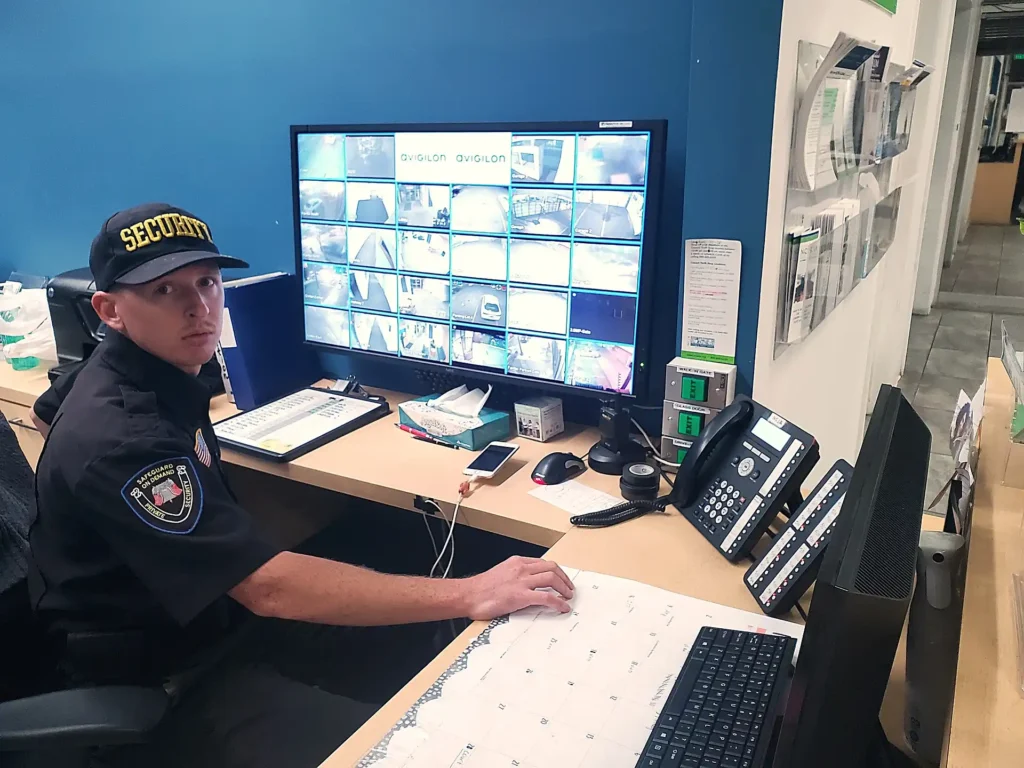
- Cameras with no one watching. Recorded-only video tells you what happened; live monitoring lets an operator intervene while it is happening.
- Predictable patrol times. Thieves watch sites. Randomized visits and lock-up checks are harder to plan around.
- Leaving keys in equipment. It undoes every other equipment theft prevention step and turns a theft attempt into a quick drive-off.
- Ignoring holidays. Long weekends and the end-of-year shutdown are peak theft windows.
- Hiring unlicensed help. An unregistered “watchman” creates liability and is not a licensed security officer.
- No written reports. Without timestamped records, insurance claims and disputes get much harder.
San Bernardino County focus
San Bernardino County is the largest county in the contiguous United States by area, and its construction work reflects that range. In the West Valley, new distribution centers and industrial parks continue to rise in Ontario and Fontana, often with large staging yards and dozens of trailers on site. Rancho Cucamonga mixes commercial pads with residential tracts, where appliances and fixtures become targets in the final weeks before move-in.
Along the I-10 and I-215, Rialto and nearby cities host logistics and infrastructure projects with long perimeters that are hard to light. Up the Cajon Pass, Victorville and the High Desert see housing, retail and energy projects on remote parcels where response distances are long and wind can knock down temporary fencing. For job site security San Bernardino County’s High Desert parcels, the best results come from solar camera towers paired with live monitoring and scheduled patrol visits.
Weather adds its own risk. Santa Ana winds can flatten temporary fencing and knock out site lighting, and summer heat pushes crews to start early and leave by mid-afternoon, which widens the unattended window. Plan extra patrol checks after wind events and keep spare fence panels and lights on hand.
Construction site security Riverside County builders use follows the same layered approach. Warehouse and housing projects in Eastvale, Jurupa Valley, Moreno Valley and around Corona sit close to the 91, I-15, SR-60 and I-215, where quick getaways make live monitoring and randomized patrols especially valuable.
Our Inland Empire office in Corona, CA covers San Bernardino County, with dispatch available 24/7. If you are also building in Riverside County or managing finished logistics buildings, our Inland Empire warehouse security playbook covers the operational side once the keys are handed over.
How Safeguard handles construction site security Inland Empire projects
Safeguard On Demand, Inc. is a licensed California private patrol operator with BSIS-registered officers, live 24/7 dispatch and offices across the state, including Corona for the Inland Empire. We start with a site walk, then build a coverage plan around your schedule and the phases that carry the most risk. Coverage can include unarmed or armed officers at the gate, marked mobile patrols with randomized checks, live remote video monitoring where operators watch and respond in real time, and mobile surveillance units for sites without fixed power. When hot work or an impaired system requires it, we also provide fire watch.
Every shift produces timestamped photo reports and GPS-verified checkpoints, so you can see exactly when the site was checked and what was found. Our bilingual officers can deploy quickly, and coverage scales up or down as the project moves from grading to closeout. Officers can also log equipment counts at lock-up, which supports equipment theft prevention and gives your insurer clean records. See our full construction site security services for details.

Construction site security Inland Empire: frequently asked questions
How much does construction site security cost in the Inland Empire?
Construction site security Inland Empire pricing depends on hours of coverage, armed or unarmed officers, site size, patrol frequency and any camera equipment. Most contractors save by combining patrol or live monitoring with a standing officer only during the riskiest phases. A free site assessment gives you an exact quote.
Is a security guard or remote video monitoring better for a job site?
It depends on the site. A standing guard gives constant presence and gate control, while live remote monitoring covers large areas overnight at lower cost. Many Inland Empire projects use both: monitoring at night and an officer during deliveries, weekends or high-value phases.
Do construction security guards need a license in California?
Yes. Security officers must be registered with the California Bureau of Security and Investigative Services (BSIS) and work for a licensed private patrol operator. Armed officers also need a BSIS firearms permit.
When is construction site theft most likely?
Nights, weekends and holidays, when crews are gone. Theft also spikes when copper wire, appliances or new equipment arrive on site, so coverage should increase during those phases.
What should I do if copper wire is stolen from my site?
Report it to local law enforcement right away, share delivery records and spool markings, and review camera footage. California’s AB 476 tightened scrap-metal dealer records, which can help investigators trace stolen material.
Which areas does Safeguard cover for construction site security?
We handle job site security San Bernardino builders need and construction site security Riverside County projects call for, from our Inland Empire office in Corona, CA. That includes Ontario, Fontana, Rancho Cucamonga, Rialto and Victorville, plus job sites across our other California service areas.
Get a free construction site security quote
Protect your schedule, materials and equipment with construction site security Inland Empire contractors can count on: BSIS-licensed officers, live 24/7 dispatch, GPS-verified patrols and no long-term contract. Call (800) 640-2327 or request your free quote online.