

Updated October 2026 · 8 min read · Reviewed by Safeguard On Demand
Key Takeaways
- ✓Security patrolling puts trained, uniformed officers in motion across your property on foot or in marked vehicles, on scheduled or randomized routes.
- ✓The biggest benefit is prevention: a visible, unpredictable patrol discourages theft, vandalism and trespassing before they start.
- ✓Patrols cover more ground than a single fixed post, which makes them cost-effective for parking lots, business parks and multi-building sites.
- ✓GPS-verified checkpoints and daily activity reports turn every patrol into documented proof of coverage for owners, insurers and managers.
- ✓In California, every patrol officer must hold a BSIS security guard registration and complete state-mandated training before and after assignment.
What Is Security Patrolling?
Security patrolling is the planned, repeated movement of trained officers through a property to observe, deter and respond. Officers travel on foot, by bicycle or in marked patrol vehicles, following routes built around the site’s entrances, perimeter, parking areas and high-value zones.
Patrols can be scheduled at fixed intervals, randomized so the timing cannot be predicted, or combined with remote video monitoring for round-the-clock coverage. The defining feature is that a person is actively checking the property, not passively waiting for an alarm. A good patrol officer tests door handles, inspects fences and gates, checks lighting, notes vehicles that do not belong and documents everything in a time-stamped report.
Patrol programs range from a few nightly visits to a single storefront up to dedicated officers who rotate continuously through a large campus. Our patrol security services are built to match the risk, layout and hours of each site rather than a one-size-fits-all route.
7 Benefits of Security Patrolling Services for Your Business
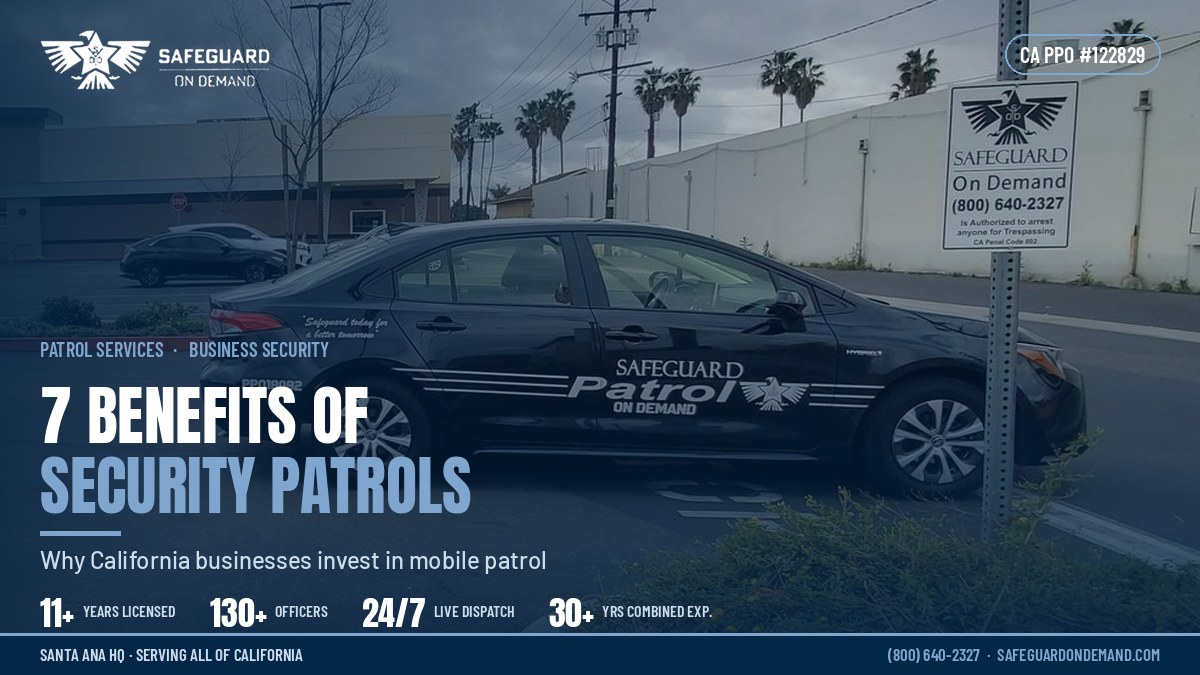
Every property is different, but these seven benefits explain why patrolling is one of the most widely used forms of commercial protection.
- 1. Visible deterrence that works. A uniformed officer moving through the property tells would-be thieves and vandals that someone is watching and can act. Most opportunistic offenders look for easy targets; an active patrol removes that sense of easy opportunity.
- 2. Faster on-site response. An officer already on the property can respond to a break-in attempt, a fire alarm, a water leak or a medical emergency within minutes, call the right responders and direct them to the exact location.
- 3. Protection from internal risks. Patrols are not only about outsiders. Routine checks of loading docks, storage rooms and after-hours access points help expose employee theft, unauthorized entry and policy violations.
- 4. Wider coverage than a fixed post. A standing guard protects one location well. A patrol covers back alleys, rooftops, garages, storage yards and parking areas that a fixed post cannot see.
- 5. A safer experience for employees and visitors. Staff leaving late, tenants walking to their cars and customers in a parking lot feel safer when they see an officer nearby. Officers can also provide escorts on request.
- 6. Real-time reporting and accountability. Modern patrols use GPS-verified checkpoints and digital incident reports with photos, so you know when each area was checked and what the officer found.
- 7. Protection customized to your property. A professional provider designs routes, timing and post orders around your entry points, lighting, crime history, operating hours and known blind spots.
Comparing Common Patrol and Guard Options
| Option | Best For | Main Strength | Trade-Off |
|---|---|---|---|
| Marked vehicle patrol | Large lots, business parks, multiple sites | Covers wide areas quickly with a visible deterrent | Officer is on site for set intervals, not continuously |
| Foot patrol | Apartments, retail centers, offices | Close inspection of doors, stairwells and common areas | Covers less ground per hour than a vehicle |
| Standing guard | Lobbies, gates, single entrances | Continuous control of one access point | Limited view of the rest of the property |
| Remote video patrol | After-hours sites with camera coverage | Constant watch with dispatch on verified activity | Needs good cameras, lighting and a field response plan |
Types of Patrol Security Services Available in California
The right format depends on property size, risk level and budget. Most sites use a combination, and the mix can change as conditions change. These are the patrol options Safeguard On Demand provides across California.
Marked Vehicle Patrol
Officers in clearly marked vehicles make scheduled or random rounds, ideal for large lots, business parks and multiple sites in one area.
Foot Patrol
Officers walk the property for close observation of doors, stairwells and common areas, which suits apartment communities, retail centers and offices.
Random and Night Patrols
Unpredictable visit times during high-risk hours make it difficult for anyone to time a break-in around the officer’s schedule.
Alarm Response
An officer is dispatched to verify alarms, secure the site and coordinate with police or fire when an actual incident is confirmed.
Lock and Unlock Service
Officers open and secure gates, doors and amenities at set times, then confirm the property is closed properly.
Remote Video Patrols
Trained operators run virtual patrols on live cameras and dispatch a field officer when activity requires an in-person response.
Patrolling Techniques That Make the Difference
Two patrol programs can look identical on paper and perform very differently in the field. The difference is in technique, supervision and documentation. These are the practices we build into every foot patrol and vehicle route.
Route Variation
Officers change the order and timing of checkpoints so no one can learn the pattern and wait for a gap.
Perimeter Checks
Fences, gates, doors, windows and lighting are inspected on every round, and defects are reported the same day.
Access Control Checks
Officers confirm that restricted areas are locked and that people and vehicles on site belong there.
Incident Documentation
Time-stamped notes and photos create a clear record for managers, insurers and, when needed, law enforcement.
Property Familiarity
Assigning consistent officers to a site builds knowledge of normal activity, which makes the abnormal easier to spot.
Emergency Readiness
Officers know shutoff locations, evacuation routes and escalation contacts before an emergency occurs.
The value of a patrol is not the number of drive-bys on a log. It is an officer who knows the property well enough to notice that something is different tonight and acts on it before it becomes an incident.
— David Nawabi
President & CEO, Safeguard On Demand
Patrol vs. Stationary Guard: Which Fits Your Property?
Patrols and fixed posts solve different problems. A fixed post is the right choice where a person must control a single access point all day, such as a lobby or a construction gate. Patrols are the better value when the risk is spread across a large area or concentrated in certain hours.
Many California properties pair the two: a daytime post at the main entrance and night patrols across the parking areas, for example. The comparison table below summarizes how the main options differ. If you are unsure which mix fits your site, our security consulting team can assess it with you.
What to Expect from a Licensed California Patrol Provider
California regulates private security through the Bureau of Security and Investigative Services (BSIS). Companies that provide guards and patrol officers for hire must be licensed as private patrol operators, and every officer must hold a BSIS security guard registration, commonly called a Guard Card.
According to BSIS, guards complete 8 hours of Power to Arrest and Appropriate Use of Force training before registration, 32 more hours of security skills training within their first six months, and 8 hours of continuing training every year. Armed officers also need a BSIS exposed firearm permit. You can learn how we exceed these minimums on our security guard training page.
Beyond licensing, ask any provider how patrols are verified, how incidents are reported and how quickly they can staff your site.
- Confirm the company’s private patrol operator license number and insurance.
- Ask for sample daily activity and incident reports.
- Find out whether patrols are GPS-verified and whether dispatch is staffed 24/7.
- Clarify contract terms, including notice periods and how schedules can change.
Why California Businesses Choose Safeguard On Demand for Patrol Security
Safeguard On Demand has protected California properties for more than 11 years. Our leadership brings more than 30 years of combined law-enforcement and private-security experience, and our 130+ BSIS-licensed officers work from offices in Santa Ana, Northridge, San Diego, Mountain View, Sacramento and Corona.
Every patrol is supported by 24/7 live dispatch, GPS-verified checkpoints and daily activity reports. We patrol shopping centers, business parks, warehouses, apartment communities, HOAs and parking garages, and we are fully bonded and insured. There is no long-term contract required, and new patrol routes are typically running within 24 to 48 hours. See the full list of California service areas or read why clients choose us.
Frequently Asked Questions
What are the main benefits of security patrolling services?
The main benefits are visible deterrence, faster on-site response, wider coverage than a single post, protection against internal theft, a safer environment for people on the property and documented proof of every check. Learn more about our security guard services.
How often should a security patrol visit my property?
It depends on the risk, the property size and your hours. Many sites start with several randomized visits per night and add more during high-risk periods. A free site assessment is the best way to set the right frequency.
Is a mobile patrol cheaper than a full-time guard?
Usually, because a patrol officer covers a site for set intervals rather than every hour of a shift. Rates depend on armed or unarmed coverage, hours and site risk, and you can compare options with our unarmed security guard service.
Can patrol officers be armed?
Yes. In California, armed officers must hold a BSIS exposed firearm permit in addition to a Guard Card. Higher-risk sites may benefit from our armed security guards.
Can patrols be combined with camera monitoring?
Yes. Pairing field patrols with remote video monitoring gives you continuous coverage, with an officer dispatched when operators see activity that needs an in-person response.
A well-designed patrol program protects more of your property, deters problems before they start and gives you a clear record of what happened every night. If you want to see what that looks like for your site, request a free quote or call Safeguard On Demand at (800) 640-2327 to schedule a free site assessment.
Get a free security assessment
Licensed armed and unarmed officers, patrols and fire watch across California. Call (800) 640-2327 or request a quote online.