
Schools & Universities
School & University Security Guards in California
Calm, community-minded officers for K-12 campuses, colleges and private schools — with the state-required school security training, fingerprint clearance and a focus on students’ safety.
- 24-hour school security course
- Fingerprint cleared
- Campus & event coverage
- Se habla español
School-trained
24-hour BSIS school security course.
Cleared for schools
Fingerprint clearance required.
Student-friendly
Approachable, calm presence.
Pickup & drop-off
Traffic and gate coverage.
Quick answer
What training do security guards need to work at California schools?
In California, every security guard working on K-12 school district property — including contract guards from a licensed private patrol operator — must complete the state’s 24-hour school security course developed by BSIS with POST, and must have fingerprint clearance and not be barred from school employment (Business & Professions Code §7583.45; Education Code §38001.5 for district-employed officers). Colleges must also publish annual campus security reports under the federal Clery Act. Safeguard On Demand provides school-qualified officers for campuses across California.
Key facts
- 24-hour BSIS school security course required
- Fingerprint clearance for school work
- Applies to contract guards on K-12 property
- Clery Act reports for colleges
- Calm, student-focused officers
The challenge
Open campuses need careful security
Schools must stay welcoming for students and families while controlling who comes on campus.
Open campuses
Multiple gates and open layouts make visitor control difficult.
Pickup and drop-off
Traffic, gates and crowds at the start and end of the day.
Working with students
Officers must be calm and community-oriented, not intimidating.
Coverage options
School security services
Matched to your campus.
Our standards
What every school post includes
Student-focused and compliant.
School-qualified officers
24-hour school security course.
Fingerprint clearance
Cleared for school work.
De-escalation
Calm, respectful approach.
Incident reports
Clear documentation for administrators.
For administrators
Questions to ask a school security provider
Here is how we answer.
| Ask the vendor | Safeguard On Demand |
|---|---|
| Have your officers completed the 24-hour school security course? | Officers assigned to K-12 campuses complete the required BSIS school security course. |
| Are officers fingerprint cleared? | Yes, as required for school work. |
| Can you cover games and events? | Yes. |
| Can you cover pickup and drop-off? | Yes — gates and traffic coordination. |
| Do you offer after-hours patrols? | Yes. |
| Is there a long-term contract? | No long-term contract. |
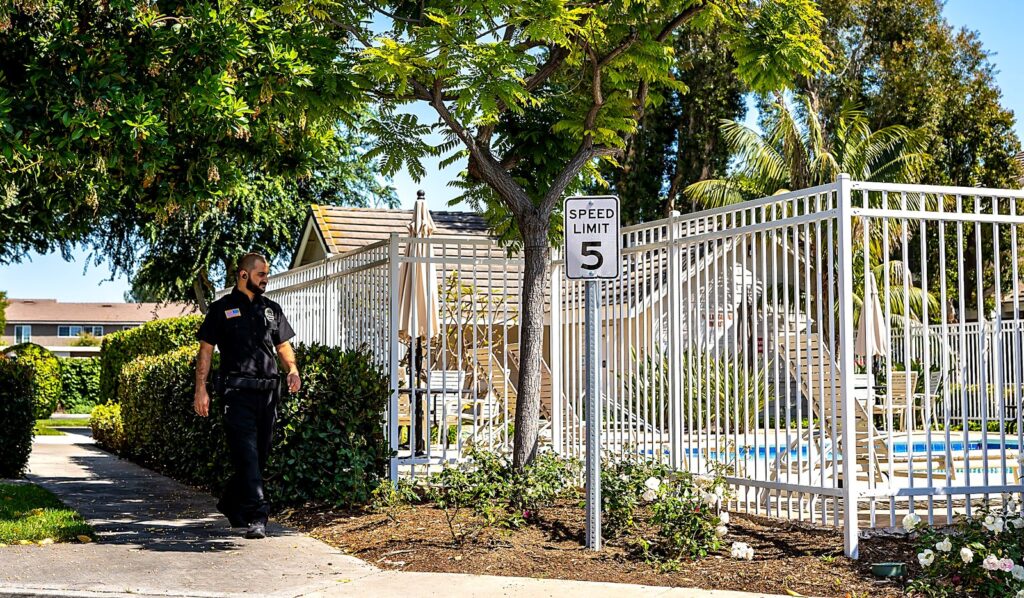
Campuses we serve
Security for every kind of campus
K-12 to higher education.
Statewide
School security across California
Served from the office nearest your site, with officers across 13 California counties.
How it works
How school security starts
Built with your administrators.
01
Campus walk
Gates, buildings, traffic and incident history.
02
Post orders
Visitor, emergency and student-interaction procedures.
03
Qualified officers
School-trained, fingerprint-cleared officers assigned.
04
Reports & review
Incident reports and regular reviews.
Choosing coverage
What does a school security program look like?
Most schools combine a campus officer during the school day with event security for games and performances and after-hours patrol to prevent vandalism. Large campuses benefit from bike and golf cart patrol.
Officers should be unarmed in most school settings, chosen for temperament and trained in de-escalation. See unarmed security guards.
California requirements
California rules for school security guards
All security guards working on K-12 school district property, including contract guards from a licensed private patrol operator, must complete the 24-hour school security course developed by BSIS with POST, have fingerprint clearance and not be barred from school employment (Business & Professions Code §7583.45). School security officers employed directly by a district must complete the same course under Education Code §38001.5; the old part-time exemption ended July 1, 2021. Officers who carry firearms also need Penal Code §832 training.
Colleges must publish an Annual Security Report with campus crime statistics under the federal Clery Act. Every officer must hold a BSIS Guard Card and work for a licensed private patrol operator — 8 hours of Power to Arrest and Appropriate Use of Force training before registration, 32 more hours within six months, and 8 hours of continuing training every year.
Every officer we assign holds a current BSIS guard card, and you can verify any license on the California Bureau of Security and Investigative Services website.
School security checklist
- 24-hour school course completed
- Fingerprint clearance confirmed
- Visitor procedure in writing
- Pickup/drop-off plan
- Emergency and lockdown plan
- Event security plan
Budgeting
What affects the cost of school security
Priced to your campus.
Hours
School day, after hours or events.
Campus size
Gates and buildings.
Officers
Number of posts.
Events
Games and performances.
After-hours patrol
Vandalism prevention.
School year
Seasonal schedules.
School security FAQs
Yes. Guards on K-12 district property must complete the 24-hour BSIS school security course and have fingerprint clearance. For schools and universities, every post includes written post orders you approve, BSIS-licensed and background-checked officers, hourly photo reports, unannounced supervisor checks and 24/7 dispatch, so you always know what happened on your property. Request a free assessment to get a written plan.
Yes — Business & Professions Code §7583.45 applies to contract guards from licensed private patrol operators. Pricing for schools and universities depends on hours of coverage, armed or unarmed officers, whether you need a full-time post, mobile patrol or remote monitoring, site size and risk. You receive a fixed-rate, all-inclusive written proposal after a free assessment, and there is no long-term contract. Our guide to what affects security guard cost in California explains each factor.
Usually not. Most school posts are unarmed and focused on de-escalation. Unarmed officers handle most schools and universities posts — access control, visible deterrence, customer service and reporting. Armed officers, who carry a BSIS exposed-firearm permit, fit sites with a credible threat of violence or high-value assets. We recommend the right level after a free risk assessment; see armed vs. unarmed security guards in California.
Yes. Our event security teams handle entry screening, crowd flow, bag checks, VIP protection and parking, scaling from one officer to crowds of 10,000 and more, with a site commander and radio dispatch on larger events.
Colleges publish annual security reports under the federal Clery Act. Every post comes with proof of service: hourly reports with timestamped, GPS-tagged photos and notes, unannounced supervisor field checks, immediate incident reports and daily activity reports you can hand to insurers, auditors or your board.
Statewide. The heaviest demand for schools and universities security comes from Los Angeles County, Orange County and Sacramento County, served from our Los Angeles (Northridge) office and Santa Ana headquarters and Sacramento office, but we cover schools and universities across all 13 California counties from six offices — Santa Ana (HQ), Northridge, San Diego, Corona, Sacramento and Mountain View. Local supervisors run each region, 24/7 dispatch backs every post, and same-day starts are available in most cases. See all office locations or request a free assessment for your site.
Where we provide this coverage
Posts are staffed from the nearest of our six California offices — same day in most areas. Free assessment: (800) 640-2327.