
4 Ways to Make Your Parking Lot Safer: A California Property Guide

Make your parking lot safer with better lighting, access control, video monitoring and security patrols. A practical guide for California property owners and managers.
4 Common Security Mistakes to Avoid in a Gated Community
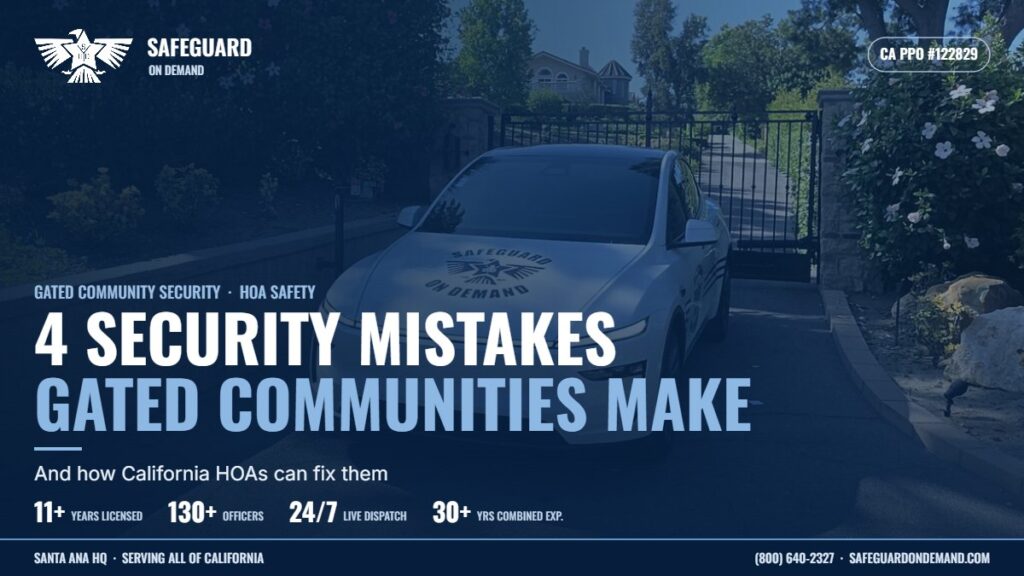
Avoid the four most common gated community security mistakes, from relying on the gate alone to weak visitor management. A practical guide for California HOAs and managers.
Which Businesses Need Security Guards? A Guide for California Owners

Which businesses need security guards in California? See the industries that benefit most, the risk signs to watch for, and how to choose armed, unarmed or patrol coverage.
Safeguard On Demand: Changing With California’s Security Landscape
A decade ago, many California property owners bought security the way they bought janitorial service: a set number of hours, a uniform on site and a monthly invoice. That model still exists, but it no longer reflects what the strongest programs deliver. Training standards have tightened, workplace violence has become a formal compliance obligation, and technology now allows one patrol route or one camera tower to cover ground that once required several fixed posts. Clients have changed as well. Property managers, HR directors and facility executives expect documentation they can hand to an owner, an insurer or a regulator. This article examines how the security landscape in California has shifted, what a modern security program actually includes, and how Safeguard On Demand has reshaped its own operations over more than eleven years as a California-licensed private patrol operator. From a Uniform at the Door to a Managed Security Program The traditional security post was built around presence. An officer stood at an entrance or sat behind a desk, and deterrence came from visibility alone. Presence still matters; an alert, professional officer remains one of the most effective deterrents available. What has changed is the expectation that presence be designed, measured and adjusted. A modern program begins with an assessment of the site, defines exactly what the officer must do and when, records whether it was done, and uses that record to refine coverage over time. In practical terms, that means a written scope of work, post orders tied to specific risks, patrol routes that can be verified and reports a client can actually read. It also means a provider willing to recommend fewer hours where technology does the job better, and more where the risk demands it. The Forces Reshaping Private Security in California Stricter training and use-of-force standards California’s Bureau of Security and Investigative Services (BSIS) has raised the bar for everyone who holds a Guard Card. Before a security guard registration is issued, the applicant must complete an eight-hour course that now pairs three hours of Power to Arrest with five hours of Appropriate Use of Force, with de-escalation and scenario work delivered in person. Officers then complete 32 hours of security officer skills training: 16 hours within 30 days of employment and the remaining 16 within six months. Every registered officer must also complete eight hours of continuing training each year, including at least two hours reviewing use-of-force topics. Armed work carries additional obligations. An exposed-firearm permit requires the applicant to be at least 21, complete a Bureau-approved firearms course and requalify on the range twice in each twelve-month period of the two-year permit term. First-time applicants who hold a security guard registration must also pass a psychological assessment of their judgment, restraint and self-control. The direction of travel is unmistakable: the state now treats de-escalation and sound judgment as core competencies rather than optional extras. Workplace violence is now a compliance issue Senate Bill 553, codified at Labor Code section 6401.9, became enforceable on July 1, 2024. It requires most California employers to maintain a written Workplace Violence Prevention Plan, train employees, keep a violent incident log and retain those logs for at least five years. The law also directs the state’s Occupational Safety and Health Standards Board to adopt a formal general-industry standard. For many organizations, the security provider has become a working partner in that plan. Officers observe and report incidents, support emergency procedures and generate much of the documentation the plan relies on. Clients expect proof, not promises Owners and boards increasingly ask a simple question: how do we know the patrol happened? Paper logbooks asked clients to take too much on trust. Today they expect GPS data, checkpoint scans, photographs and time stamps confirming when an officer was on site and what the officer found. Insurers and attorneys request the same records after an incident, often months later. Labor costs and the case for blended coverage California wage and hour rules shape every staffing decision. Overtime begins after eight hours in a workday and double time after twelve, and an officer working more than five hours is entitled to a meal period that, at most posts, requires relief coverage. As labor costs rise, well-advised clients put human officers where judgment is needed and let technology carry the routine observation. What a Modern Security Program Looks Like Technology-assisted, GPS-verified patrols Mobile patrol has become far more accountable. A well-run patrol security service tracks officers and vehicles by GPS, places scannable checkpoints at gates, stairwells and loading docks, and randomizes arrival times so that routines cannot be studied. A marked vehicle patrol can cover several properties in one shift, perform lock-ups and unlocks, respond to alarms and still document every stop. For the client, the result is coverage spread across the night at a fraction of the cost of a fixed post. Remote video monitoring and mobile surveillance units Cameras once recorded crime for later review. Remote video monitoring now lets trained operators watch live feeds, issue audio warnings through on-site speakers and dispatch an officer or police while an intrusion is still underway. Where there is no power or network, mobile surveillance units, the solar-powered camera towers and trailers now common on California job sites, extend the same capability to parking lots, vacant parcels and active construction projects. Paired with a patrol response, these tools close the gaps between officer visits. Hourly reports with timestamped photos Daily activity reports have evolved from a handwritten summary at the end of a shift into structured, hourly entries. A strong report records each round, any condition found, the action taken and who was notified, supported by timestamped photographs. A client can see an open gate at 2:14 a.m. and the photo of it secured two minutes later. That record has value on its own, and it becomes indispensable when a property must support an insurance claim or complete an SB 553 incident log. De-escalation as a core skill Most situations an officer encounters are not
Common Areas That Are Vulnerable to Security Lapses (and How to Protect Them)
Lobbies, parking garages, stairwells, mailrooms, loading docks and amenities are where security lapses happen. Learn how California properties protect common areas.
Professional Security Guard Services in Orange County: A Guide
Orange County is home to 3,149,507 people, according to the U.S. Census Bureau’s July 1, 2025 estimate, spread across 34 incorporated cities and roughly 793 square miles of land. Census data also counted 106,961 employer establishments in the county in 2023. That density of residents and businesses, from coastal resort towns to inland logistics hubs, produces an unusually varied security landscape. A program that works for an Irvine office campus would be wrong for a Huntington Beach apartment complex, and neither resembles what a construction site in Santa Ana needs at 2 a.m. This guide covers the property types that define Orange County, the services available, what professional security guard services typically cost, and how to choose a provider. For a summary of our regional coverage, see our Orange County security services page. Orange County’s Security Landscape Few regions combine so many property types in such a compact area. Business parks and corporate campuses sit a short drive from master-planned communities, regional shopping centers, world-famous attractions, major medical centers and active construction. Each brings its own pattern of risk. Business parks and corporate campuses Irvine’s business districts, the office corridors near John Wayne Airport and the commercial centers of Costa Mesa and Tustin house thousands of employers. Their concerns are access control, after-hours intrusion, vehicle break-ins in surface lots and parking structures, and the workplace violence prevention obligations California’s SB 553 placed on most employers in July 2024. Lobby officers, randomized patrols of parking areas and clear escalation procedures form the backbone of effective business park security. HOAs and master-planned communities Much of south Orange County, including cities such as Mission Viejo, was developed as master-planned communities governed by homeowners associations. Boards typically need gate officers, patrols of common areas and amenities, enforcement of parking and pool rules, and documentation they can present at board meetings. Officers serving an HOA community must balance firm enforcement with the courtesy residents expect from a service paid for with their dues. Retail and hospitality Orange County’s regional malls, open-air lifestyle centers and neighborhood plazas face organized retail theft, vehicle break-ins, loitering and disturbances, especially during the holiday season. The resort and hospitality district around Anaheim and the coastal hotels of Newport Beach and Huntington Beach add guest safety, event crowds and late-night activity to the mix. Healthcare Hospitals, urgent care centers and community clinics throughout the county need officers trained to calm distressed patients and visitors, control access to sensitive areas and support emergency codes. Healthcare employers are covered by their own Cal/OSHA workplace violence standard, and security officers are often central to how those facilities meet it. Construction and development Residential infill, mixed-use projects and infrastructure work keep construction active across the county. Job sites lose copper wire, tools, appliances and heavy equipment to theft, and partially built structures attract trespassers. Overnight patrols, standing officers at gates, solar-powered camera towers and fire watch for buildings with impaired fire protection systems are the standard tools. Security Services Available in Orange County Unarmed security officers for lobbies, gatehouses, retail centers, healthcare facilities and residential communities. Armed security officers holding BSIS exposed-firearm permits, for cash handling, high-value assets and sites with elevated threat levels. Mobile vehicle patrol with GPS-verified, randomized visits, lock-ups, alarm response and trespass enforcement. Concierge and reception officers for Class A office buildings and luxury residential properties. Bike and golf cart patrol for large HOAs, campuses and outdoor centers where vehicles are impractical. Parking enforcement for apartment communities, HOAs and commercial lots. Event security for corporate functions, community festivals, private parties and venue operations. Construction site security and fire watch, including overnight coverage and documented fire watch rounds. Remote video monitoring and mobile surveillance units for lots, yards and sites without permanent power. Executive protection and security consulting, including written risk assessments. City-by-City Considerations Security needs shift noticeably from one Orange County city to the next. A few examples illustrate the range: Santa Ana. As the county seat, Santa Ana combines government buildings, a dense downtown, older industrial districts and busy commercial corridors. It is also home to Safeguard On Demand’s headquarters. Irvine. Corporate campuses, research and technology tenants, a major university and extensive master-planned neighborhoods call for polished lobby officers and well-documented patrols. Anaheim. The resort district, convention and sports venues, hotels and the Anaheim Canyon business district create demand for both crowd-focused and asset-focused coverage. Huntington Beach. Beachfront commercial districts, seasonal crowds, hotels and large apartment communities make evening and weekend coverage especially important. Costa Mesa and Newport Beach. High-end retail, office towers, marinas and luxury residences require officers with a refined, customer-facing manner. Tustin and Mission Viejo. Shopping centers, business parks and HOA-governed neighborhoods benefit from a mix of patrol and standing coverage tailored to each community. Seasonal Patterns Worth Planning For Orange County’s risks rise and fall with the calendar, and a well-managed program anticipates the shifts rather than reacting to them. Summer brings heavy crowds to the coastal cities, longer pool and amenity hours at residential communities and more late-night activity around beach-area businesses. Independence Day celebrations in coastal cities draw especially large crowds, and nearby properties often add officers or patrol visits for the holiday weekend. From November through early January, retail centers face their busiest weeks, with higher theft, crowded parking fields and more vehicle break-ins. The academic calendar changes conditions around campuses and student housing every fall and spring. Adjusting coverage for these periods, and scaling it back afterward, is one of the simplest ways to keep protection strong while controlling cost. Month-to-month terms make that flexibility practical. What Security Guard Services Cost in Orange County Pricing depends on the type of coverage, the number of hours, the time of day and the qualifications the post requires. In California, unarmed officers typically run $28 to $42 per hour and armed officers $42 to $65 per hour, depending on region, hours and requirements. Specialized assignments, holiday coverage and short-notice requests can affect the rate. Mobile patrol and remote video monitoring usually cost a fraction
How Burglars Choose a Home, and How to Make Yours a Harder Target

Learn what makes a home look like an easy target to burglars and the practical steps California homeowners and HOAs can take to prevent break-ins, from lighting to neighborhood patrols.
Common Misunderstandings About Security Guard Services (and the Facts)
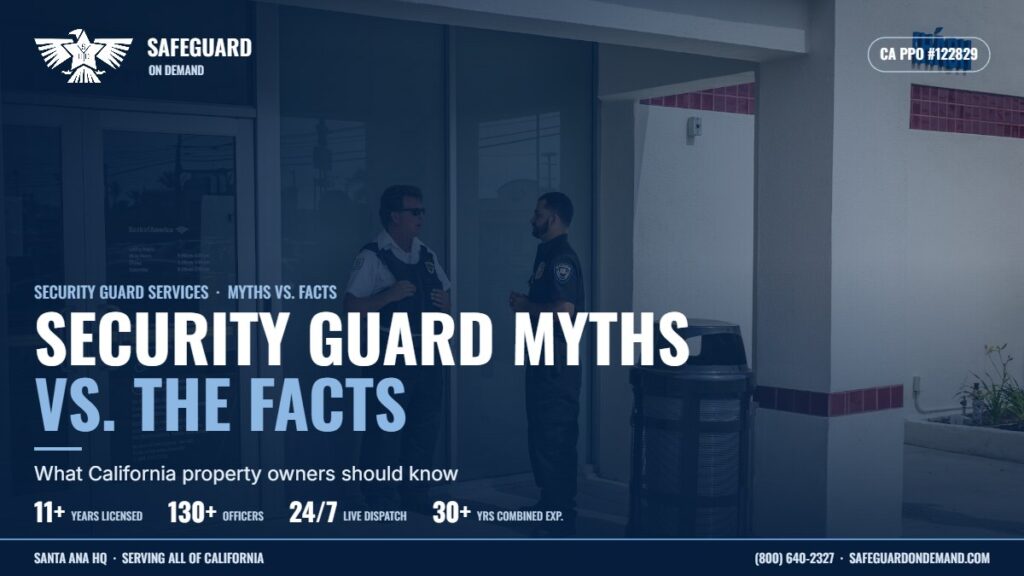
Common misunderstandings about security guard services in California, from what guards can legally do to cost and training. Get the facts before you hire.
The Benefits of Warehouse Security for California Distribution and Logistics Sites
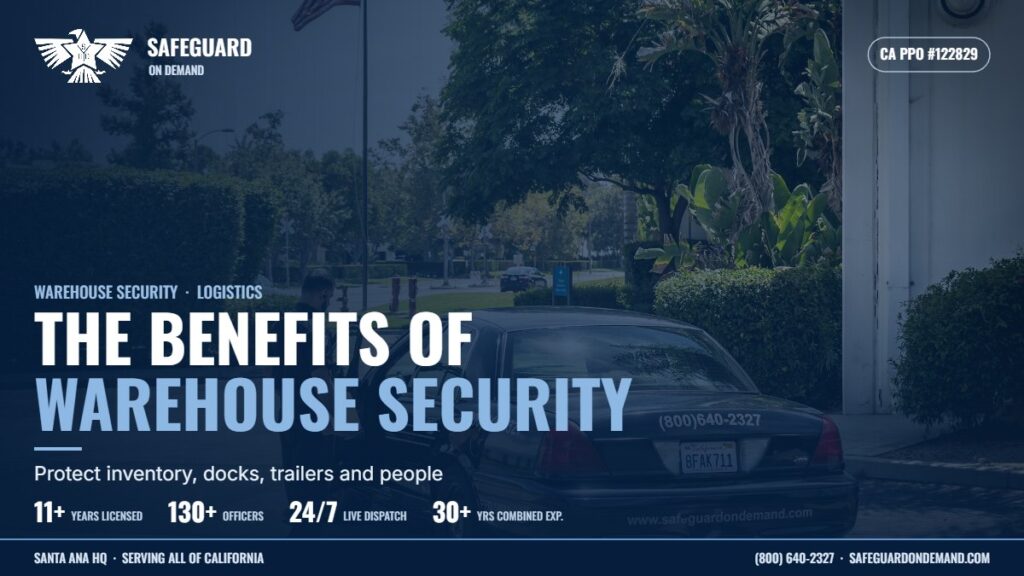
Warehouse security benefits for California logistics and distribution sites: cargo theft prevention, dock and gate control, insider theft deterrence, safety compliance and 24/7 monitoring.
The Major Benefits of Hiring Armed Security Guards in California

The major benefits of hiring armed security guards in California: stronger deterrence, faster threat response, asset protection and more. Plus licensing, when armed makes sense and costs.