Business & Office Parks
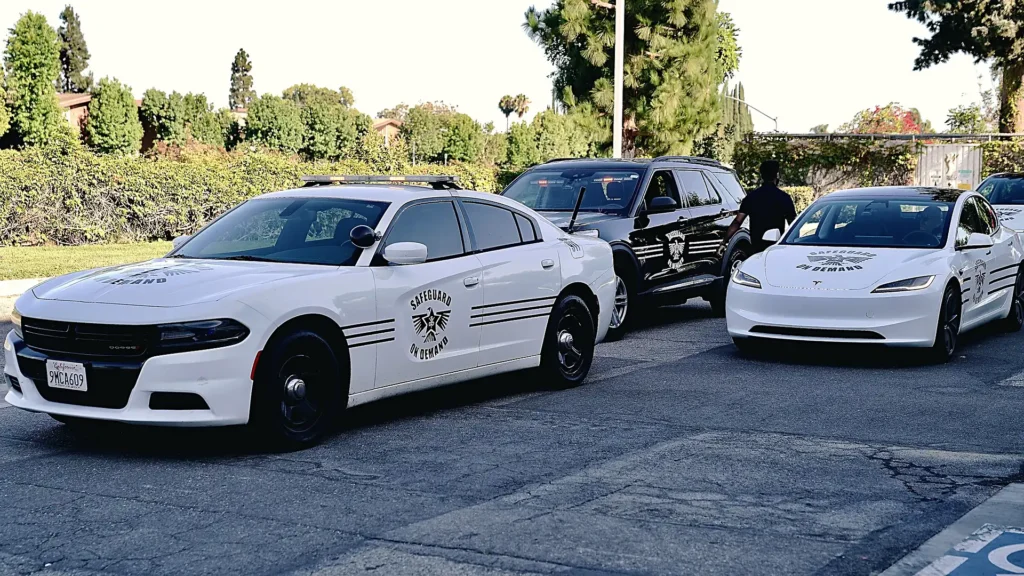
Patrols, lot and building checks, alarm response and on-site officers for multi-tenant business and office parks — security that tenants notice and owners can share the cost of.
One program for the whole park.
Visits nobody can predict.
Units respond to tenant alarms.
Activity reports for property managers.
Quick answer
Business and office parks usually need randomized after-hours patrols of lots, buildings and loading areas, alarm response, lock-ups and, for larger parks, an on-site officer during business hours. Because costs can be shared across tenants, mobile patrol often delivers the best value. Most California employers in those buildings also need workplace violence prevention plans under SB 553, and park security procedures can support them.
The challenge
Large lots, many entrances and empty buildings after 6 p.m. make business parks easy targets.
Break-ins and catalytic-converter theft spread across large, quiet lots.
Vacant suites, loading docks and landscaping draw trespassers.
SB 553 paperwork needs real on-site response to work.
Coverage options
From patrols to on-site officers.
Our standards
Built for owners and tenants.
Every visit logged.
Lots, doors and problem areas.
One contact for the whole park.
Guard Card verified.
For owners and managers
Here is how we answer.
| Ask the vendor | Safeguard On Demand |
|---|---|
| Can the cost be shared across tenants? | Yes — one park-wide program, billed to the owner or association. |
| Do you respond to tenant alarms? | Yes, with marked patrol units. |
| Can officers do lock-ups? | Yes, on schedule. |
| Will tenants get incident reports? | Reports go to the property manager, who shares with tenants as needed. |
| Can you help with tenants’ SB 553 plans? | We provide security procedures and incident reports that support them. |
| Is there a long-term contract? | No long-term contract. |
Properties we protect
Single buildings to corporate campuses.
Statewide
Served from the office nearest your site, with officers across 13 California counties.
How it works
One plan for the whole park.
01
Lots, buildings, docks and incident history.
02
Visits, checkpoints and alarm response.
03
Contacts and reporting shared.
04
Monthly reviews with management.
Choosing coverage
Most business parks get the best value from mobile patrol after hours, shared across all tenants. Large parks, corporate campuses and parks with public-facing tenants may add an on-site officer during business hours or bike and golf cart patrol. Remote video monitoring covers large lots overnight.
California requirements
Since July 1, 2024, most California employers must have a written Workplace Violence Prevention Plan under SB 553 (Labor Code 6401.9). Employers must train employees when the plan is set up and every year after, keep a violent incident log for at least five years, keep training records for at least one year, and review the plan at least once a year and after any violent incident. Cal/OSHA enforces the law, and a permanent general-industry standard is due by the end of 2026.
Park-wide security — patrols, incident reports and clear contacts — gives every tenant something concrete to include in their plan. Every officer must hold a BSIS Guard Card and work for a licensed private patrol operator — 8 hours of Power to Arrest and Appropriate Use of Force training before registration, 32 more hours within six months, and 8 hours of continuing training every year.
Budgeting
Priced to the park.
Visits per night.
Acres, buildings and lots.
Business-hours officers.
Tenant alarms covered.
Camera coverage.
Shared programs.
After-hours patrols, lot and building checks, alarm response, lock-ups and, for larger parks, on-site officers.
Yes. Park-wide programs are billed to the owner or association and shared across tenants.
Most do under SB 553 (Labor Code 6401.9), in effect since July 1, 2024.
Yes, with marked patrol units.
Usually within a few days.
Across 13 California counties from offices in Santa Ana, Los Angeles (Northridge), San Diego, the Inland Empire, Sacramento and Silicon Valley.